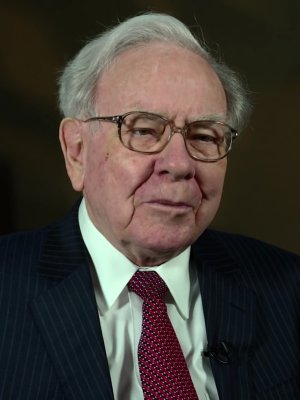
Not claimed by Warren Buffett

Warren Buffett has not joined FLAPSS and has not endorsed it. This page is a reference record assembled from published interviews and public remarks. Every answer below is a direct quotation with the source and date shown next to it.

Is this you, or is something wrong?

Warren Buffett

Chairman and chief executive of Berkshire Hathaway, 1970–2025

United States · b. 1930

Business and finance

About

Ran Berkshire Hathaway, a diversified holding company, from 1965 until stepping down as chief executive at the end of 2025. He studied under Benjamin Graham at Columbia Business School and has written an annual letter to Berkshire shareholders since the 1970s.

22 answers

Question What lesson has mattered most in your life? Time & hindsight read 137 other answers →
The number one rule I give them is just not give them the golden rule. Do unto others, I'm not a religious guy, but, I mean, nobody said it any better in a couple thousand years than that, which may be why it's lasted to a certain degree too. I mean, more people are reading a 2000-year-old book about how to behave than anything that anybody's coming up with lately. Now it's got a lot of, particularly the Old Testament, it's got different kinds of stories, to some extent, but if the whole world lived by the golden rule, it would be such a more wonderful society.
Recorded Becky Quick, Interview at the 2026 Berkshire Hathaway annual meeting; CNBC's own transcript of its own broadcast, 2 May 2026 source ↗
Question What became visible only after your working life slowed down or ended? Time & hindsight read 20 other answers →
I go in every day to the office. I don't accomplish hardly anything. I mean, in terms of – it just takes me way longer to do things. And Greg is so good. It was kind of embarrassing how good he is, because he has covered – you know, we've got about 200 businesses within Berkshire, you know, that came about, and I can't name the manager's names or their wives names, or – and I haven't seen them, you know, in a long time.
Recorded Becky Quick, CNBC Squawk Box, 31 March 2026 source ↗
Question What made you stop something you were known for, and how did you know it was time? Time & hindsight read 13 other answers →
Well, I ran out of gas. You know, I got to be what, 93 at that time, or something like that. And it just – same reason I gave up teaching. I teach – I was – I taught every year from when I was 21 till 88 or 89, and there just came a period when your body said different things to you, and you should turn it over to somebody, just like I did at Berkshire.
Recorded Becky Quick, CNBC “Squawk Box”, recorded in Omaha; CNBC's own transcript of its own broadcast, 31 March 2026 source ↗
Question What do you fear most? Identity & self read 255 other answers →
And now, you've got nine countries, including, you know, a guy in North Korea. I mean, and there will be, something will happen. And we worried enormously about it when there were two. And we had perfectly, we had really pretty sane leaders in Kennedy and Khrushchev. You know, I mean, you were not dealing with unstable people or anything like that.
Recorded Becky Quick, CNBC “Squawk Box”, recorded in Omaha; CNBC's own transcript of its own broadcast, 31 March 2026 source ↗
Question Who alive today do you admire most, and what draws you to them? Values & belief read 406 other answers →
I think that Jay Powell in when, when the epidemic broke out, I think he acted in March of 2020 and I think if he'd waited two or three weeks, it would have been a disaster. Once the dominoes start toppling, they just start toppling and, and, and, and that line is shorter than anybody thinks, and it topples faster. And I think he did exactly the right thing, and he, he did it even stronger than Volker did. You know, I mean, he, he and Volker are my heroes at the Fed.
Recorded Becky Quick, CNBC “Squawk Box”, recorded in Omaha; CNBC's own transcript of its own broadcast, 31 March 2026 source ↗
Question What worries you about getting older? Time & hindsight read 60 other answers →
I go in every day to the office. I don't accomplish hardly anything. I mean, in terms of – it just takes me way longer to do things. And Greg is so good. It was kind of embarrassing how good he is, because he has covered – you know, we've got about 200 businesses within Berkshire, you know, that came about, and I can't name the manager's names or their wives names, or – and I haven't seen them, you know, in a long time. It's easier just to write the letter once a year and kind of do my own thing. Greg covers more ground in a day than I would in a week, even when I was at my peak, let alone my present condition.
Recorded Becky Quick, CNBC “Squawk Box”, recorded in Omaha; CNBC's own transcript of its own broadcast, 31 March 2026 source ↗
Question In the last five years, what have you become better at saying no to? Daily life read 21 other answers →
Yeah and we get calls all the time, and there's so many calls, but the like I said, it takes me five seconds to say no. It takes, Greg's a little more polite than I am, but I just as soon get the calls just to see what people are doing. But they aren't offering anything that's at an attractive price, and what they want is a trade.
Recorded Becky Quick, CNBC “Squawk Box”, recorded in Omaha; CNBC's own transcript of its own broadcast, 31 March 2026 source ↗
Question What has life taught you about being human? Values & belief read 14 other answers →
Well, I won't say what I thought about them, particularly related to Bill Gates, but I would say it's astounding to me how human people are. I mean, it, here you had a guy that was a convicted guy, a sensational con man, and the percentage of people that he knocked off. I mean, whether it was, he found their weakness, it might have been sex. It might be power, it might be, whatever it might be.
Recorded Becky Quick, CNBC “Squawk Box”, recorded in Omaha; CNBC's own transcript of its own broadcast, 31 March 2026 source ↗
Question What part of your job would surprise outsiders because it takes up so much of your time? Craft & work read 40 other answers →
The extraordinary delegation of authority now existing at Berkshire is the ideal antidote to bureaucracy. In an operating sense, Berkshire is not a giant company but rather a collection of large companies. At headquarters, we have never had a committee nor have we ever required our subsidiaries to submit budgets (though many use them as an important internal tool). We don't have a legal office nor departments that other companies take for granted: human relations, public relations, investor relations, strategy, acquisitions, you name it. We do, of course, have an active audit function; no sense being a damned fool.
Recorded Berkshire Hathaway annual shareholder letter, Berkshire Hathaway Inc., 27 February 2015 source ↗
Question What bad recommendations do people in your field repeat too often? Craft & work read 31 other answers →
Most investors, of course, have not made the study of business prospects a priority in their lives. If wise, they will conclude that they do not know enough about specific businesses to predict their future earning power. I have good news for these non-professionals: The typical investor doesn't need this skill. ... The goal of the non-professional should not be to pick winners – neither he nor his "helpers" can do that – but should rather be to own a cross-section of businesses that in aggregate are bound to do well. A low-cost S&P 500 index fund will achieve this goal.
Recorded Berkshire Hathaway annual shareholder letter, Berkshire Hathaway Inc., 28 February 2014 source ↗
Question What does happiness look like for you when life is going well? Identity & self read 157 other answers →
The reaction of my family and me to our extraordinary good fortune is not guilt, but rather gratitude. Were we to use more than 1% of my claim checks on ourselves, neither our happiness nor our well-being would be enhanced. In contrast, that remaining 99% can have a huge effect on the health and welfare of others.
Recorded His own pledge letter, written on joining the Giving Pledge in 2010, The Giving Pledge, 2010 source ↗
Question Who deserves an apology from you, and for what? Failure & regret read 208 other answers →
I've mentioned that we strongly prefer to use cash rather than Berkshire stock in acquisitions. A study of the record will tell you why: If you aggregate all of our stock-only mergers (excluding those we did with two affiliated companies, Diversified Retailing and Blue Chip Stamps), you will find that our shareholders are slightly worse off than they would have been had I not done the transactions. Though it hurts me to say it, when I've issued stock, I've cost you money.
Recorded His letter to Berkshire Hathaway shareholders in the 1997 annual report, Berkshire Hathaway Inc., February 1998 source ↗
Question Which thinking habit do you wish you could break? Craft & work read 20 other answers →
Ironically, though, this is also the purchase in which I made my biggest mistake - of a kind, however, never recognized on financial statements. We paid $600 million in 1989 for Gillette preferred shares that were convertible into 48 million (split-adjusted) common shares. Taking an alternative route with the $600 million, I probably could have purchased 60 million shares of common from the company. The market on the common was then about $10.50, and given that this would have been a huge private placement carrying important restrictions, I probably could have bought the stock at a discount of at least 5%. I can't be sure about this, but it's likely that Gillette's management would have been just as happy to have Berkshire opt for common. But I was far too clever to do that.
Recorded His letter to Berkshire Hathaway shareholders in the 1995 annual report, Berkshire Hathaway Inc., February 1996 source ↗
Question What does everyone in your world seem to agree on that you think is wrong? Values & belief read 79 other answers →
The strategy we've adopted precludes our following standard diversification dogma. Many pundits would therefore say the strategy must be riskier than that employed by more conventional investors. We disagree. We believe that a policy of portfolio concentration may well decrease risk if it raises, as it should, both the intensity with which an investor thinks about a business and the comfort-level he must feel with its economic characteristics before buying into it.
Recorded His letter to Berkshire Hathaway shareholders in the 1993 annual report, Berkshire Hathaway Inc., February 1994 source ↗
Question What are you unwilling to optimise? Values & belief read 29 other answers →
Charlie and I decided long ago that in an investment lifetime it's just too hard to make hundreds of smart decisions. That judgment became ever more compelling as Berkshire's capital mushroomed and the universe of investments that could significantly affect our results shrank dramatically. Therefore, we adopted a strategy that required our being smart - and not too smart at that - only a very few times. Indeed, we'll now settle for one good idea a year. (Charlie says it's my turn.)
Recorded His letter to Berkshire Hathaway shareholders in the 1993 annual report, Berkshire Hathaway Inc., February 1994 source ↗
Question Who makes your work possible behind the scenes? Craft & work read 1 other answer →
We have two pieces of regrettable news this year. First, Gladys Kaiser, my friend and assistant for twenty-five years, will give up the latter post after the 1993 annual meeting, though she will certainly remain my friend forever. Gladys and I have been a team, and though I knew her retirement was coming, it is still a jolt.
Recorded His letter to Berkshire Hathaway shareholders in the 1992 annual report, Berkshire Hathaway Inc., February 1993 source ↗

Every quotation above is reproduced from the source shown beside it and has not been edited. Warren Buffett did not write these answers for FLAPSS. Request a correction or removal.