What is the hardest thing that has happened to you, and what did you carry out of it?
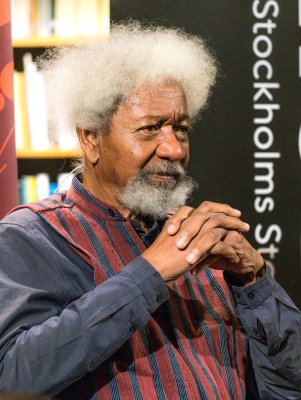
Recorded Wole Soyinka said elsewhere, not written here
Writing became a therapy. First of all, it meant I was reconstructing my own existence. It was also an act of defiance. I wasn’t supposed to write. ... I evolved all kinds of mental exercises, even went back to those subjects which I said I hated in school, in particular mathematics. ... You know, anything to keep the mind alive.

Academy of Achievement interview, 3 July 2009 source ↗

Others on this question

View all 36 →
Athol Fugard Playwright, director and actor
I don’t think I could. Of course I’m saying this on American soil. I’m facing a few more months of work in this city, but at the end of it, I will be returning to South Africa. I would like to believe that if for some reason the situation deteriorated to the point where I was told, “If you leave South Africa, you can never come back,” I’d stay there. There were periods in my life when I could have been seduced away. I am incredibly fortunate that the government took away my passport at the point when I was most open to seduction. With my passport gone, I could have left on a one-way ticket. But the issue was so starkly highlighted that I had no problem in saying, “No.”
Recorded Lloyd Richards, Interview conducted in front of an audience at the Poetry Center of the 92nd Street YMHA, New York, The Paris Review, Issue 111, Summer 1989, 13 October 1985 source ↗
Winston Churchill Prime Minister of the United Kingdom, 1940–1945 and 1951–1955; Member of Parliament 1900–1964
Prisoner of War! That is the least unfortunate kind of prisoner to be, but it is nevertheless a melancholy state. You are in the power of your enemy. You owe your life to his humanity, and your daily bread to his compassion. You must obey his orders, go where he tells you, stay where you are bid, await his pleasure, possess your soul in patience. Meanwhile the war is going on, great events are in progress, fine opportunities for action and adventure are slipping away. Also the days are very long. Hours crawl like paralytic centipedes. Nothing amuses you. Reading is difficult; writing impossible. Life is one long boredom from dawn till slumber. Moreover, the whole atmosphere of prison, even the most easy and best regulated prison, is odious. Companions in this kind of misfortune quarrel about trifles and get the least possible pleasure from each other's society. If you have never been under restraint before and never known what it was to be a captive, you feel a sense of constant humiliation in being confined to a narrow space, fenced in by railings and wire, watched by armed men, and webbed about with a tangle of regulations and restrictions. I certainly hated every minute of my captivity more than I have ever hated any other period in my whole life. ... Therefore in after years, when I was Home Secretary and had all the prisons of England in my charge, I did my utmost consistent with public policy to introduce some sort of variety and indulgence into the life of their inmates, to give to educated minds books to feed on
Recorded Chapter of his autobiography, written at Chartwell in 1930, Winston S. Churchill, My Early Life (Thornton Butterworth, 1930), Project Gutenberg Canada, October 1930 source ↗
Lewis Hamilton British Formula One driver
For me, school was probably the most traumatising and most difficult part of my life. I already was being bullied at the age of six. I think at the time, (at) that particular school, I was probably one of three kids of colour and just bigger, stronger, bullying kids were throwing me around a lot of the time.
Recorded Jay Shetty, On Purpose podcast, Sky Sports, 23 January 2023 source ↗
Siya Kolisi South Africa international rugby union flanker and captain
It went past being hungry; it was actually painful in your stomach. I could feel my intestines twisting in the middle of the night. I would scream to my grandmother and she would get me sugar water and it would settle it down. A lot of my values come from being resilient. The people from my community might be poor financially but they are happy, proud and resilient people.
Recorded Dan Roan, The Sports Desk podcast, BBC, BBC Sport, 15 October 2021 source ↗

More from Wole Soyinka

View profile →
Question Which teacher, parent, coach or friend most made you who you are, and what did you learn from them? Relationships
The early influence in my life I think was my father. That’s the earliest influence. He and his circle of friends. Usually, in our society, children are supposed to be neither seen nor heard. When elders are around, they’re supposed to very respectfully leave them alone. But I was curious. I just loved their debates. They used to get excited over issues, and so somehow I was allowed to eavesdrop, unlike the other children. And I picked up some of the ideas that they had, and I would ask questions. I was known as the questioner. Afterwards, I would ask questions, and my father would indulge me by trying to explain things to me. So that’s one of the reasons I consider him the earliest influence. And also, he had a small library, and I used to go into his library and try and read the books which I found there. Later on, as my circle of adult acquaintances increased, I think the next influence on me was my uncle, the Reverend I.O. Ransome-Kuti, who was another very erudite person, a great educationist. I used to visit them in Igbein, where he lived with his wife and they ran a school. So on weekends sometimes I would go there. And of course it was the usual story. I wanted to listen to them discussing and so on. Don’t misunderstand me. I was also very playful. I loved disappearing by myself, climbing trees, all that I did. But additionally, I was just fascinated by the whole discourse. Exchange of ideas between adults just used to fascinate me for some reason. I was never tired of listening to them. So my uncle was my next great influence.
Recorded Academy of Achievement interview source ↗
Question What are you unwilling to optimise? Values & belief
That’s a very good question. I think I’m a very lazy writer and by that I mean that I do not battle, I don’t struggle too hard against it. If I have difficulties in the writing, I just go and do other things. I don’t feel a compulsion to write. Of course, when I start writing then it becomes a compulsive activity, because I’ve begun something and I want to continue, want to finish it. … I know there are other writers who sit down religiously every morning, they take their espresso, they put a clean sheet of paper there and they sit looking at that paper until they’ve finished or covered at least a number of those pages. No, I’m not like that. I have to be ready. It has to gestate it for quite a while and then it’s ready to burst forth.
Recorded Simon Stanford, NobelPrize.org (Nobel Prize Outreach), 28 April 2005 source ↗
Question What is something everyone in your world agrees about that you think is wrong? Values & belief
Yes, I do. I do, but I were part company with certain schools of writers that I do not believe that it is necessarily the duty of the writer. I don’t believe that. If a writer is true to his vocation, to his or her vocation, the very process of creativity enlarges these human horizons. It provides insights, even when you’re not writing, when your writing’s not dealing with a concrete political situation.
Recorded Simon Stanford, NobelPrize.org (Nobel Prize Outreach), 28 April 2005 source ↗

More on failure & regret

Also answered this

Christopher Hitchens, Suzan-Lori Parks, Tony Judt, Maurice Sendak, Clive James, Jenny Diski

Search the directory for somebody in particular.

Explore further

Report this answer