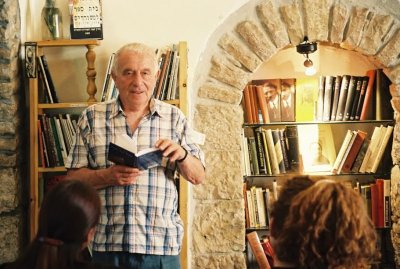
Managed profile Not claimed by Yehuda Amichai

Yehuda Amichai has not joined FLAPSS and has not endorsed it. This page is a reference record assembled from published interviews and public remarks. Every answer below is a direct quotation with the source and date shown next to it.

Is this you, or is something wrong?

YA

Yehuda Amichai

Poet

Israel · 1924–2000

Born in Würzburg, Germany, and emigrated with his Orthodox Jewish family to Palestine in 1936. He fought with the Jewish Brigade of the British army in the Second World War and later in the 1948, 1956 and 1973 wars. Widely regarded as Israel’s foremost modern poet and among the most translated poets of his generation.

2 answers 0 followers reference

Question Which book changed the way you think, and what did it change?
Very much so. I went to synagogue regularly. My first education was interpreting the Bible. But I also grew up with German folk songs and stories, which became as much a part of my imagination as the Bible stories. My sense of history came from these stories—I was fascinated with what you might call fairy-tale-shaped history. But from the beginning I felt I belonged to a different people, which wasn’t any problem for me. I made the German landscape, which was very beautiful to me—flowing rivers, mountains, forests, lakes—into a biblical landscape. The valley of sunshine into which we went on school excursions in my imagination became the valley in which David and Goliath fought.

Recorded Lawrence Joseph, Cafés in Greenwich Village, New York, The Paris Review, Issue 122, Spring 1992, 1992 source ↗

Question What is something everyone in your world agrees about that you think is wrong?
Some people think that anti-Semitism didn’t really exist in Germany until 1933. I certainly don’t want to take anything away from Hitler’s guilt, but the anti-Semitism I grew up with predated Hitler. We were called names. We had stones thrown at us. And, yes, this created real sorrow. We defended ourselves as well as we could. Funny thing, the common name we were called was Isaac—the way Muslims are called Ali or Mohammed. They’d call out, Isaac, go back to Palestine, leave our home, go to your place. They threw stones at us and shouted, Go to Palestine. Then in Palestine we were told to leave Palestine—history juxtaposed can be very ironic.

Recorded Lawrence Joseph, Cafés in Greenwich Village, New York, The Paris Review, Issue 122, Spring 1992, 1992 source ↗

Every quotation above is reproduced from the source shown beside it and has not been edited. Yehuda Amichai did not write these answers for FLAPSS. Request a correction or removal.