I remember one teacher in particular. I was in a school in the third grade and they were thinking of skipping me, putting me in a higher grade. But then somebody said that would be bad psychologically. So, for that entire year, because I had learned all the lessons that year — the multiplication tables, whatever the reading was — this teacher let me go off by myself and draw pictures. So I had hours and hours of time where I was just left to my own devices, drawing pictures. And she would encourage me. That was a wonderful period in my life. I mean, I didn’t become an artist, but somebody let me do something I loved. What a luxury, to do something you love to do. I would still like to have that luxury, to be able to just sit and draw for hours and hours and hours. In a way, that’s what I do as a writer. I just sit by myself, being in my own mind, not being directed at what I should be doing moment-by-moment, not having a clear plan set out by anybody and just letting imagination enter into the blank page. So in that respect, I can thank Miss Grudoff of the third grade for allowing me that.
Originally asked
The Paris Review, to novelists and poets, The Art of Fiction
A durable Art of Fiction question asked through named literary influences and artistic models.
You answer as yourself. Nobody on FLAPSS answers as anybody else.
Academy of Achievement interview, New York City, 16 December 1990 source ↗
Others on this question
View all 42 →I always suspected that she was the biggest influence on me. It seems unlikely, but I always suspected that. I used to say that in interviews, and people would think I was just being smart and evasive. But I reread Jane Eyre recently, and also Villette , her other great novel. I just came across episode after episode where I thought “Oh my goodness, I just ripped that off from this book!” Perhaps you wouldn’t recognize it, but I did. Certain kinds of techniques, certain moments when you understand that the narrator is crying, not because she tells you, but because somebody watching her makes a remark. All these little things that I thought, “Oh, I used that in that book,” or “Oh, that trick.” I think Charlotte Brontë had an enormous influence on me, and I think it’s something to do with that use of first-person and the evasiveness, the indirectness, of her first-person narrative. I mean this phrase, “the unreliable narrator,” has become very popular in creative writing. So it’s not quite that, but a very subtle use of the relationship between the writer and the book and the reader — something I tuned in on, I homed in on instantly, when I started to read Charlotte Brontë. But I’ll tell you, my favorite author — novelist — is somebody who you probably wouldn’t think had any relationship to me, which is Dostoyevsky. I’ve always loved Dostoyevsky, ever since I first read him. I think he’s one of the reasons I started to read, you know, when I read Crime and Punishment when I was about 17 or 18. Dostoyevsky and Chekhov for me remain like two poles in terms of a way to approach things. I love the messiness of Dostoyevsky, the improvised — I mean a lot of it is a mess, but I like the way that strange, unexpected things have obviously come tumbling out of him that he didn’t want to necessarily have come tumbling out. On the other hand, you know, Chekhov, another great Russian writer, exemplifies the calm, controlled, very carefully structured, understated kind of work. I aspire to them both. They’re two of my great heroes.
Yes, a major one, along with Sir Georg Solti. Because they’re both Hungarian, I used to call them the Hungarian mafia. He was always onto me. “Have you bring to Vera?” And then she’d say, “Georg, he won’t be liking this bit.” And between the two of them, there was this whish-whish-whish, like sword fighting, and I was being killed by the both of them. But I enjoyed every minute of it. It was good for me.
I spent time with Rauschenberg a lot during the combine period. I think just around the combine period. He had a big influence on me because he was very free and not full of philosophy and why I’m doing this and that. Some of the artists had this anchor of having to be — relate sometimes to Hegel and Kant and Nietzsche. It was sort of baggage that they brought to the table that was irrelevant. I mean it was in their head and it was relevant, but it was irrelevant to this moment of truth. So I found the artists that were kind of “dumb smart,” that were really smart but didn’t parade it, that were willing to take the risks and stuff.
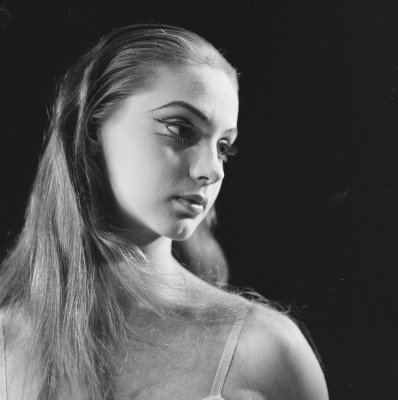
More from Suzanne Farrell
View profile →Well, I’ve had injuries, but I’d always get out on stage because I think the body is a wonderful thing, and you have to treat it with respect. We haven’t even reached our potential for what we can do as human beings. I went through a period where I had hip trouble. I thought it was just a typical pulled muscle, so I used liniment, and warmed up more than I thought was necessary, all the things we learn to do when you have a typical dance-related injury or sore muscle. Over the months, it didn’t go away. In fact, it got worse. Eventually I realized that I had a very serious problem, and it was the first time that dance had let me down. What had been my salvation and my security with my body was abandoning me. This was emotionally and physically devastating.
By the time I admitted that I needed a hip operation, I had denied it for so long that it was a breakthrough to suddenly say, “I need this.” I knew I would probably never dance again, but I had no choice. By that time, I just wanted to be normal. I wanted to walk down the street without limping. I couldn’t tie my shoes. I couldn’t put slacks on. I was the farthest thing from a person who ever could dance and do all those extremely incredible extensions and contortions that we do.
I think he was a great philosopher. He had a wonderful theory that you live in the “now,” which I think is important. Along with living in the moment, you also have to assume the responsibility that goes along with it, and you don’t take your position lightly. But it also means that you get the full value of the moment that you are living, so you don’t look back on your life and say, “If only I hadn’t wasted time, if only I had done this.” You do the best you can. It was wonderful to be able to go home after a performance, and think, well it wasn’t maybe so good, but it was the best I could be at that time.
No, never. Strangely enough, being such a tomboy, and being so—as my mother says—spoiled as a child, once I started dancing and in a way growing up, I was not the spoiled brat or the rebellious child that I was when I really had no reason to be as a child. When you work, it’s a laboratory. The dance studio, when we were working together, was the place where you experiment. I’m not intimidated by failure or making a mistake, because you learn from those situations. You don’t learn from a situation where you do something well. You enjoy it and you give yourself credit, but you don’t really learn from that. You learn from trial and error, trial and error, all the time. When you fail, maybe you failed in that particular instance, but you have discovered something else. A lot of the ballets that we went on to do were built around mistakes that we had made in the classroom. So you never throw anything out. Rebelling takes up energy. As a dancer, you don’t have that kind of energy to throw away.
More on taste & recommendation
Also answered this
Mohamed ElBaradei, Philip Johnson, Linus C. Pauling, Ph.D., John Lewis, Amy Tan, Noah Baumbach
Search the directory for somebody in particular.
Explore further
- All taste & recommendation questions
- The The Art of Fiction questionnaire — 3 questions from the same format
- Explore the archive — by field, age, era, and subject