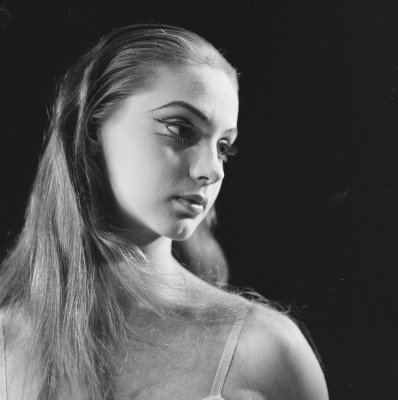
The bitterness. I am very sad if I think of the status of the world now. This is my deepest inspiration. This could be also an inspiration for the next generation or generations in literature. Inspiration to give something for the next generation, somehow to survive this time because these are very, very dark times and we need much more power in us to survive this time than before.
Originally asked
The Creative Independent, to working artists, its interview series
A repeated Creative Independent tension, asked as inspiration, muse, discipline, ritual, or the requirement to show up.
You answer as yourself. Nobody on FLAPSS answers as anybody else.
Academy of Achievement interview, New York City, 16 December 1990 source ↗
Others on this question
View all 27 →Well, I hate the word, but it’s true that something sometimes visits and other times doesn’t. I wish I felt otherwise, but I feel as though there has to be some catalyst, some inspiration. All of a sudden there’s a phrase in your head. Where does that thing come from? I don’t know, and because I don’t know, I don’t know how to have more of them.
It comes out of an intuition, or a learned intuition, I guess. You study a long time ’til you can do it. But it’s from looking around you, it’s from understanding what’s happening in the culture, what’s happening in the world.
It takes a combination of ways to do these things, more than discipline. It’s a way of life. It’s like diet or gymnastics. You can know all the gymnastic things, all the exercises. You can know all the diets, but if you don’t do the diets, if you don’t do the exercise, it won’t work. It’s the same if you have some rules, but you don’t live them. It doesn’t work.
More from Suzanne Farrell
View profile →Well, I’ve had injuries, but I’d always get out on stage because I think the body is a wonderful thing, and you have to treat it with respect. We haven’t even reached our potential for what we can do as human beings. I went through a period where I had hip trouble. I thought it was just a typical pulled muscle, so I used liniment, and warmed up more than I thought was necessary, all the things we learn to do when you have a typical dance-related injury or sore muscle. Over the months, it didn’t go away. In fact, it got worse. Eventually I realized that I had a very serious problem, and it was the first time that dance had let me down. What had been my salvation and my security with my body was abandoning me. This was emotionally and physically devastating.
That’s an easy question. It was, of course, George Balanchine. He came from Russia via Europe and settled in America in 1933. He started a little company which was not very successful, so he had to start over and over again. Ultimately, he founded the New York City Ballet. I happened to be born at the right time, came to the right place, and had the fortune to audition for him, and work with him, because he is the genius of the century of ballet. I learned how to dance with him.
I think he was a great philosopher. He had a wonderful theory that you live in the “now,” which I think is important. Along with living in the moment, you also have to assume the responsibility that goes along with it, and you don’t take your position lightly. But it also means that you get the full value of the moment that you are living, so you don’t look back on your life and say, “If only I hadn’t wasted time, if only I had done this.” You do the best you can. It was wonderful to be able to go home after a performance, and think, well it wasn’t maybe so good, but it was the best I could be at that time.
By the time I admitted that I needed a hip operation, I had denied it for so long that it was a breakthrough to suddenly say, “I need this.” I knew I would probably never dance again, but I had no choice. By that time, I just wanted to be normal. I wanted to walk down the street without limping. I couldn’t tie my shoes. I couldn’t put slacks on. I was the farthest thing from a person who ever could dance and do all those extremely incredible extensions and contortions that we do.
More on craft & work
- What is the worst job you have done? 229 answers
- What do you consider your greatest achievement? 192 answers
- How do you know when a piece of work is finished? 67 answers
- What do you do when you feel creatively blocked or stuck? 66 answers
- How does a new work begin for you? 63 answers
- How much rewriting or revision do you do? 46 answers
Also answered this
Esperanza Spalding, Arlo Parks, Carlos Slim Helú, Carlos Fuentes, Tiler Peck, Gore Vidal
Search the directory for somebody in particular.
Explore further
- All craft & work questions
- The The Creative Independent questionnaire — 4 questions from the same format
- Explore the archive — by field, age, era, and subject