The question

Do you rely more on inspiration or discipline to make your work?

Originally asked

The Creative Independent, to working artists, its interview series

A repeated Creative Independent tension, asked as inspiration, muse, discipline, ritual, or the requirement to show up.

You answer as yourself. Nobody on FLAPSS answers as anybody else.

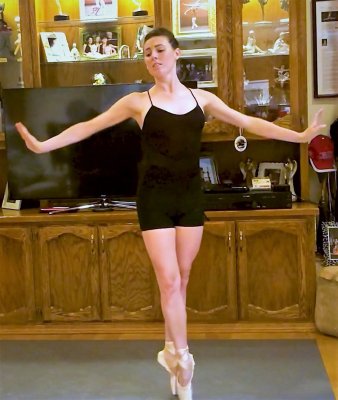
Tiler Peck

Principal dancer, New York City Ballet; choreographer

Recorded said elsewhere, not written here
Well, you’re right, I think the hard work definitely paid off. My grandmother drove me three hours to dance and three hours back from age six to age 11. I would do my school work in the car on the way there and then get home at like 11 o’clock at night, five days a week for many years. My training was seriously intense, and nothing came easy. I worked for everything I’ve ever been given.

The Talks, published interview, 6 July 2022 source ↗

Others on this question

View all 27 →
Suzanne Farrell Ballerina and ballet master; répétiteur for the Balanchine Trust
No, never. Strangely enough, being such a tomboy, and being so—as my mother says—spoiled as a child, once I started dancing and in a way growing up, I was not the spoiled brat or the rebellious child that I was when I really had no reason to be as a child. When you work, it’s a laboratory. The dance studio, when we were working together, was the place where you experiment. I’m not intimidated by failure or making a mistake, because you learn from those situations. You don’t learn from a situation where you do something well. You enjoy it and you give yourself credit, but you don’t really learn from that. You learn from trial and error, trial and error, all the time. When you fail, maybe you failed in that particular instance, but you have discovered something else. A lot of the ballets that we went on to do were built around mistakes that we had made in the classroom. So you never throw anything out. Rebelling takes up energy. As a dancer, you don’t have that kind of energy to throw away.
Recorded Academy of Achievement interview, New York City, 16 December 1990 source ↗
Spencer Bailey Journalist and editor; co-founder of The Slowdown; host of Time Sensitive
And that’s a fine balance. It’s something I’ve really struggled with: slowing down and letting go of that urgent feeling of creative energy that’s bubbling up within me at all times; this urge I have to create, this endless urge. When I let go of that, it’s almost like a form of peace washes over me, where I’m so much more relaxed and at ease with whatever project it is I’m doing. If you become too all-consumed by a project, it becomes hard to actually see beyond that.
Recorded The Talks, published interview, 1 January 2025 source ↗
Edward O. Wilson, Ph.D. Biologist and entomologist; founder of the field of sociobiology
Yes, that’s right. I saw what I could succeed in. I never considered myself very bright, and I always thought of myself as mathematically mediocre. So I figured that probably, like your college runner who has difficulty breaking a ten-second hundred — well, breaking an 11-second, shall we say, 100-meter — realizes that their best shot is to rely less on strength and speed and more on self-discipline, planning, and long hard work. Yes. That’s the way I do science.
Recorded Academy of Achievement interview, Cambridge, Massachusetts, 5 April 2001 source ↗
John Banville Novelist; winner of the Booker Prize, 2005
I keep office hours. I work from 9:30 to 6:00. It’s curious. In the morning, I could just about tie my shoelaces before noon, but I can write. It’s obviously a different part of my brain that’s working.
Recorded Academy of Achievement interview, London, England, 18 October 2017 source ↗

More on craft & work

Also answered this

Athol Fugard, Denton Cooley, Louise Glück, John Banville, Edward O. Wilson, Ph.D., Mellody Hobson

Search the directory for somebody in particular.

Explore further

Report this answer