The question

Which writers or artists most influenced your work?

Originally asked

The Paris Review, to novelists and poets, The Art of Fiction

A durable Art of Fiction question asked through named literary influences and artistic models.

You answer as yourself. Nobody on FLAPSS answers as anybody else.

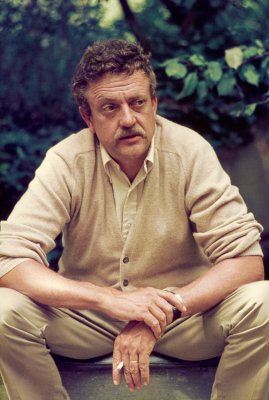
Kurt Vonnegut

Novelist and essayist

Recorded said elsewhere, not written here
I am from a family of artists. Here I am making a living in the arts, and it has not been a rebellion. It’s as though I had taken over the family Esso station. My ancestors were all in the arts, so I’m simply making my living in the customary family way.

Harry James Cargas, Christian Century / Religion Online, 24 November 1976 source ↗

Others on this question

View all 71 →
Gertrude B. Elion Biochemist and pharmacologist; Nobel laureate in physiology or medicine
It was a very important finding for us because we were involved in nucleic acids. There weren’t many people interested in nucleic acids. There weren’t many people who believed that was the way to find drugs. But when we found out the structure, and we began to understand what kind of bases could be incorporated, and which ones couldn’t, and where they could be incorporated, it put a whole new dimension on it. So it had a very significant effect.
Recorded Academy of Achievement interview, San Francisco, California, 6 March 1991 source ↗
Ja’Tovia Gary visual artist and filmmaker
Yes, the Kuleshov effect. When you place one image next to another, meaning emerges. If you change one image, the meaning changes. They are these psychological landscapes that are being painted. So I find this technique and the various ways that montages can be assembled extremely helpful.
Recorded Beandrea July, Current, The Criterion Collection, 22 April 2026 source ↗
Andrew Lloyd Webber Composer of musical theatre
Well, I mean, obviously, as I said, Richard Rodgers, very obviously say, composers like Prokofiev, like Gershwin, all of these, the great musical theater writers. I would add, as melodists, I think if you were talking about the great melodists of the 20th century, I would put Paul McCartney in there. I would definitely put Rodgers. I would definitely put Prokofiev. I’d definitely put Gershwin because he died so young, but definitely would put him there. And those, of course, in the theater side of things, I’d definitely put Hal Prince
Recorded Academy of Achievement interview, New York City, 13 September 2019 source ↗

More from Kurt Vonnegut

View profile →
Question What scares you about getting older? Time & hindsight
Yes, well, that’s the reason that I don’t want to be in New York any longer. I don’t want to go to parties any more. There are no familiar faces anymore. You know, you go to a party and you hone in on the couple people you know. There are none of those people for me at parties any more. I’ve lost my sister, my brother, my editor, my publisher. It’s a whole generation gone by. Old war buddies of mine, my colleagues, my family.
Recorded J. Rentilly, McSweeney’s Internet Tendency, 17 September 2002 source ↗
Question How has a failure, or apparent failure, set you up for later success? Do you have a favourite failure? Failure & regret
I would try to write my war story, whether it was interesting or not, and try to make something out of it. I describe that process a little in the beginning of Slaughterhouse Five; I saw it as starring John Wayne and Frank Sinatra. Finally, a girl called Mary O’Hare, the wife of a friend of mine who’d been there with me, said, “You were just children then. It’s not fair to pretend that you were men like Wayne and Sinatra, and it’s not fair to future generations, because you’re going to make war look good.” That was a very important clue to me.
Recorded George Plimpton, David Hayman, David Michaelis and Richard Rhodes, The Paris Review, issue 69, Spring 1977, 1 January 1977 source ↗
Question What did you want to be when you were growing up? Identity & self
I was going to be a journalist. But after the war I studied anthropology, just in order to become educated. I thought it was worth knowing the science of man. I still intended to become a journalist, but there were no jobs, because the reporters who had gone to war were coming back and were entitled to their jobs, and the women who had replaced them were damned if they’d leave, and they shouldn’t have left.
Recorded Frank Houston, Salon, 8 October 1999 source ↗

More on taste & recommendation

Also answered this

Margaret Atwood, Richard Ford, David Hare, Gore Vidal, Jia Tolentino, Alan Cumming

Search the directory for somebody in particular.

Explore further

Report this answer