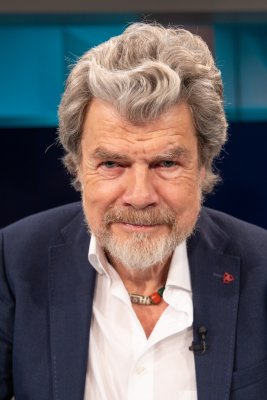
Reinhold Messner

Mountaineer; first to climb all fourteen eight-thousand-metre peaks

Recorded said elsewhere, not written here
I was very well organized in my things. I am an exceptional worker, not only a risk taker. And I was not in competition with anybody. Many people died because they were in competition.

Academy of Achievement interview, 22 August 2018 source ↗

Others on this question

View all 80 →
Christiane Nüsslein-Volhard Developmental biologist; Nobel laureate in Physiology or Medicine, 1995
I continued the work on dorsal, discovered the recessive phenotype and interpreted the phenotype postulating a gradient determining the dorsoventral axis. At that time, gradients were not widely accepted as mechanisms, in particular biochemists were highly sceptical, however the Tübingen influence made such models attractive to me.
Recorded Laureate-written autobiography for Les Prix Nobel, Nobel Prize Outreach, 1 December 1995 source ↗
Ngozi Okonjo-Iweala Director-General of the World Trade Organization from 2021; Finance Minister of Nigeria, 2003–2006 and 2011–2015
What I want to do this morning is share with you a couple of stories and talk about a different Africa. Already this morning there were some allusions to the Africa that you hear about all the time: the Africa of HIV/AIDS, the Africa of malaria, the Africa of poverty, the Africa of conflict, and the Africa of disasters. While it is true that those things are going on, there's an Africa that you don't hear about very much. And sometimes I'm puzzled, and I ask myself why. This is the Africa that is changing, that Chris alluded to. This is the Africa of opportunity. This is the Africa where people want to take charge of their own futures and their own destinies.
Recorded TED2007, 3 March 2007 source ↗
Andre Geim Condensed matter physicist; Nobel laureate in Physics, 2010
Instant information about everything and everyone often allows an individual opinion to compete with consensus and paranoia with evidence. It is a time when one blunt honest statement can finish a life-long political career, and one opinionated journalist can bully a government or a royal family. Science is not immune from such pressures. For example, how many Nobel prize-winning experiments – you think – would have been stopped, if ethics or health-and-safety regulations at that time were as zealous as they are today? I can think of more than a few.
Recorded Nobel Banquet, Stockholm City Hall, Nobel Prize Outreach, 10 December 2010 source ↗
Muhammad Yunus Founder of Grameen Bank; Nobel Peace Prize laureate, 2006
To me poor people are like bonsai trees. When you plant the best seed of the tallest tree in a flower-pot, you get a replica of the tallest tree, only inches tall. There is nothing wrong with the seed you planted, only the soil-base that is too inadequate. Poor people are bonsai people. There is nothing wrong in their seeds. Simply, society never gave them the base to grow on.
Recorded Nobel Peace Prize lecture, Oslo City Hall, The Nobel Foundation, 10 December 2006 source ↗

More from Reinhold Messner

View profile →

More on values & belief

Also answered this

Naomi Osaka, Allyson Felix, Rahul Dravid, Serena Williams, Megan Rapinoe, Ursula K. Le Guin

Search the directory for somebody in particular.

Explore further

Report this answer