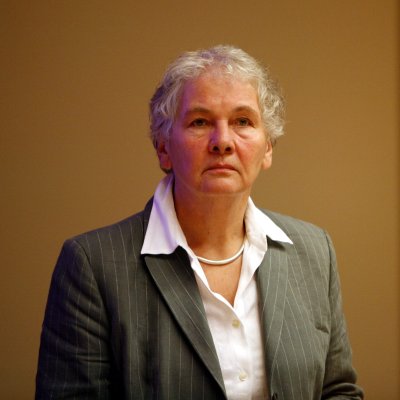
Christiane Nüsslein-Volhard

Developmental biologist; Nobel laureate in Physiology or Medicine, 1995

Recorded said elsewhere, not written here
I continued the work on dorsal, discovered the recessive phenotype and interpreted the phenotype postulating a gradient determining the dorsoventral axis. At that time, gradients were not widely accepted as mechanisms, in particular biochemists were highly sceptical, however the Tübingen influence made such models attractive to me.

Laureate-written autobiography for Les Prix Nobel, Nobel Prize Outreach, 1 December 1995 source ↗

Others on this question

View all 80 →
Twyla Tharp Choreographer, dancer and author
I already knew this, because I had been studying classical ballet for a long time. But a lot of people insisted on a wall between modern dance and ballet, that the two disciplines were totally separate, and if you did one, you couldn’t do the other. I’m beginning to think that walls are very unhealthy things.
Recorded Academy of Achievement (achievement.org), 1993 source ↗
Jessye Norman Operatic soprano and recitalist
I went to the opera practically every night. I went to something practically every night, just learning and seeing and absorbing, and what I noticed is that there were singers that were only sort of slightly older than I whose voices sounded as though they were many decades older than that, and didn’t sound pretty, and I needed to understand what was happening. I mean there were singers that were 28 or 30 years old or something, and I would speak to them afterwards to say, “Was your voice tired tonight? Tell me what’s happening,” because I didn’t understand it. Their voices should have sounded fresh and blooming and wonderful, but instead they sounded different, and it was because they were singing a different opera every night, and singing whatever was offered, and I didn’t understand and needed to understand — because no one was telling me these things — why they just didn’t say no. Why didn’t they just say, “Oh no, I don’t think I should.”
Recorded Academy of Achievement (achievement.org) source ↗
Daniel Kahneman Psychologist; laureate of the Sveriges Riksbank Prize in Economic Sciences, 2002
Under the stress of the event, we felt, the soldiers' true nature would reveal itself, and we would be able to tell who would be a good leader and who would not. But the trouble was that, in fact, we could not tell. Every month or so we had a "statistics day," during which we would get feedback from the officer-training school, indicating the accuracy of our ratings of candidates' potential. The story was always the same: our ability to predict performance at the school was negligible. But the next day, there would be another batch of candidates to be taken to the obstacle field, where we would face them with the wall and see their true natures revealed. I was so impressed by the complete lack of connection between the statistical information and the compelling experience of insight that I coined a term for it: "the illusion of validity."
Recorded Laureate-written autobiography for Les Prix Nobel, Nobel Prize Outreach, 1 December 2002 source ↗
Sylvia Earle Marine biologist and oceanographer; first woman to serve as Chief Scientist of NOAA
To the extent that we ignore this, forget about it, become complacent, or believe that it is so infinite that it can take care of itself, we are in trouble.
Recorded Academy of Achievement interview, 27 January 1991 source ↗

More from Christiane Nüsslein-Volhard

View profile →
Question What makes you want to keep learning? Attention & the world
I think a very big curiosity. I’m very curious and I like to understand things and not only science but also other things where I just try to find out why things work or how things work. Science and nature caught my attention as a small child already. I was growing up in a city but we had a garden and I loved the garden and then often on vacation I was at a farm and I loved these animals and plants and so on, so I was attracted very early on and then we had a very good teaching actually at my … I don’t know whether my teachers really had much of a role because I was determined very early, but then I also did music and I did languages and Literature and so on. I have broad interests actually other than science, but this is really true, this curiosity.
Recorded Marika Griehsel, Interview at the 53rd Lindau Nobel Laureate Meeting, 30 June–4 July 2003, Nobel Prize Outreach, 1 July 2003 source ↗
Question Which teacher, parent, coach, or friend most made you who you are, and what did you learn from them? Relationships
we had a wonderful education because my parents were so practical … Christiane Nüsslein-Volhard: Yes I mean, I have a strong likeness of culture and also I mean my grandmother was a painter and we do music in the family quite a lot and I think that’s very important. What was also important, I thought about that recently, also maybe as a follow-up of an interview but I was asked what my parents did and so on and looking at my brothers and sisters, we had a wonderful education because my parents were so practical, they did books themselves and we did a lot of handicrafts and I knew how to knit and sew and cook and we learnt a lot to do things ourselves, to make things ourselves so we all have some dexterity in doing things ourselves and this is also very important for Science
Recorded Marika Griehsel, Interview at the 53rd Lindau Nobel Laureate Meeting, 30 June–4 July 2003, Nobel Prize Outreach, 1 July 2003 source ↗
Question Which problem are you still chipping away at? Craft & work
we know the fish, we know the worm, we know the fly, but we don’t know the links between and we don’t know, when we go back to the branches in evolution, we really don’t know what happened there when they branched and how they divert and what is the major drive for evolution.
Recorded Marika Griehsel, Interview at the 53rd Lindau Nobel Laureate Meeting, 30 June–4 July 2003, Nobel Prize Outreach, 1 July 2003 source ↗
Question Whose work makes you envious? Craft & work
I felt at the time that Eric was much more successful than I, he was extremely productive during his time in Zurich, and worked on many very original projects, germ line, cell lineage, sex determination, where not many people could follow him. I also had the impression that I was dependent on him because he had more fly experience and without him I would not have gotten the job. This made our start in Heidelberg a little difficult, until we sorted things out, and from then on we thoroughly enjoyed working in the same lab.
Recorded Laureate-written autobiography for Les Prix Nobel, Nobel Prize Outreach, 1 December 1995 source ↗
Question What do you fear most? Identity & self
I don’t think it’s misused yet, people are afraid of it might be misused but on the other hand, there is also value in finding out about the relation between several particular predispositions. You might be more careful if you are told that your genetic background is such that you shouldn’t eat fat in large amounts or so, it does help you change your life a little bit and so it’s not so bad, but it’s hard to find out which genetic background is causing these things.
Recorded Marika Griehsel, Interview at the 53rd Lindau Nobel Laureate Meeting, 30 June–4 July 2003, Nobel Prize Outreach, 1 July 2003 source ↗

More on values & belief

Also answered this

John Hopfield, Lee Berger, Maryam Mirzakhani, Jocelyn Bell Burnell, Esther Duflo, Andre Geim

Search the directory for somebody in particular.

Explore further

Report this answer