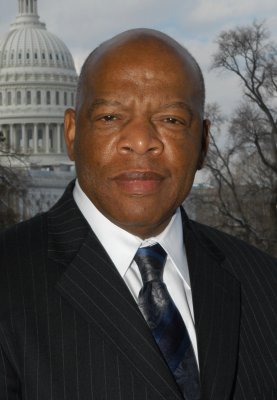
I do think my mother had a lot to do with that. I mean, after all, you know her — it was not near as bad as having your husband die in a car wreck after — he survives World War II. They had a great life planned, and he gets killed in a car wreck, not because of a concussion, but because in a fluke, the tire blows out on his car. He’s thrown out of the car. He lands in a ditch in a field, and the ditch is full of water, and he can’t get out of the ditch before he drowns. There’s — it made it look a little whiny for me to be all bent out of shape about losing an election, and I realized that it was a weird deal. It was 1980. It was Reagan’s election. It was a period not unlike now, widespread resentment over the stagnant economy, the Iran hostage crisis, and I bet I had a hundred people coming to — I’m not exaggerating — coming to me and saying, “God, Bill, I didn’t know you were going to lose. I just voted against you to because I didn’t like some of the things you’d done.” And I remember once — one of the funniest things that ever happened to me. I was driving over to see my mother. I lived in Little Rock, and she lived in Hot Springs 50 miles away, and in the middle of the trip was a little country store owned by a guy who ran the elections in that area and was real smart, so I went in to get a Coke, and started talking to him. And this little boy came up to me in overalls, and he said, “You’re Bill Clinton, aren’t you?” I said, “Yes.” He said, “I helped to beat you. I cost you 11 votes, and it was no accident.” I said, “You did?” He said, “Yeah.” He said, “It was me, my wife, our two boys and their wives, and five of my friends. We just decked you.” I said, “Why’d you do it?” He said, “I had to because you raised my car tax. The car license.” And so we’re standing on the interstate. I said, “Look over there. You remember when I was governor? That highway broke wide open, and even big trucks were off in the ditch, and I had to send the National Guard down here to clean it up, and we had to fix it.” He said, “Yeah, I remember. I don’t care. I still didn’t want to pay it.” So I was laughing at the guy, and I said, “Let me ask you something.” I said, “If I ever ran again, would you vote for me?” He said, “Absolutely.” I said, “You would?” He said, “Sure. We’re even now.” And I went — and there were no cell phones, so I had a dime. I went and put it in the payphone, and I called Hillary, and I said, “You know, I’m not dead yet. We might have to run again.
Originally asked
The American Academy of Achievement, to its honourees, its oral-history interviews
The Academy of Achievement repeatedly asks honorees to identify a major professional obstacle or challenge and describe confronting it.
You answer as yourself. Nobody on FLAPSS answers as anybody else.
Academy of Achievement interview, Chicago, 10 June 2004 source ↗
Others on this question
View all 30 →No. Unfortunately, it hasn’t worked out quite that way. At that time, everybody was euphoric that we will have a new world order, you know, a world order that does not rely on nuclear weapons, nuclear deterrence. Unfortunately, it didn’t work that way. ... We still have thousands of warheads in existence. We still have more than 20 — 30 countries relying on nuclear deterrence for their own survival.
I realized that the biggest obstacle was my mind. It was the biggest obstacle, and if I could get out of the way of myself, I would grow. So every time I had that attitude, I changed it, and I’d say, “You can. Today you can, and take it one day at a time, and today, I’m going to get up and I’m not going to think about the other six days of this week. I’m going to get up right now, and I’m going to go to the gym, and I’m going to learn about my boxing, and I’m going to be in the moment.” You know, in anything, you hit a wall, and then you have to break through it, and I just had to get out of my own way.
At Cornell, I’d work on preparing my courses, and I’d go over to the library a lot and read through the Arabian Nights and ogle the girls that would go by. But when it came time to do some research, I couldn’t get to work. I was a little tired; I was not interested; I couldn’t do research! This went on for what I felt was a few years, but when I go back and calculate the timing, it couldn’t have been that long. Perhaps nowadays I wouldn’t think it was such a long time, but then, it seemed to go on for a very long time. I simply couldn’t get started on any problem: I remember writing one or two sentences about some problem in gamma rays and then I couldn’t go any further. I was convinced that from the war and everything (the death of my wife) I had simply burned myself out.
More from John Lewis
View profile →Jim Lawson. Jim Lawson was an unbelievable human being. Born in Ohio. He was a pacifist. He studied Gandhi. He was part of the Methodist Student Movement. He lived in India. He became an organizer for FOR, the Fellowship of Reconciliation.
I would come home and ask my mother, my father, my grandparents, my great-grandparents, 'Why?'. And they would say, 'That's the way it is. Don't get in the way, don't get in trouble!'
As a participant in the movement, as I was sitting in, I came to that point where I lost all sense of fear.
When I was growing up on a farm in rural Alabama, I fell in love with raising chickens. They seem truly innocent. Whenever I'm around chickens, I feel happy.
When I was growing up I wanted to be a minister. I wanted to preach.
I wanted to know. I asked a lot of questions and she would say, "Read, read."…So she inspired me a great deal.
More on craft & work
- What is the worst job you have done? 232 answers
- What do you consider your greatest achievement? 193 answers
- How does a new work begin for you? 70 answers
- How do you know when a piece of work is finished? 69 answers
- What do you do when you feel creatively blocked or stuck? 69 answers
- How much rewriting or revision do you do? 51 answers
Also answered this
Bill Clinton, Edmund Hillary, Mohamed ElBaradei, John M. Martinis, Ephraim Asili, Tom Lubbock
Search the directory for somebody in particular.
Explore further
- All craft & work questions
- Explore the archive — by field, age, era, and subject