What is the biggest obstacle you have faced professionally?

Originally asked

The American Academy of Achievement, to its honourees, its oral-history interviews

The Academy of Achievement repeatedly asks honorees to identify a major professional obstacle or challenge and describe confronting it.

You answer as yourself. Nobody on FLAPSS answers as anybody else.

Recorded Edmund Hillary said elsewhere, not written here
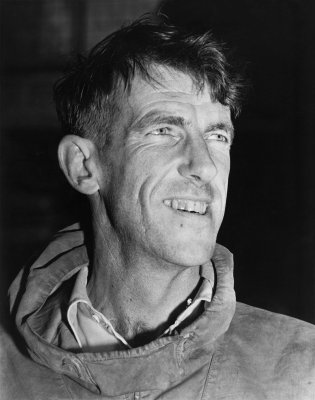
But, of course, we had one problem that the modern mountaineer doesn’t have. That is, this psychological barrier. We really didn’t know whether it was humanly possible to reach the top of Mt. Everest. And even using oxygen as we were, if we did get to the top, we weren’t at all sure whether we wouldn’t drop dead or something of that nature. All the physiologists had warned us that the altitude at the summit of Everest was a very marginal altitude and might be extremely dangerous. So, one had this feeling in your mind all the time that maybe you were pushing things a bit beyond what humans were meant to do and you couldn’t ignore that feeling. But, because of strong motivation, you keep plugging on and you seem to be going okay and nothing seems to be going wrong, so you persist. And we persisted, of course, and ultimately, set foot on the summit.

Academy of Achievement interview source ↗

Others on this question

View all 38 →
John Lewis U.S. Representative from Georgia, 1987–2020; Chairman of the Student Nonviolent Coordinating Committee 1963–1966
More than anything else, I had to combat the barriers, and we tore down those barriers. I just had to set a sail against the wind, those strong winds, to end segregation and racial discrimination, but somehow, in some way, I didn’t let those barriers keep me down.
Recorded Academy of Achievement interview, Chicago, 10 June 2004 source ↗
David Lynch Film director, screenwriter and painter
The studios are superreluctant to give final cut. They have so much money riding on these things, so they want a committee to go and rule the roost.
Recorded Carol Diehl, Interview Magazine, 25 January 2012 source ↗
Philip Johnson Architect; first winner of the Pritzker Prize
Then you have the clients. The care and feeding of clients is really one of the main obstacles, because you always have a client with some preconceived idea of what a house looks like, and all you want him to do is leave a check and go to Europe for a couple of years. Or leave two checks. But alas, life isn’t simple. If it were, more people would be better architects.
Recorded Academy of Achievement, Academy of Achievement interview, New Canaan, Connecticut, 1 April 2000 source ↗
John M. Martinis Physicist; Nobel laureate in Physics, 2025
I would say there are many challenges, and that's kind of what's hard about it. And my particular thesis, since leaving Google and doing my own company, is that building a quantum computer is a little bit harder than the scientists think about because of the system engineering. Building a powerful computer is hard. So what we're particularly working on is the manufacturing of qubits and doing that much better than what people are doing right now. I really enjoyed being in academia, and even at Google working on that. But I really enjoy right now trying to think very practically about what we have to do to get this to work. And what kind of people we have to collaborate with in order to put all the pieces together and build a quantum computer in a cost effective, economic way that makes business sense.
Recorded Adam Smith, Telephone interview recorded shortly after the prize announcement, October 2025, Nobel Prize Outreach, 1 October 2025 source ↗

More from Edmund Hillary

View profile →
Question What is something you were told by a parent, teacher, or mentor that you still repeat to yourself? Time & hindsight
My mother used to say to me a thing which, when I look back on it, wasn’t terribly logical. — and I had a pretty hearty appetite, but when I had had a large meal put in front of me, and even I couldn’t get through it, she would say, “Edmund, remember the starving millions in Asia.” Now what possible use my consuming it would do for the starving millions in Asia, I don’t really know, but the fact remains that I was brought up to think about the starving millions in Asia. That meant I had to clean my plate up and not waste it. Later on, I got more involved with the starving millions in Asia, perhaps in a slightly more practical way: helping some of them with schooling and hospitaling and even in agriculture.
Recorded Academy of Achievement interview source ↗
Question Which moment embarrassed you most? Failure & regret
I can always remember, when I was at high school we had a school sort of army battalion and because, at that time, I was one of the larger boys, I was appointed sergeant of the number one platoon, and I was always absolutely petrified that when I was meant to turn the platoon left or turn it right, I was really actually hopeless at knowing quite what to do. But fortunately, my platoon, who were really all the misfits in the school, the larger misfits, they stood by me, and some of them were quite good at knowing when to turn left or turn right. So whatever command I gave, they would do the right thing. We were a pretty good platoon as a consequence although, at the time, I felt an absolute idiot.
Recorded Academy of Achievement interview source ↗
Question What are you still hoping to finish? Death & what remains
As I’ve gotten older, my goals have become more solidified. My main concentration is on the welfare of the people I’ve worked with in the Himalayas and on human welfare in general. I’m also extremely interested in the environment and trying to encourage people to be more concerned about what we’re doing to our world. Now I’m just one of thousands and thousands of people who have these same views these days. I think this is one of the great steps forward we’ve seen in modern decades — the considerable growing interest that people have in the environment and in keeping it reasonably clean and wholesome. I certainly hope it remains that way.
Recorded Academy of Achievement interview source ↗
Question What role should instinct play in major decisions? Craft & work
I think it was a combination of feeling and judgment. I happened to be that sort of person that enjoyed making out plans, but I also enjoy changing plans. On an expedition, although I may start out with a detailed plan, I’m prepared to change it at any moment and completely redo it. So our expeditions turned out to be very adaptable ones. We achieved the final objectives just the same as many other expeditions, but maybe we had more fun in the process because it seemed something we could vary. We still carried on to achieve our major objectives.
Recorded Academy of Achievement interview source ↗
Question How close have you come to death? Death & what remains
I had one experience on the ice-fall with Tenzing. We were actually descending after having been further up the mountain, and it was getting close towards dark so we wanted to get through the ice-fall before darkness fell. We were roped together, but I was rushing down ahead in the lead. About halfway down there was a narrow crevasse. I guess it was about four feet wide, but just a bit too wide to step across. On the lower lip was a great chunk of ice stuck against the ice wall, and we’d used that as sort of a stepping stone to get over the gap. I came rushing down the hill without thinking too carefully. I just leapt in the air and landed on the chunk of ice, whereupon the chunk of ice broke off and dropped into the crevasse with me on top of it. It was interesting how everything seemed to start going slowly, even though I was free-falling into the crevasse. My mind, obviously, was working very quickly indeed. The great chunk of ice started tipping over and I realized, if I wasn’t careful, I’d be crushed between the ice and the wall of the crevasse. So I just sort of bent my knees and leapt in the air. I was still falling, but now I was a couple of feet clear of the chunk of ice. Time really seemed to pass even though I was falling clear, and I realized that unless the rope came tight fairly soon, I would come to a rather sticky end on the bottom of the crevasse. Up top, Tenzing had acted very quickly. He had thrust his ice axe into the snow, whipped the rope around it, and the rope came tight with a twang, and I was stopped and swung in against the ice wall. The great chunk of ice just carried on and smashed to smithereens at the bottom of the crevasse. Then really the rest was what I would have called a routine mountaineering matter. I had my ice axe and my crampons on my feet, so I chipped steps in the side. I was able to bridge the crevasse, and I worked my way up to the top and got safely out. I wouldn’t have said at any stage, because it all happened so quickly, fear really didn’t have much opportunity to emerge. My only idea was to get safely out of this unfortunate predicament. And of course, without Tenzing’s very competent mountaineer’s response, I certainly wouldn’t have made it. But once he had stopped me, then I was able to, using the techniques of mountaineering, to get myself safely to the top again.
Recorded Academy of Achievement interview source ↗
Question What is the hardest thing that has happened to you, and what did you carry out of it? Failure & regret
Well, then of course, came the disaster in 1975, when my wife and my youngest daughter were flying into the Nepal hills where I was building a hospital and their plane crashed and they were killed. And this certainly, for me, was an absolute disaster, really because the two people that meant most to me in life had been killed in one fell swoop. It did take me quite a number of years to get over it. I found the only way to deal with it was to carry on very energetically, doing the things that we had all been doing together, which was largely building schools and things for the mountain people. Although, people used to say to me, “Time is the great healer,” certainly for the first two years I simply didn’t accept this. But, time was a great healer and after the years passed, the memories still remain. But, I think quite a lot of the pain tends to fade a little bit, and life did become a little bit easier.
Recorded Academy of Achievement interview source ↗

More on craft & work

Also answered this

Mohamed ElBaradei, John Lewis, Bill Clinton, John Clauser, Larry Ellison, Clive James

Search the directory for somebody in particular.

Explore further

Report this answer