Which teacher, parent, coach or friend most made you who you are, and what did you learn from them?
Recorded Wynton Marsalis said elsewhere, not written here
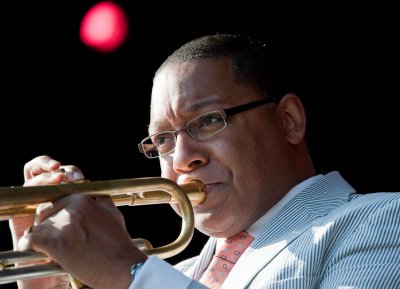
Well, I am always trying to study, and when I came to New York, I was fortunate enough to meet Stanley Crouch, who is a writer. He had tremendous influence on me intellectually, because he had like a million books in his apartment, and a thousand records. So when I met him and saw all the records and books and stuff, and he didn’t graduate from college either, he just would voraciously read books. Every time I’d see him, he’d be talking about, “Hey, check this book out.” And I didn’t know any of that stuff, and I felt stupid when I was around him. And he knew more about the music than I did. I was 17 or 18, and he’d be saying “Well what about this record?” Him and also Albert Murray, who was Stanley Crouch’s mentor. Albert Murray has written the greatest books on jazz, Stomping the Blues, which is on blues, but it is one of the greatest books written about the poetics of jazz music, what the musician should be trying to do. And from having the opportunity to be around Stanley and Albert Murray, Stanley much more than Albert Murray, because I’m always too embarrassed to be around him, because he knows so much I always feel like I’m just in the way. But it really made me develop my intellectual curiosity, and Al Murray would give me books to read, and tell me where to go, and tell me about an important exhibit in town, “Go check this out.” I talk to Stanley almost every day. We never talk about just anything, it’s always something definite: “Did you check out this new Romare Bearden book that they put out?” He keeps me on a certain level of intellectual engagement. And always understand that you have to constantly work to develop your intellect, and just increase your curiosity.

Academy of Achievement interview source ↗

Others on this question

View all 67 →
Stephen Schwarzman Co-founder, chairman and chief executive of Blackstone
I had some amazing teachers and coaches. I had a history teacher in the eleventh grade in American history named Norman Schmitt who was wonderful. He just made American history burst forth, and I was entranced by it. I always liked to study and get good grades, but there were always kids smarter. I might be in the top — oh, I don’t know — six percent of my class, but that meant there were five percent that were smarter, and indeed they were. I also had an amazing track coach, ironically named Jack Armstrong, very much like an all-American boy, and indeed, he was. When we ran competitively, we were second in the country in the AAU junior championships. His teams — as a testament to him, rather than any of the individuals like myself — when I graduated from high school, until that time, he had been 107 and 2 as a record in dual meets, which meant that he went through many different generations of kids, and the kids always mysteriously ended up being enormously capable, which was a testament to him. He would have all kinds of wonderful ways of motivating people. We used to train in the winter as well as the summer. We trained outdoors in the freezing cold, ran sprints and middle distances on frozen parking lots, which is a real challenge as the wind’s whipping and you’re wondering if your legs are going to go out from under you. No matter how miserable you felt, he would be there smiling, and as you rounded the location where he was, he’d say, “You’ve got to make some deposits on training day to make some withdrawals on meet day,” and he was very cheerful because, after a while, you were wondering why were you going through this level of agony. So I realized what I was doing was making these horrible deposits of sort of bashing myself physically, so when it was time to actually compete, it was effortless. So I’ve learned many lessons from great inspirational people. But that seemed totally practical to me, unfortunately, and I hated every minute of it, but I liked the winning when we had meets. That was just an example. But the camaraderie on the team was fantastic.
Recorded Academy of Achievement interview source ↗
Bill Clinton 42nd President of the United States, 1993–2001
So Quigley taught a course called “The History of Civilizations,” and at the end, he said that the great gift of Western civilization to the human race was the idea of progress in a very specific way. He said it was the idea that the future can be better than the present and that every single person, not just the rulers, not just the elected leaders, not just the billionaires, every person has a personal moral obligation to make it so, to keep it going, to make the future better. And it resonated with me. I thought, “That’s the purpose of politics.” It made me really think even more than I had before that I might like a career in public service. It also made me aware of why in the aftermath of something like the 2008 crash you are going to have so much disorientation and anger and frustration because too many people have gotten up every day, and some still do, and looked in the mirror and thought all their tomorrows were going to be like yesterday. It’s the ultimate disempowerment. There’s nothing you can do for yourself, and even worse, for your family. It’s going to be all the same, and Quigley made us understand that our whole culture in Western civilization was designed to counter that, to believe that you personally could make a difference, and I never got over it.
Recorded Academy of Achievement interview source ↗
Edmund Hillary Mountaineer and explorer; first ascent of Everest, 1953
I did have — definitely — one heroic figure who impressed me very much indeed, and that was the great Antarctic explorer, Shackleton. Shackleton I always admired because he was a tough man and a very good leader. And whenever he was in difficult circumstances, which he frequently was, he seemed to have the great ability to inspire his men and lead his party safely out of those conditions. So certainly Shackleton, I would have said, more than anything, was a role model for me.
Recorded Academy of Achievement interview source ↗
Mike Krzyzewski Basketball coach at Duke University, 1980-2022; winner of five NCAA championships
The person who has inspired me my whole life is my Mom, because she taught me commitment. She sacrificed. We weren’t dirt poor, but we weren’t real rich or anything. I would always have what I needed, and when I looked in her closet, she would have two dresses. She taught me to be outside of yourself, to get outside of yourself, and to be committed to somebody. That’s the same thing that I try to teach. Throughout my life, my mom has been the person that I’ve always looked up to. She never went to high school. I remember, in an old Polish way, she said, “Mike, I went to the eighth grade twice because the teacher liked me.” She had great, self-effacing humor, and loved life. I really admire her.
Recorded Academy of Achievement interview source ↗

More from Wynton Marsalis

View profile →
Question What are you most proud of? Identity & self
I’m the most proud when I get something from cities, or people. At first I was against awards, you know. I would always say, “This is so fake. The people who vote on this stuff, they never listen to the music.” But for me it’s when I received awards or something from the city. Just to go to somebody’s house and eat. Or people come and say, “We spent our anniversary checking you out,” or “We were making love to one of your records, and we had a child!” See that kind of stuff makes me feel good. Like you get a key to the city and the people are really into it. Not just, “Oh, let’s give him the key to the city because he got some publicity.” It will be some people you knew, and you were there at their school, and you worked in the community.
Recorded Academy of Achievement interview, New York, New York, 8 January 1991 source ↗

More on relationships

Also answered this

Nora Ephron, Ephraim Asili, Francis Ford Coppola, James Earl Jones, Andy Serkis, James Cameron

Search the directory for somebody in particular.

Explore further

Report this answer