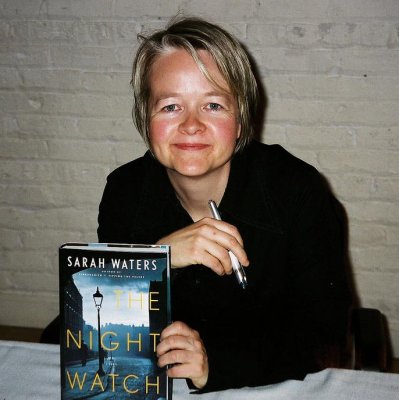
Sarah Waters

Novelist

Recorded said elsewhere, not written here
Writing fiction is not “self-­expression” or “therapy”. Novels are for readers, and writing them means the crafty, patient, selfless construction of effects. I think of my novels as being something like fairground rides: my job is to strap the reader into their car at the start of chapter one, then trundle and whizz them through scenes and surprises, on a carefully planned route, and at a finely engineered pace.

The Guardian Review, 20 February 2010 source ↗

Others on this question

View all 51 →
Drew Houston Co-founder and chief executive of Dropbox
I was going to say work on what you love, but that's not really it. It's so easy to convince yourself that you love what you're doing — who wants to admit that they don't? When I think about it, the happiest and most successful people I know don't just love what they do, they're obsessed with solving an important problem, something that matters to them.
Recorded MIT 147th Commencement, MIT News (Massachusetts Institute of Technology), 7 June 2013 source ↗
John Banville Novelist; winner of the Booker Prize, 2005
But my own mottos are, “Don’t imagine for a moment that you’re going to be able to express yourself.” ... And most aspiring artists think, “I have something to say.”
Recorded Academy of Achievement interview, 18 October 2017 source ↗
Yo-Yo Ma Cellist
Perfection is always a desired goal, but it cannot be a primary goal. Expression has to be the primary goal, because otherwise, there is no need for an actual person to be there.
Recorded Voice of America, VOA feature, January 2009, Voice of America, 2 November 2009 source ↗
Ursula K. Le Guin Novelist, poet and essayist
Right now, we need writers who know the difference between production of a market commodity and the practice of an art. Developing written material to suit sales strategies in order to maximise corporate profit and advertising revenue is not the same thing as responsible book publishing or authorship.
Recorded National Book Awards ceremony, New York, 19 November 2014, ursulakleguin.com (the author's own site), 19 November 2014 source ↗

More from Sarah Waters

View profile →
Question When you feel overwhelmed or unfocused, what do you do? Daily life
Don’t panic. Midway through writing a novel, I have regularly experienced moments of bowel-curdling terror, as I contemplate the drivel on the screen before me and see beyond it, in quick succession, the derisive reviews, the friends’ embarrassment, the failing career, the dwindling income, the repossessed house, the divorce . . . Working doggedly on through crises like these, however, has always got me there in the end. Leaving the desk for a while can help. Talking the problem through can help me recall what I was trying to achieve before I got stuck. Going for a long walk almost always gets me thinking about my manuscript in a slightly new way.
Recorded The Guardian Review, 20 February 2010 source ↗
Question What is the part of your job that people would be surprised is most of your job? Craft & work
Treat writing as a job. Be disciplined. Lots of writers get a bit OCD-ish about this. Graham Greene famously wrote 500 words a day. Jean Plaidy managed 5,000 before lunch, then spent the afternoon answering fan mail. My minimum is 1,000 words a day – which is sometimes easy to achieve, and is sometimes, frankly, like shitting a brick, but I will make myself stay at my desk until I’ve got there, because I know that by doing that I am inching the book forward. Those 1,000 words might well be rubbish – they often are. But then, it is always easier to return to rubbish words at a later date and make them better.
Recorded The Guardian Review, 20 February 2010 source ↗

More on craft & work

Also answered this

John Banville, Alan Cumming, Nick Cave, Ursula K. Le Guin, Zadie Smith, J.K. Rowling

Search the directory for somebody in particular.

Explore further

Report this answer