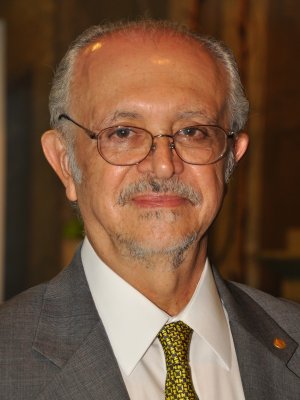
Mario Molina

Atmospheric chemist; Nobel laureate in Chemistry, 1995

Recorded said elsewhere, not written here
I did. As a kid, I liked music. I still like it a lot of course. I used to play the violin. I did contemplate, well, maybe that’s an option. I could become a musician. Somehow my parents got some advice that unless I was willing to spend eight or 10 hours a day just playing the violin that I should just give it up. To me, that was very bad advice because you could of course, get very involved in music without being a musician. Fortunately, even though I gave up eventually playing the violin myself, I never gave up my fondness for music. But if I had a chance again, I would not give it up. I would just do it as a hobby. I think that was just because I did not get the correct advice.

Adam Smith, Nobel Prize Talks, recorded April 2014; re-released as Nobel Prize Conversations, Nobel Prize Outreach, 11 April 2014 source ↗

Others on this question

View all 7 →
Al Franken Senator and comedian
Some of the worst advice I've been given doesn't sort of sound like terrible advice. And maybe it's the way I've internalized the advice. Always stand up for your principles is probably good advice. The way I've internalized it is burn your bridges. So I think that--you know what I mean?
Recorded Terry Gross, Fresh Air Archive, 30 April 2002 source ↗
Bozoma Saint John Marketing executive; former chief marketing officer of Netflix
But it was really – it came across sinister. And for me, I really did listen to it. I accepted it. I tried to implement that. The reason why I say it’s the worst advice I ever received was that it was damaging to me because she was totally wrong. ... And so, when somebody who is successful tells you to do something, you try to do it, even when it damages you.
Recorded Tim Ferriss, The Tim Ferriss Show podcast, 4 February 2018 source ↗
Soman Chainani Novelist and screenwriter; author of The School for Good and Evil
This professor was obviously on the jury, and I wanted to stay the faculty’s blessed son, and so I trusted external validation at this point in my life more than my own creative compass. So, like a lemming, I followed his advice. I spent the whole night undoing eight months’ work and recutting the film. And the next day, I presented this hacked up Frankenstein to the faculty, who absolutely demolished it.
Recorded Tim Ferriss, The Tim Ferriss Show podcast, 6 February 2018 source ↗
Derek Sivers Founder of CD Baby; author of Anything You Want
The worst advice was to start a record label when I wanted to be a musician. It was smart advice. It could have made me more money, but it did not inspire me.
Recorded Lydia Chen, podcast transcript, Escape 9 to 5, 2 April 2025 source ↗

More from Mario Molina

View profile →
Question What problem are you still trying to solve? Craft & work
I certainly want to continue trying to understand how the global environment functions. The earth as a system is a very complicated one. And to understand it, we need very many disciplines, very many different scientists working together. I want to continue working with my specialty, which is chemistry, with the atmosphere. There is still much to learn about chemical reactions that occur out there in the air, in the atmosphere. So one of my projects now is to really learn more about this pollution that occurs in cities and that is spreading more through the globe. To learn it in enough detail so we can better tackle it, we can better come up with new ways of using energy, for example, that are not so damaging to the environment.
Recorded Academy of Achievement interview, Sun Valley, Idaho, 29 June 1996 source ↗
Question What is the biggest obstacle you have faced professionally? Craft & work
In terms of this issue of these industrial gases affecting the environment, at the beginning the road was not easy, because we were suggesting that society had to change, that industries had to do something different than they were doing at that time. And of course, initially we did not meet with a good reception to these ideas from industry. And even from the scientific community — even though our ideas were well received in the small group of specialists in what we were doing — it was not necessarily well received by the scientific community at large. So we really had to continue doing as good a science as we could, and at the same time trying to well communicate our conviction that it was something important, something that had to change in the way society was functioning.
Recorded Academy of Achievement interview, Sun Valley, Idaho, 29 June 1996 source ↗
Question What is the part of your job that people would be surprised is most of your job? Craft & work
Although my years at Irvine were very productive, I missed not doing experiments myself because of the many responsibilities associated with a faculty position: teaching courses, supervising graduate students, meetings, etc. After spending seven years at Irvine as Assistant and then Associate Professor, I decided to move to a non-academic position. I joined the Molecular Physics and Chemistry Section at the Jet Propulsion Laboratory in 1982. I had a smaller group – only a few postdoctoral fellows – but I also had the luxury of conducting experiments with my own hands, which I enjoyed very much.
Recorded Laureate-written autobiography, provided by the laureate in November 2007, Nobel Prize Outreach, 1 November 2007 source ↗
Question Which book changed the way you think, and what did it change? Taste & recommendation
It was probably a series of biographies of scientists like Pasteur, or even earlier ones — Leeuwenhoek inventing the microscope and Madame Curie. I forget how many others, but it was really just, for me, a fascination to learn about these great heroes. At that time, of course, they were totally inaccessible, almost non-human, to me. It became very interesting to me.
Recorded Academy of Achievement interview, Sun Valley, Idaho, 29 June 1996 source ↗

More on failure & regret

Also answered this

Soman Chainani, Alan Cumming, Bozoma Saint John, Al Franken, Derek Sivers, Tobias Lütke

Search the directory for somebody in particular.

Explore further

Report this answer