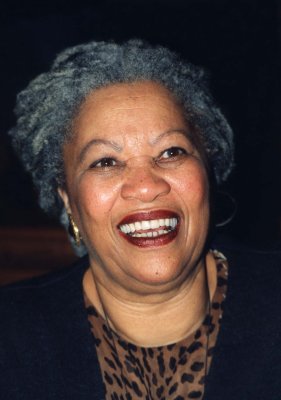
Novelist and editor; Nobel laureate in Literature, 1993
We die. That may be the meaning of life. But we do language. That may be the measure of our lives.
PBS, Interview, PBS, 23 June 2020 source ↗
Novelist and editor; Nobel laureate in Literature, 1993
We die. That may be the meaning of life. But we do language. That may be the measure of our lives.
PBS, Interview, PBS, 23 June 2020 source ↗
The day I retired from teaching, again, was one of the most satisfying days of my life and it was sad, but when I — the day I retired, I went home and I was by myself and I was having a glass of wine. I was thinking about the lunch the teachers gave me that day. The retirement lunch. And I was able to look back on that life, that 30 years in the classroom, and say — I was able to congratulate myself. I'm glad I did that. That was good. I felt useful, that I don't think I would have felt if I had gone into business or something like that.
Now, it's been very hard for me to accept that. I never - I felt like - I always felt like I could blow it and nothing would never happen until this happened. So now, it's - no matter how hard I practice, it just seem like I can't do the plays I did.
No two weeks have been the same since I retired. Since this is my fifth year out of professional basketball, I'm at a point where I want to evaluate and make a decision whether I want more consistency and continuity, or I want things to continue in that mode. This is a transitional time.
I ignored my stand-up career for 25 years, but now, having finished this memoir, I view this time with surprising warmth. One can have, it turns out, an affection for the war years.
it's not profound regret. It's just a wiping up of tiny, little messes that you didn't recognize as a mess when they were going on
You are your best thing.
I always thought I was able and competent all the while I was rearing them.
Writing before dawn began as a necessity—I had small children when I first began to write and I needed to use the time before they said, “Mama”—and that was always around five in the morning. Many years later, after I stopped working at Random House, I just stayed at home for a couple of years. I discovered things about myself I had never thought about before.
I, at first, thought I didn’t have a ritual, but then I remembered that I always get up and make a cup of coffee while it is still dark—it must be dark—and then I drink the coffee and watch the light come. And she said, “Well, that’s a ritual.” And I realized that for me this ritual comprises my preparation to enter a space that I can only call nonsecular … For me, light is the signal in the transition. It’s not being in the light, it’s being there before it arrives. It enables me, in some sense.
Riley Moynes, Arvid Carlsson, Simone Campbell, Mike Stone, I. M. Pei, Julius Erving
Search the directory for somebody in particular.