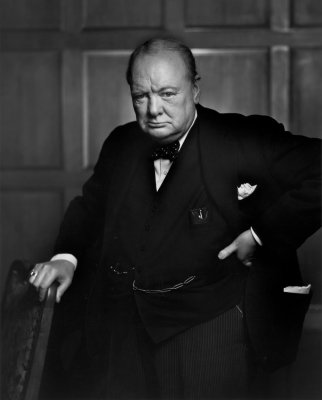
The questions of the students are often the source of new research. They often ask profound questions that I’ve thought about at times and then given up on, so to speak, for a while. It wouldn’t do me any harm to think about them again and see if I can go any further now. The students may not be able to see the thing I want to answer, or the subtleties I want to think about, but they remind me of a problem by asking questions in the neighborhood of that problem. It’s not so easy to remind yourself of these things.
Originally asked
Vox, to writers and thinkers, 9 Questions, 2017
This exact prompt is one of Vox's nine recurring questions about intellectual habits.
You answer as yourself. Nobody on FLAPSS answers as anybody else.
Chapter of his autobiography, written at Chartwell in 1930, Winston S. Churchill, My Early Life (Thornton Butterworth, 1930), Project Gutenberg Canada, October 1930 source ↗
Others on this question
View all 8 →I wanted to know. I asked a lot of questions and she would say, "Read, read."…So she inspired me a great deal.
I have also benefited from teaching; as I try to explain my views to students with critical and open minds, I find myself continually being challenged to go back and rethink ideas. I now see teaching and research as complementary, mutually reinforcing activities.
One of the saints in my life is this woman named Imogene Hill, who was a fourth-grade teacher who taught this advanced class. She got hip to my whole situation in about a month and kindled a passion in me for learning things. I learned more that year than I think I learned in any year in school.
More from Winston Churchill
View profile →At that moment the loud approaching sound of a motor-car was heard in the drive. From this chariot there stepped swiftly and lightly none other than the gifted wife of Sir John Lavery. 'Painting! But what are you hesitating about? Let me have a brush—the big one.' Splash into the turpentine, wallop into the blue and the white, frantic flourish on the palette—clean no longer—and then several large, fierce strokes and slashes of blue on the absolutely cowering canvas. Anyone could see that it could not hit back. No evil fate avenged the jaunty violence. The canvas grinned in helplessness before me. The spell was broken. The sickly inhibitions rolled away. I seized the largest brush and fell upon my victim with Berserk fury. I have never felt any awe of a canvas since.
Painting is complete as a distraction. I know of nothing which, without exhausting the body, more entirely absorbs the mind. Whatever the worries of the hour or the threats of the future, once the picture has begun to flow along, there is no room for them in the mental screen. They pass out into shadow and darkness. All one's mental light, such as it is, becomes concentrated on the task. Time stands respectfully aside, and it is only after many hesitations that luncheon knocks gruffly at the door.
I cannot pretend to feel impartial about the colours. I rejoice with the brilliant ones, and am genuinely sorry for the poor browns. When I get to heaven I mean to spend a considerable portion of my first million years in painting, and so get to the bottom of the subject. But then I shall require a still gayer palette than I get here below. I expect orange and vermilion will be the darkest, dullest colours upon it, and beyond them there will be a whole range of wonderful new colours which will delight the celestial eye.
First of all, you can correct mistakes much more easily. One sweep of the palette-knife 'lifts' the blood and tears of a morning from the canvas and enables a fresh start to be made; indeed the canvas is all the better for past impressions.
One by one the more vigorous sports and exacting games fall away. Exceptional exertions are purchased only by a more pronounced and more prolonged fatigue. Muscles may relax, and feet and hands slow down; the nerve of youth and manhood may become less trusty. But painting is a friend who makes no undue demands, excites to no exhausting pursuits, keeps faithful pace even with feeble steps, and holds her canvas as a screen between us and the envious eyes of Time or the surly advance of Decrepitude. Happy are the painters, for they shall not be lonely.
When I think of the fate of poor old women, so many of whom have no one to look after them and nothing to live on at the end of their lives, I am glad to have had a hand in all that structure of pensions and insurance which no other country can rival and which is especially a help to them.
More on attention & the world
Also answered this
John Lewis, Desmond Tutu, Steve Jobs, Richard Feynman, Mario Molina, Shinya Yamanaka
Search the directory for somebody in particular.
Explore further
- All attention & the world questions
- The 9 Questions questionnaire — 5 questions from the same format
- Explore the archive — by field, age, era, and subject