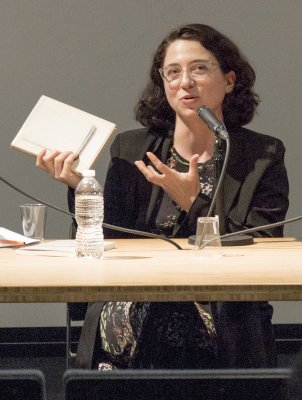
Usually I’m overcome with sadness and fear, actually. And when I have that feeling where the bottom drops out of things, I know that it’s done.
Maddie Crum, The Creative Independent interview source ↗
The question
How do you tell when a piece of work is done?Originally asked
The Creative Independent, to working artists, its interview series
A repeated process question in The Creative Independent, asked across visual art, music, writing, performance, and mixed media.
You answer as yourself. Nobody on FLAPSS answers as anybody else.
Usually I’m overcome with sadness and fear, actually. And when I have that feeling where the bottom drops out of things, I know that it’s done.
Maddie Crum, The Creative Independent interview source ↗
My mind is nearly like an infinite tunnel of potential ideas, but the ideas are all a part of what is already there. In my imagination, I always think there are more parts to record. Then when I work it through, I make it to a certain point and I’m like, “Actually, that’s enough.” Some of the extra bits that I’m thinking of are suggested anyway by interaction with what is already there, and it gets to a point where to add anything more would just be too much. I often imagine recording parts that people actually do hear, but are not actually there. By the time I’m done with the main guitar and other elements, [more parts] don’t capture anything else with all those suggested things. If I try to realize them, it’s less effective. I think that’s why people have often said they hear different things depending on how they listen to [our music].
You just have to call it eventually. [For example,] technically speaking, yes, our September Issue is done. It has shipped. But do I feel finished with it? Never. We were ambitious with this issue—we decided we couldn’t platform just one, “face of fashion” and instead went with three exciting covers who each have added something unique to the conversation about style. Having one solid image for a magazine cover is one thing, but it’s another to say something through three rich stories. It was an exciting challenge, and I give my incredible team a lot of credit for their dedication and endless hours. I can’t wait for you to see it.
I don’t think I’ve ever worked so hard on something, but working on Macintosh was the neatest experience of my life. Almost everyone who worked on it will say that. None of us wanted to release it at the end. It was as though we knew that once it was out of our hands, it wouldn’t be ours anymore.
Often it’s the deadline, to be really honest. Also, research is my favorite part. I could just research forever. But then I actually need to produce. Maybe that’s why the offering part is so beautiful, because each offering/performance is different because it’s a different time, it’s a different space, and I’m a different person. Each day you’re a different person, and because the people you’re doing this with are also different, the work changes. Maybe you’ve found something else that inspired you, so you add it and let the work grow. It grows infinitely, alongside you. With video, it’s set, so it’s harder to add to it even if sometimes you’re kind of like, “Oh my god, I would love to add this.” With embodied practice it’s easier. It grows with me. That’s something I love, especially because my research never ends. It’s ever evolving.
I revise the book, and then a few other people read it, and then there is a master document listing all of the things that have to be revised. And then those are broken out, and the book is printed out in various ways. I don’t know if you’ve ever used that function on the printer, where you can do four pages to a sheet or six pages to a sheet. I’ll often read things I write in very small font, to get an overview of them. And then I’ll print them out in really big font, and look at them that way.
Lauren Groff, Hanif Abdurraqib, António Lobo Antunes, Neel Patel, Boris Fishman, Matthew Gavin Frank
Search the directory for somebody in particular.