What is the book you have given most as a gift, and why?
Recorded Amartya Sen said elsewhere, not written here
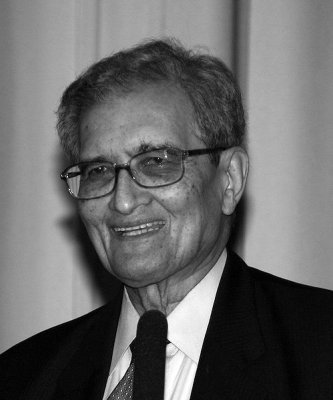
It was not long after Kenneth Arrow's path-breaking study of social choice, Social Choice and Individual Values, was published in New York in 1951, that my brilliant co-student Sukhamoy Chakravarty drew my attention to the book and to Arrow's stunning "impossibility theorem" (this must have been in the early months of 1952). Sukhamoy too was broadly attracted by the left, but also worried about political authoritarianism, and we discussed the implications of Arrow's demonstration that no non-dictatorial social choice mechanism may yield consistent social decisions.

Laureate-written autobiography for Les Prix Nobel, Nobel Prize Outreach, 1 December 1998 source ↗

Others on this question

View all 14 →
Hilary Mantel Novelist and critic
Read Becoming a Writer, by Dorothea Brande. Then do what it says, including the tasks you think are impossible. You will particularly hate the advice to write first thing in the morning, but if you can manage it, it might well be the best thing you ever do for yourself. This book is about becoming a writer from the inside out. Many later advice manuals derive from it. You don’t really need any others, though if you want to boost your confidence, “how to” books seldom do any harm.
Recorded The Guardian Review, 20 February 2010 source ↗
Cheryl Strayed Author of Wild and Tiny Beautiful Things
Some books I return to again and again: Alice Munro's books, but especially "Lives of Girls and Women," Toni Morrison's "Beloved," Mary Oliver's poetry collections, Raymond Carver's short stories, Joan Didion's essays. There are so many more! It's hard to name them all. Books are my cure.
Recorded lets_nap, Reddit AMA, BestofAMA, 30 October 2015 source ↗
Satya Nadella Chief executive of Microsoft
And this is where, a couple of years before I had become CEO, I had read this book by Carol Dweck out of Stanford [University] called “Mindset,” which was more in relation to my kids. And the simple concept in that book, which I loved a lot, was it's better to be a learn-it-all even if the know-it-all has more innate capability, because the learn-it-all ultimately will do better. And I said, well, that applies to CEOs. That applies to companies made up of people. And I said: What if we introduce that as the meme to have the cultural dialogue at Microsoft?
Recorded The Economic Club of Washington, D.C. (official transcript) source ↗
Bill Gates Co-founder of Microsoft; co-chair of the Bill & Melinda Gates Foundation
I read Stephen Pinker's The Better Angels of Our Nature a few years ago and got to talk to him about it after, which was a lot of fun. I reviewed it for my blog, Gates Notes, because I wanted other people to read it, love it, and hopefully learn from it the way I did. It's probably my favorite book and the one I recommend most often.
Recorded TIME interview, 2017 source ↗

More from Amartya Sen

View profile →
Question What is something everyone in your world agrees about that you think is wrong? Values & belief
And yet, despite the high moral and ethical quality of social commiseration, political dedication and a deep commitment to equity, there was something rather disturbing about standard leftwing politics of that time: in particular, its scepticism of process-oriented political thinking, including democratic procedures that permit pluralism. The major institutions of democracy got no more credit than what could be portioned out to what was seen as "bourgeois democracy," on the deficiencies of which the critics were most vocal. The power of money in many democratic practices was rightly identified, but the alternatives – including the terrible abuses of non-oppositional politics – did not receive serious critical scrutiny.
Recorded Laureate-written autobiography for Les Prix Nobel, Nobel Prize Outreach, 1 December 1998 source ↗
Question What is the most overrated virtue? Values & belief
This was a co-educational school, with many progressive features. The emphasis was on fostering curiosity rather than competitive excellence, and any kind of interest in examination performance and grades was severely discouraged. ("She is quite a serious thinker," I remember one of my teachers telling me about a fellow student, "even though her grades are very good.") Since I was, I have to confess, a reasonably good student, I had to do my best to efface that stigma.
Recorded Laureate-written autobiography for Les Prix Nobel, Nobel Prize Outreach, 1 December 1998 source ↗

More on taste & recommendation

Also answered this

Mario Molina, Katalin Karikó, Shinya Yamanaka, Rita Levi-Montalcini, Tu Youyou, David Hare

Search the directory for somebody in particular.

Explore further

Report this answer