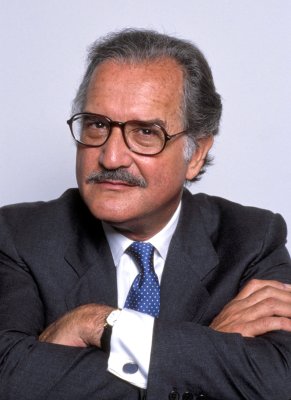
Which teacher, parent, coach or friend most made you who you are, and what did you learn from them?
Recorded Carlos Fuentes said elsewhere, not written here
My father was a great educator for me. He taught me so many things. He named me Carlos after a brother he lost — a very brilliant young man who died at 21 in Mexico. He had written very good poems. He was an intellectual. I think my father wanted to see his brother in me, so he put books into my hands at a very early age. He fostered my literary and artistic inclinations. So he was my best teacher.

Academy of Achievement interview source ↗

Others on this question

View all 57 →
Benazir Bhutto Prime Minister of Pakistan, 1988–1990 and 1993–1996
A very important influence. Now when I look back on it, it was my father who was against the gender constraints of my time. And my mother, she used to be a working woman herself, she joined the National Guards. She was a captain in the National Guards. She was the first woman in Karachi to own a car and to drive, and people used to talk about her because they said, you know, “We’re not supposed to drive cars.” But when I look back on it, it was my mother who taught that a woman grew up to be married and to have children, and she would tell my father in front of me, “Why do you want to educate her? No man will want to marry her.” So all the time, for her, success depended on having a good catch as a husband, and having children. Whereas for my father, he broke free of those constraints, and he insisted that I have an education. He said, “Boys and girls are equal. I want my daughter to have the same opportunities.”
Recorded Academy of Achievement interview source ↗
Antonio Villaraigosa 41st Mayor of Los Angeles, 2005-2013; Speaker of the California State Assembly
I grew up in a home of domestic violence and alcoholism, and with a mom of just unconditional love and this indomitable spirit to overcome. And she gave all of her kids — all four of her kids, but the three that I grew up with — she gave us this really sense of self, this strong character that we all have, this belief in the possible. She always emphasized education. She would say to us things like, “Maybe you’re poor, but nobody can take away your education. Education is very, very important.” So my mom was, without question, the most important influence in my life and the person who I owe the greatest debt of gratitude to. There are a lot of people who have come in my life that I have looked to and look up to, but nobody has had the influence on my life that my mom has.
Recorded Academy of Achievement interview source ↗
Desmond Tutu Anglican Archbishop of Cape Town; chair of South Africa’s Truth and Reconciliation Commission; Nobel Peace Prize, 1984
I recall when I was about nine picking up a tattered copy of Ebony magazine and I think — I mean, maybe journalists ought to know just how much power they actually have because here I was 10,000 miles away from America with this copy of Ebony magazine and it was describing the exploits of Jackie Robinson and how he broke into major league baseball. Now I didn’t know baseball from ping pong but what was so important for me, what made me grow inches was to know that a black guy had triumphed over all of the obstacles that were placed in his way and there he was now playing for something called Brooklyn Dodgers. Now I didn’t know Brooklyn Dodgers. I didn’t know Jackie, but it helped to exorcise what is the most awful consequence of racial injustice and it is the sense — this demon of self-hate when you have a very low self-esteem.
Recorded Academy of Achievement interview source ↗
Nora Ephron Journalist, essayist, screenwriter and film director
Yes. I had a couple of great, great teachers. The teacher who changed my life was my journalism teacher, whose name was Charles Simms. I always tell this story. I love it. I had already decided that I was going to be a journalist. I didn’t know why exactly, except that I had seen a lot of Superman comics. Lois Lane and all of those major literary characters like that, but Mr. Simms got up the first day of class, and he went to the blackboard, and he wrote “Who, what, where, why, when, and how,” which are the six things that have to be in the lead of any newspaper story. Then he did what most journalism teachers do, which is that he dictated a set of facts to us, and then we were all meant to write the lead that was supposed to have “who, what, where, why, when, and how” in it. He dictated a set of facts that went something like, “The principal of Beverly Hills High School announced today that the faculty of the high school will travel to Sacramento, Thursday, for a colloquium in new teaching methods. Speaking there will be Margaret Mead, the anthropologist, and two other people.” So we all sat down at our typewriters, and we all kind of inverted that and wrote, “Margaret Mead and X and Y will address the faculty in Sacramento, Thursday, at a colloquium on new teaching methods, the principal announced today.” Something like that. We were very proud of ourselves, and we gave it to Mr. Simms, and he just riffled through them and tore them into tiny bits and threw them in the trash, and he said, “The lead to this story is: There will be no school Thursday!” and it was this great epiphany moment for me. It was this, “Oh my God, it is about the point! It is about figuring out what the point is.” And I just fell in love with journalism at that moment. I just fell in love with the idea that underneath, if you sifted through enough facts, you could get to the point, and you had to get to the point. You could not miss the point. That would be bad. So he really kind of gave that little shift of mind a major push.
Recorded Academy of Achievement interview source ↗

More from Carlos Fuentes

View profile →
Question How much rewriting or revision do you do? Craft & work
Not that important. I seem to rewrite in my head a great deal. I write in these English ruled notebooks. So I write on the right, and then I correct on the left. Then, when it’s typed out, I even make another correction, and then maybe in the typed sheets also. But not that much. I seem to have a great facility to go right into what I want to say. I do correct, but not like Balzac, who went crazy over the printing presses. He was correcting at the last minute.
Recorded Academy of Achievement interview, 2006 source ↗
Question Do you rely on inspiration or discipline to make work? Craft & work
A writer is no different than a bricklayer or a bus driver in that sense. You must have discipline. Oscar Wilde said that writing is 10 percent genius, 90 percent discipline. You must have discipline for writing. It is not an easy task. It is very lonely. You’re all alone. You are not in company. You are not enjoying yourself in that sense. You are enjoying yourself in another sense. You are delving into your depths, but you are profoundly lonely. It is one of the loneliest careers in the world. In the theater, you are with companions, with directors, actors. In film. In an office. In writing, you are alone. That takes a lot of strength and a lot of will to do it. You must really be in love with what you’re doing to tolerate the huge loneliness of writing.
Recorded Academy of Achievement interview, Los Angeles, California, 2 June 2006 source ↗

More on relationships

Also answered this

Rita Dove, Joyce Carol Oates, Maya Angelou, Khaled Hosseini, Wole Soyinka, John Grisham

Search the directory for somebody in particular.

Explore further

Report this answer