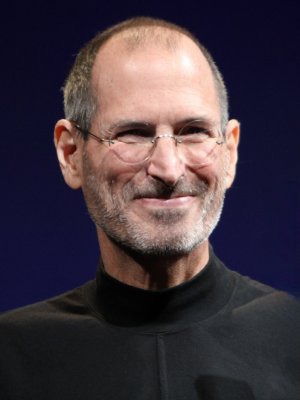
Steve Jobs

Co-founder and chief executive of Apple; co-founder of NeXT; chief executive of Pixar

Recorded said elsewhere, not written here
We spent some time in our family talking about what's the trade-off we want to make. We ended up talking a lot about design, but also about the values of our family. Did we care most about getting our wash done in an hour versus an hour and a half? Or did we care most about our clothes feeling really soft and lasting longer? Did we care about using a quarter of the water? We spent about two weeks talking about this every night at the dinner table.

Gary Wolf, Wired 4.02, February 1996 source ↗

Others on this question

View all 31 →
Tanni Grey-Thompson British wheelchair racer, 1988–2007; member of the House of Lords
One thing that I did was race against the British men a lot and they used to push me round the road; they used to make my life really hard but then when I was racing against the best women in the world, I'd been through just about every experience you could imagine. I remember this one race – a half marathon – where my husband literally pushed me into every kerb he could find, he pushed me into every corner, you know, messed around and tried to drop me out the back of the pack. Then when you're in a race that really matters, if that happens, you've got the skills to deal with it… you need to have practised everything you possibly could in the lead up to it.
Recorded Bernardo Moya, The Best You Magazine, 21 August 2015 source ↗
Richard Feynman Theoretical physicist; Nobel laureate in Physics, 1965
one of my diseases, one of my things in life, is that anything that is secret I try to undo. And so the locks to those filing cabinets represented a challenge to me. How the hell to open them? So I worked and worked on them. There are all kinds of stories about how you can feel the numbers and listen to things and so on. That's true; I understand it very well - for old- 19 fashioned safes. But these had a new design so that nothing would be pushing against the wheels while you were trying them, and none of the old methods would work. I read books by locksmiths, which always say in the beginning how they opened the locks when the safe is under water and the woman in it is drowning or some-thing, and the great locksmith opened the safe. And then in the back they tell you how they do it, and they don't tell you anything sensible. It doesn't sound like they could really open safes that way — like guess the combination on the basis of the psychology of the person who owns it! So I always figured they were keeping the method a secret, and like a kind of disease, I kept working on these things until I found out a few things. First, I found out how big a range you need to open the combination, how close you have to be. And then I invented a system by which you could try all the necessary combinations - 8,000, as it turned out, because the woman DROWNING عزه Books are always telling how the great locksmith opens the safe under water when the woman in it is drowning. 20 you could be within two of every number. And then I worked out a scheme by which I could try numbers without altering a number that I had already set, by correctly moving the wheels, so that I could try all the combinations in eight hours. And then finally I discovered (this took me about two years of researching) that it's easy to take the last two numbers of the combination off the safe if the safe is open. If the drawer was pulled out, you could turn the number and see the bolt go up and play around and find out what number it comes back at, and stuff like that. With a little trickery, you can get the combination off. So I used to practice it like a cardsharp practices cards, you know - all the time. Quicker and quicker and more and more unobtrusively I would come in and talk to some guy. I'd sort of lean against his filing cabinet, and you wouldn't even notice I'm doing any-thing. I'm not doing anything— just playing with the dial, that's all, just playing with the dial. But all the time I was taking the two numbers off! And then I would go back to my office and write the two numbers down, the last two numbers of the three. Now, if you have the last two numbers, it takes just a minute to try for the first number; there's only 20 possibilities, and it's open. OK? It takes about three minutes to open a safe if you know the last two numbers. So I got an excellent reputation for safe-cracking.
Recorded Engineering and Science / Caltech Magazine, 1976 source ↗
Denton Cooley Cardiothoracic surgeon; founder of the Texas Heart Institute
I don’t lead by force, I lead by example. And if I can, set a good example. If I can set an example to my staff and my group, by being punctual, I come to work every morning, walk onto the hospital floor within two or three minutes of the same time every day, and they can depend upon it.
Recorded Academy of Achievement recorded interview, American Academy of Achievement, 11 April 1991 source ↗
Ricardo Semler Chief executive and later chairman of Semco Partners, Brazil
What we've done all of these years is very simple, is use the little tool, which is ask three whys in a row. Because the first why you always have a good answer for. The second why, it starts getting difficult. By the third why, you don't really know why you're doing what you're doing.
Recorded TEDGlobal, 16 October 2014 source ↗

More from Steve Jobs

View profile →
Question Who makes your work possible behind the scenes? Craft & work
You're missing it. This is not a one-man show. What's reinvigorating this company is two things: One, there's a lot of really talented people in this company who listened to the world tell them they were losers for a couple of years, and some of them were on the verge of starting to believe it themselves. But they're not losers. What they didn't have was a good set of coaches, a good plan.
Recorded Andy Reinhardt, Business Week Q&A in the Apple boardroom, extended online-only version, 25 May 1998 source ↗
Question When did you last change your mind about something important? Change of mind
I used to think that technology could help education. I've probably spearheaded giving away more computer equipment to schools than anybody else on the planet. But I've had to come to the inevitable conclusion that the problem is not one that technology can hope to solve. What's wrong with education cannot be fixed with technology. No amount of technology will make a dent. It's a political problem.
Recorded Gary Wolf, Wired 4.02, February 1996 source ↗
Question What fills you with the most pride? Identity & self
The things I'm most proud about at Apple is where the technical and the humanistic came together, as it did in publishing for example. The Macintosh basically revolutionized publishing and printing. The typographic artistry coupled with the technical understanding and excellence to implement that electronically--those two things came together and empowered people to use the computer without having to understand arcane computer commands. It was the combination of those two things that I'm the most proud of.
Recorded Daniel Morrow, Smithsonian Institution Oral and Video Histories, for the Computerworld Smithsonian Awards Program, 20 April 1995 source ↗
Question What lesson has mattered most in your life? Time & hindsight
I'm convinced that about half of what separates the successful entrepreneurs from the non-successful ones is pure perseverance. It is so hard. You put so much of your life into this thing. There are such rough moments in time that I think most people give up. I don't blame them. Its really tough and it consumes your life.
Recorded Daniel Morrow, Smithsonian Institution Oral and Video Histories, for the Computerworld Smithsonian Awards Program, 20 April 1995 source ↗

More on daily life

Also answered this

Linus Torvalds, Nithin Kamath, Toni Morrison, Geoff Dyer, Ricardo Semler, Serena Williams

Search the directory for somebody in particular.

Explore further

Report this answer