We've just passed a milestone: Twenty years ago, on January 3, 1972, Blue Chip Stamps (then an affiliate of Berkshire and later merged into it) bought control of See's Candy Shops, a West Coast manufacturer and retailer of boxed-chocolates. The nominal price that the sellers were asking - calculated on the 100% ownership we ultimately attained - was $40 million. But the company had $10 million of excess cash, and therefore the true offering price was $30 million. Charlie and I, not yet fully appreciative of the value of an economic franchise, looked at the company's mere $7 million of tangible net worth and said $25 million was as high as we would go (and we meant it). Fortunately, the sellers accepted our offer. The sales of trading stamps by Blue Chip thereafter declined from $102.5 million in 1972 to $1.2 million in 1991. But See's candy sales in the same period increased from $29 million to $196 million. Moreover, profits at See's grew even faster than sales, from $4.2 million pre-tax in 1972 to $42.4 million last year.
Not claimed by Warren Buffett
Warren Buffett has not joined FLAPSS and has not endorsed it. This page is a reference record assembled from published interviews and public remarks. Every answer below is a direct quotation with the source and date shown next to it.
Warren Buffett
Chairman and chief executive of Berkshire Hathaway, 1970–2025
United States · b. 1930
Business and finance
About
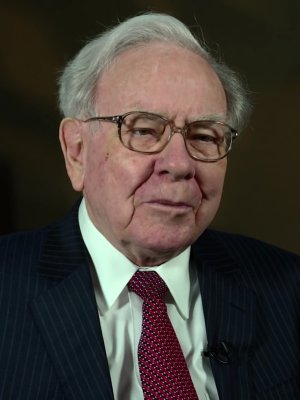
Ran Berkshire Hathaway, a diversified holding company, from 1965 until stepping down as chief executive at the end of 2025. He studied under Benjamin Graham at Columbia Business School and has written an annual letter to Berkshire shareholders since the 1970s.
22 answers
My first mistake, of course, was in buying control of Berkshire. Though I knew its business - textile manufacturing - to be unpromising, I was enticed to buy because the price looked cheap. Stock purchases of that kind had proved reasonably rewarding in my early years, though by the time Berkshire came along in 1965 I was becoming aware that the strategy was not ideal. If you buy a stock at a sufficiently low price, there will usually be some hiccup in the fortunes of the business that gives you a chance to unload at a decent profit, even though the long-term performance of the business may be terrible. I call this the "cigar butt" approach to investing. A cigar butt found on the street that has only one puff left in it may not offer much of a smoke, but the "bargain purchase" will make that puff all profit. Unless you are a liquidator, that kind of approach to buying businesses is foolish.
Every quotation above is reproduced from the source shown beside it and has not been edited. Warren Buffett did not write these answers for FLAPSS. Request a correction or removal.