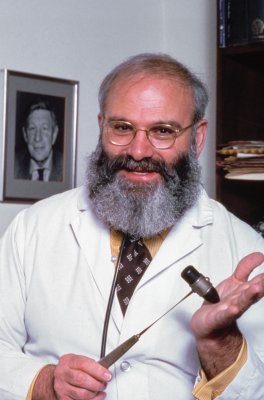
There is always an impulse to degrade people who are different from you, to diminish them, to demean them, and it never seems to go away, even when there is ample evidence that when we work together, we do better. It’s not about material progress or personal comfort. It’s about personal identity, and there are still so many forces at work in the human psyche that lead some people to think that their identity requires them to have someone to look down on or to demean or to feel that they’re superior to, and I think that that’s at the root of all this. It’s the only story in human society. Who is the other? Who is one of yours? Cain and Abel.
Originally asked
Krista Tippett, to her guests, On Being
Krista Tippett uses this as a recurring, sometimes-closing On Being question; the wording is intentionally adapted to each guest.
You answer as yourself. Nobody on FLAPSS answers as anybody else.
The New York Times, Op-Ed, 19 February 2015 source ↗
Others on this question
View all 14 →Part of what separates us from the other creatures on earth is that we make up stories. We are storytellers. And we can tell bad stories and we can tell good stories. We can tell stories that lead to division and hate and war. Or we can tell stories that lead to cooperation and peace and progress.
The stroke cut out a lot of my external trips: my sports car and golf and my cello. This [ points to hand ] is just not much use with a cello, and I was—forced inside, and finding myself living in my inside. And that has made me be part of my soul. And that's perceiving my incarnation from here [ points to heart ], rather than from here [ points to head ]. And since this is words, I start from here, go over there.
I was forced to think very hard about what it meant to be me, what it means to be a person who is only a brain. Pascal's 'thinking reed' really does capture it, because I'm just a bunch of dead muscles thinking.
More from Oliver Sacks
View profile →I feel a sudden clear focus and perspective. There is no time for anything inessential. I must focus on myself, my work and my friends. I shall no longer look at “NewsHour” every night. I shall no longer pay any attention to politics or arguments about global warming. This is not indifference but detachment — I still care deeply about the Middle East, about global warming, about growing inequality, but these are no longer my business; they belong to the future. I rejoice when I meet gifted young people — even the one who biopsied and diagnosed my metastases. I feel the future is in good hands.
It was this celestial splendor that suddenly made me realize how little time, how little life, I had left. My sense of the heavens’ beauty, of eternity, was inseparably mixed for me with a sense of transience — and death. ... I told my friends Kate and Allen, “I would like to see such a sky again when I am dying.” “We’ll wheel you outside,” they said.
On the contrary, I feel intensely alive, and I want and hope in the time that remains to deepen my friendships, to say farewell to those I love, to write more, to travel if I have the strength, to achieve new levels of understanding and insight. This will involve audacity, clarity and plain speaking; trying to straighten my accounts with the world. But there will be time, too, for some fun (and even some silliness, as well).
And now, weak, short of breath, my once-firm muscles melted away by cancer, I find my thoughts, increasingly, not on the supernatural or spiritual, but on what is meant by living a good and worthwhile life — achieving a sense of peace within oneself. I find my thoughts drifting to the Sabbath, the day of rest, the seventh day of the week, and perhaps the seventh day of one’s life as well, when one can feel that one’s work is done, and one may, in good conscience, rest.
The peace of the Sabbath, of a stopped world, a time outside time, was palpable, infused everything, and I found myself drenched with a wistfulness, something akin to nostalgia, wondering what if: What if A and B and C had been different? What sort of person might I have been? What sort of a life might I have lived?
The first biography I read — I think the first scientific biography — was Madame Curie . And my mother, who was a surgeon, worked at the Marie Curie Hospital. She’d met Marie Curie, who was one of her great heroines. And reading the book, I think, was the first portrait of a scientist and the romance of a scientific life.
More on values & belief
- Which living person do you most admire, and why? 406 answers
- What is the trait you most deplore in others? 197 answers
- What is something everyone in your world agrees about that you think is wrong? 79 answers
- What are you unwilling to optimise? 30 answers
- What is the most overrated virtue? 10 answers
- What do you need to believe in order to get through the day? 9 answers
Also answered this
Paul Kalanithi, Tony Judt, Christopher Hitchens, Kate Bowler, Steve Jobs, Barack Obama
Search the directory for somebody in particular.
Explore further
- All values & belief questions
- Explore the archive — by field, age, era, and subject