Which book changed the way you think, and what did it change?
Recorded Oliver Sacks said elsewhere, not written here
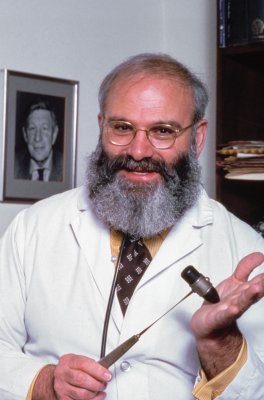
The first biography I read — I think the first scientific biography — was Madame Curie . And my mother, who was a surgeon, worked at the Marie Curie Hospital. She’d met Marie Curie, who was one of her great heroines. And reading the book, I think, was the first portrait of a scientist and the romance of a scientific life.

Academy of Achievement recorded interview, American Academy of Achievement, 17 June 2000 source ↗

Others on this question

View all 27 →
Alex Honnold Rock climber; first person to free solo El Capitan
some of the most noteworthy books I’ve read I guess, like A People’s History of the US, the Howard Zinn book totally changed the way I look at politics. And then in the same way I read a book recently called Sacred Economics that like totally changed the way I looked at economics.
Recorded Tim Ferriss, The Tim Ferriss Show podcast, 1 January 2018 source ↗
Rana el Kaliouby Computer scientist; co-founder of Affectiva
the thesis in the book is that computers need to understand human emotions just the way people do. I read the book and I was just fascinated by this idea. I made that my research topic and it became my obsession and it just really changed the trajectory of my life.
Recorded Tim Ferriss, The Tim Ferriss Show podcast, 13 May 2020 source ↗
Jimmy Carter 39th President of the United States, 1977–1981; Governor of Georgia 1971–1975
When I was a young boy, [my schoolteacher Julia Coleman] introduced me to Leo Tolstoy's novel, "War and Peace." She interpreted that powerful narrative as a reminder that the simple human attributes of goodness and truth can overcome great power. She also taught us that an individual is not swept along on a tide of inevitability but can influence even the greatest human events.
Recorded Oslo City Hall, The Nobel Foundation, 10 December 2002 source ↗
Anthony Kennedy Associate Justice of the Supreme Court of the United States, 1988–2018
I think fiction is very important because it gets us into the mind of a person. Hamlet is a tremendous piece of literature. You know Hamlet better than you know most real people. Do you know the reason? Because you know what he’s thinking. And this teaches you that every human has an integrity and an autonomy and a spirituality of his own, of her own, and great literature can teach you that.
Recorded Academy of Achievement recorded interview, American Academy of Achievement, 3 June 2005 source ↗

More from Oliver Sacks

View profile →
Question How would you like to die? Death & what remains
It was this celestial splendor that suddenly made me realize how little time, how little life, I had left. My sense of the heavens’ beauty, of eternity, was inseparably mixed for me with a sense of transience — and death. ... I told my friends Kate and Allen, “I would like to see such a sky again when I am dying.” “We’ll wheel you outside,” they said.
Recorded The New York Times, Sunday Review, 24 July 2015 source ↗
Question What is the most important lesson life has taught you? Time & hindsight
And now, weak, short of breath, my once-firm muscles melted away by cancer, I find my thoughts, increasingly, not on the supernatural or spiritual, but on what is meant by living a good and worthwhile life — achieving a sense of peace within oneself. I find my thoughts drifting to the Sabbath, the day of rest, the seventh day of the week, and perhaps the seventh day of one’s life as well, when one can feel that one’s work is done, and one may, in good conscience, rest.
Recorded The New York Times, Sunday Review, 14 August 2015 source ↗
Question What are you unwilling to optimise? Values & belief
I’ve had this concern all the time, but I can only hope that if one writes with appreciation and delicacy and respect, then it’s okay. I have to say that I’ve written a hundred times as much as I’ve published, because if there’s any thought of offense or embarrassment, then I will put the thing quietly away.
Recorded Academy of Achievement recorded interview, American Academy of Achievement, 17 June 2000 source ↗
Question What are you still hoping to finish? Death & what remains
On the contrary, I feel intensely alive, and I want and hope in the time that remains to deepen my friendships, to say farewell to those I love, to write more, to travel if I have the strength, to achieve new levels of understanding and insight. This will involve audacity, clarity and plain speaking; trying to straighten my accounts with the world. But there will be time, too, for some fun (and even some silliness, as well).
Recorded The New York Times, Op-Ed, 19 February 2015 source ↗
Question What is the hardest thing that has happened to you, and what did you carry out of it? Failure & regret
And I spent four years at a boarding school in the country, probably a rather abusive boarding school, and seeing very little of my parents, and that was a very bad time for me. A bad and almost a mad time. ... I think that some sort of trust, and ability for closeness, may have been compromised. And I think I’ve perhaps, to some extent, sort of kept a distance since that time, although this is not a distance I feel with my patients or my students.
Recorded Academy of Achievement recorded interview, American Academy of Achievement, 17 June 2000 source ↗

More on taste & recommendation

Also answered this

John Vervaeke, Mario Molina, Sylvia Earle, Keith Black, Edmund Hillary, Whitney Cummings

Search the directory for somebody in particular.

Explore further

Report this answer