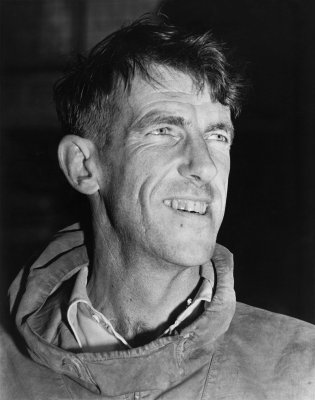
Edmund Hillary

Mountaineer and explorer; first ascent of Everest, 1953

Recorded said elsewhere, not written here
I still regard adventure pretty much as a hobby to tell you the honest truth, and I think this approach to it keeps one refreshed almost. I think if you just regard adventure as a business, working becomes very boring as many other businesses can become. But even though adventure changed my life considerably, both in what I was doing and even economically, I’ve always regarded myself in a sense as a competent amateur.

Academy of Achievement interview source ↗

Others on this question

View all 30 →
Derek Sivers Founder of CD Baby; author of Anything You Want
Do you have a big visionary master plan for how the world will work in twenty years? Do you have massive ambitions to revolutionize your industry? Don’t feel bad if you don’t. I never did. A year and a half after starting CD Baby, it was just me and John, my first employee, running it out of my house. One night, I decided I should think more about the long-term future of this thing. I sat with my diary for a few hours of introspection. Afterwards, I wrote John an email that went like this: “I think there’s a chance that this thing might be huge one day, so we better start preparing for that now. I mean some day, we might have a thousand artists. We might need a third employee! We’d need three computers, and need to figure out how to network them together. We might even need to start moving CDs into the garage, since eventually they might fill up the living room. Yes, I know it sounds grandiose, but I think things are headed that way.” Years later, after I had 100,000 artists and 85 employees, John would often get a good laugh out of this letter I sent him in 1999. Journalists would ask, “What’s your long-term goal?” I’d say, “I don’t have one. I surpassed my goals long ago. I’m just trying to help musicians with whatever they need today.” So please don’t think you need a huge vision. Just stay focused on helping people today.
Recorded Essay on sive.rs, Derek Sivers, 14 July 2011 source ↗
Steve Jobs Co-founder and chief executive of Apple; co-founder of NeXT; chief executive of Pixar
When you’re a carpenter making a beautiful chest of drawers, you’re not going to use a piece of plywood on the back, even though it faces the wall and nobody will ever see it. You’ll know it’s there, so you’re going to use a beautiful piece of wood on the back. For you to sleep well at night, the aesthetic, the quality, has to be carried all the way through.
Recorded David Sheff, Playboy Interview, February 1985 source ↗
Werner Herzog Film director, screenwriter and opera director
It’s how we are made as homo sapiens. We are biologically organized to cover distances on foot. That’s what we did for tens of thousands of years until we started to use horses, of course, until the mechanical age. And I would not call it “walking” because it’s not going out for a stroll or going out for a “power walk” or ambling in your city. It’s “traveling on foot.” You are reading the world, learning the essence of the world.
Recorded National Geographic, National Geographic, interview conducted via Zoom, 1 January 2020 source ↗
David Oyelowo Actor, director and producer
Any lasting relationship needs non-negotiables. We made the decision early on never to be apart for longer than two weeks: 26 years married and we’ve only broken that rule once, by 11 hours, when my wife was in Sleepy Hollow. If I ever meet [director] Tim Burton, I’ll be having words.
Recorded The Observer / The Guardian, 19 April 2025 source ↗

More from Edmund Hillary

View profile →
Question What is the hardest thing that has happened to you, and what did you carry out of it? Failure & regret
Well, then of course, came the disaster in 1975, when my wife and my youngest daughter were flying into the Nepal hills where I was building a hospital and their plane crashed and they were killed. And this certainly, for me, was an absolute disaster, really because the two people that meant most to me in life had been killed in one fell swoop. It did take me quite a number of years to get over it. I found the only way to deal with it was to carry on very energetically, doing the things that we had all been doing together, which was largely building schools and things for the mountain people. Although, people used to say to me, “Time is the great healer,” certainly for the first two years I simply didn’t accept this. But, time was a great healer and after the years passed, the memories still remain. But, I think quite a lot of the pain tends to fade a little bit, and life did become a little bit easier.
Recorded Academy of Achievement interview source ↗
Question What counsel would you give your twenty-year-old self — and what should they ignore? Time & hindsight
I would advise them to aim high. To set their sights at a pretty tough target and don’t be too worried if you’re not successful at first. Just keep persisting and keep improving your standards, getting better and better and ultimately, you’ve got a pretty fair chance at achieving your desired goal. ... But, I do think that virtually everybody that’s born has the ability to be very competent at doing something. I think that, in itself, is worthy of aiming towards, just to be competent at doing anything you particularly wish to do.
Recorded Academy of Achievement recorded interview, American Academy of Achievement, 16 November 1991 source ↗
Question How do you balance creative work with everything else in your life? Daily life
In the first 33 years of my life which is up until I climbed Everest, I was a very restless and slightly unhappy sort of person. I really didn’t have a great deal of social life, but I’d become very interested in adventurous activities. Perhaps, I was, in some respects something of a loner. But after I got married, that certainly changed my life very considerably, indeed. I found that it was possible to mix having a family with continuing on with adventurous activities, but I think a great deal of that was having a suitable wife. My wife was very, long-suffering. She knew that there were certain things I wanted to do and she was happy that I should do them. She was prepared to put up with considerable periods of being alone with the kids. She, was marvelous, so it made it possible for me to do the things that I wanted to do as well.
Recorded Academy of Achievement interview source ↗
Question Which teacher, parent, coach, or friend most made you who you are, and what did you learn from them? Relationships
I did have — definitely — one heroic figure who impressed me very much indeed, and that was the great Antarctic explorer, Shackleton. Shackleton I always admired because he was a tough man and a very good leader. And whenever he was in difficult circumstances, which he frequently was, he seemed to have the great ability to inspire his men and lead his party safely out of those conditions. So certainly Shackleton, I would have said, more than anything, was a role model for me.
Recorded Academy of Achievement interview source ↗
Question When were you most embarrassed? Failure & regret
I can always remember, when I was at high school we had a school sort of army battalion and because, at that time, I was one of the larger boys, I was appointed sergeant of the number one platoon, and I was always absolutely petrified that when I was meant to turn the platoon left or turn it right, I was really actually hopeless at knowing quite what to do. But fortunately, my platoon, who were really all the misfits in the school, the larger misfits, they stood by me, and some of them were quite good at knowing when to turn left or turn right. So whatever command I gave, they would do the right thing. We were a pretty good platoon as a consequence although, at the time, I felt an absolute idiot.
Recorded Academy of Achievement interview source ↗
Question How close have you come to dying? Death & what remains
I had one experience on the ice-fall with Tenzing. We were actually descending after having been further up the mountain, and it was getting close towards dark so we wanted to get through the ice-fall before darkness fell. We were roped together, but I was rushing down ahead in the lead. About halfway down there was a narrow crevasse. I guess it was about four feet wide, but just a bit too wide to step across. On the lower lip was a great chunk of ice stuck against the ice wall, and we’d used that as sort of a stepping stone to get over the gap. I came rushing down the hill without thinking too carefully. I just leapt in the air and landed on the chunk of ice, whereupon the chunk of ice broke off and dropped into the crevasse with me on top of it. It was interesting how everything seemed to start going slowly, even though I was free-falling into the crevasse. My mind, obviously, was working very quickly indeed. The great chunk of ice started tipping over and I realized, if I wasn’t careful, I’d be crushed between the ice and the wall of the crevasse. So I just sort of bent my knees and leapt in the air. I was still falling, but now I was a couple of feet clear of the chunk of ice. Time really seemed to pass even though I was falling clear, and I realized that unless the rope came tight fairly soon, I would come to a rather sticky end on the bottom of the crevasse. Up top, Tenzing had acted very quickly. He had thrust his ice axe into the snow, whipped the rope around it, and the rope came tight with a twang, and I was stopped and swung in against the ice wall. The great chunk of ice just carried on and smashed to smithereens at the bottom of the crevasse. Then really the rest was what I would have called a routine mountaineering matter. I had my ice axe and my crampons on my feet, so I chipped steps in the side. I was able to bridge the crevasse, and I worked my way up to the top and got safely out. I wouldn’t have said at any stage, because it all happened so quickly, fear really didn’t have much opportunity to emerge. My only idea was to get safely out of this unfortunate predicament. And of course, without Tenzing’s very competent mountaineer’s response, I certainly wouldn’t have made it. But once he had stopped me, then I was able to, using the techniques of mountaineering, to get myself safely to the top again.
Recorded Academy of Achievement interview source ↗

More on values & belief

Also answered this

Barack Obama, Elie Wiesel, Oliver Sacks, David Oyelowo, Tom Stoppard, Richard Hamming

Search the directory for somebody in particular.

Explore further

Report this answer