I think it’s probably a natural, adversarial position between a commissioner in any sport and their players association, or union. I was very concerned about this problem. I wanted to be sure that we were clean, so I set up a testing program. Their union took it to arbitration, and got it softened a great deal. So now I will be criticized in the future for drug incidents, yet I was unable to execute a testing program that could stop it.
Originally asked
Lifehacker, to people about their working day, How I Work
Lifehacker repeatedly used this exact closing prompt in its named How I Work questionnaire.
You answer as yourself. Nobody on FLAPSS answers as anybody else.
Academy of Achievement interview source ↗
Others on this question
View all 25 →We can’t delude ourselves into thinking that anything we or any other business does is “sustainable”. The best we can do is minimize the harm we do to the planet. We’ll do what we can to clean up our own house and convince other businesses and suppliers to use cleaner energy and more responsible materials, but it’s a never-ending summit. The work is never done.
And in many, many parts of the world, if you’re going to deprive a parent of custody of their child, you better give them a lawyer. And we don’t. We have an unequal representation of people in our court system. And that does, I think, provide an injustice that we don’t pay enough attention to.
The world ‘ageing’ itself is an issue: we do not know what it means.
More from Edmund Hillary
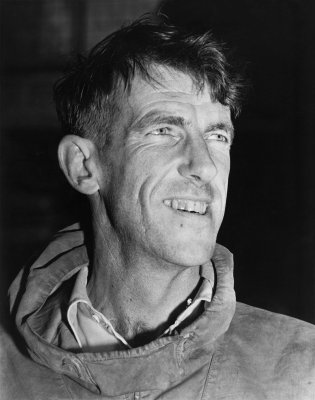
View profile →I think it was a combination of feeling and judgment. I happened to be that sort of person that enjoyed making out plans, but I also enjoy changing plans. On an expedition, although I may start out with a detailed plan, I’m prepared to change it at any moment and completely redo it. So our expeditions turned out to be very adaptable ones. We achieved the final objectives just the same as many other expeditions, but maybe we had more fun in the process because it seemed something we could vary. We still carried on to achieve our major objectives.
Well, then of course, came the disaster in 1975, when my wife and my youngest daughter were flying into the Nepal hills where I was building a hospital and their plane crashed and they were killed. And this certainly, for me, was an absolute disaster, really because the two people that meant most to me in life had been killed in one fell swoop. It did take me quite a number of years to get over it. I found the only way to deal with it was to carry on very energetically, doing the things that we had all been doing together, which was largely building schools and things for the mountain people. Although, people used to say to me, “Time is the great healer,” certainly for the first two years I simply didn’t accept this. But, time was a great healer and after the years passed, the memories still remain. But, I think quite a lot of the pain tends to fade a little bit, and life did become a little bit easier.
I always have, in my expeditions, people who are academically far cleverer than I am, and even technically, far more competent. So if you want to lead an expedition, in a sense, you’ve got to keep ahead of them. These bright, competent characters you have with you who are marvelous to have on the expedition. And I’ve always found you can do that by, each night, when you go to bed, just let your mind dwell on the likely things that may happen next day, and think out carefully the sort of decisions that might be necessary to make in order to have the program carried through. So next day, when something happens, you’re the one that’s thought about it and you’re the one who has the ideas.
I had one experience on the ice-fall with Tenzing. We were actually descending after having been further up the mountain, and it was getting close towards dark so we wanted to get through the ice-fall before darkness fell. We were roped together, but I was rushing down ahead in the lead. About halfway down there was a narrow crevasse. I guess it was about four feet wide, but just a bit too wide to step across. On the lower lip was a great chunk of ice stuck against the ice wall, and we’d used that as sort of a stepping stone to get over the gap. I came rushing down the hill without thinking too carefully. I just leapt in the air and landed on the chunk of ice, whereupon the chunk of ice broke off and dropped into the crevasse with me on top of it. It was interesting how everything seemed to start going slowly, even though I was free-falling into the crevasse. My mind, obviously, was working very quickly indeed. The great chunk of ice started tipping over and I realized, if I wasn’t careful, I’d be crushed between the ice and the wall of the crevasse. So I just sort of bent my knees and leapt in the air. I was still falling, but now I was a couple of feet clear of the chunk of ice. Time really seemed to pass even though I was falling clear, and I realized that unless the rope came tight fairly soon, I would come to a rather sticky end on the bottom of the crevasse. Up top, Tenzing had acted very quickly. He had thrust his ice axe into the snow, whipped the rope around it, and the rope came tight with a twang, and I was stopped and swung in against the ice wall. The great chunk of ice just carried on and smashed to smithereens at the bottom of the crevasse. Then really the rest was what I would have called a routine mountaineering matter. I had my ice axe and my crampons on my feet, so I chipped steps in the side. I was able to bridge the crevasse, and I worked my way up to the top and got safely out. I wouldn’t have said at any stage, because it all happened so quickly, fear really didn’t have much opportunity to emerge. My only idea was to get safely out of this unfortunate predicament. And of course, without Tenzing’s very competent mountaineer’s response, I certainly wouldn’t have made it. But once he had stopped me, then I was able to, using the techniques of mountaineering, to get myself safely to the top again.
I would advise them to aim high. To set their sights at a pretty tough target and don’t be too worried if you’re not successful at first. Just keep persisting and keep improving your standards, getting better and better and ultimately, you’ve got a pretty fair chance at achieving your desired goal. ... But, I do think that virtually everybody that’s born has the ability to be very competent at doing something. I think that, in itself, is worthy of aiming towards, just to be competent at doing anything you particularly wish to do.
I personally wouldn’t be, if I could possibly help it, involved in a serious pursuit in which there weren’t a few people who could laugh a bit about it. Because I can remember many occasions — maybe we’ve been stuck in a tent or we’re up on the side of a mountain, this heavy snow, avalanches all around us, and we can’t get up and we can’t get down, but we just sat in the tent and reminisced about occasions and days gone by and laughed about old jokes and all the rest of it. Then you really have a very good time, even though you’re sort of poised there between disaster both up and down. People who can make you laugh under those circumstances are very valuable indeed in an expedition.
More on craft & work
- What is the worst job you have done? 235 answers
- What do you consider your greatest achievement? 202 answers
- How does a new work begin for you? 75 answers
- What do you do when you feel creatively blocked or stuck? 75 answers
- How do you know when a piece of work is finished? 72 answers
- How much rewriting or revision do you do? 54 answers
Also answered this
Sonia Sotomayor, Mohamed ElBaradei, John Lewis, Bill Clinton, Rosa Parks, Desmond Tutu
Search the directory for somebody in particular.
Explore further
- All craft & work questions
- The How I Work questionnaire — 3 questions from the same format
- Explore the archive — by field, age, era, and subject