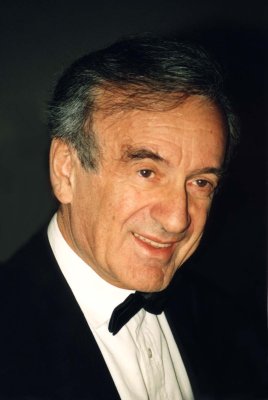
Which book changed the way you think, and what did it change?
Recorded Elie Wiesel said elsewhere, not written here
I remember the awakening that occurred in me when I read, for the first time, Franz Kafka. ... That morning I was happy. I wanted to run out and embrace them, all these garbage collectors, because they taught me that there was another world than the world of Kafka, which is absurd and desperate, and despairing.

Academy of Achievement interview, 29 June 1996 source ↗

Others on this question

View all 25 →
Winston Churchill Prime Minister of the United Kingdom, 1940–1945 and 1951–1955; Member of Parliament 1900–1964
In history I decided to begin with Gibbon. Someone had told me that my father had read Gibbon with delight; that he knew whole pages of it by heart, and that it had greatly affected his style of speech and writing. So without more ado I set out upon the eight volumes of Dean Milman's edition of Gibbon's Decline and Fall of the Roman Empire . I was immediately dominated both by the story and the style. All through the long glistening middle hours of the Indian day, from when we quitted stables till the evening shadows proclaimed the hour of Polo, I devoured Gibbon. I rode triumphantly through it from end to end and enjoyed it all.
Recorded Chapter of his autobiography, written at Chartwell in 1930, Winston S. Churchill, My Early Life (Thornton Butterworth, 1930), Project Gutenberg Canada, October 1930 source ↗
Wendy Kopp Founder of Teach For America; chief executive of Teach For All
The Fountainhead , I think, pretty much saved me in the initial years of Teach For America. I loved that book, but I’m not sure books were the seminal thing that guided my path. ... I think it was sort of about “the creator against the world,” and I was probably feeling at that point that I was up against lots of boulders, to pull off the big idea of Teach For America.
Recorded Academy of Achievement recorded interview, American Academy of Achievement, 17 September 2013 source ↗
Anthony Kennedy Associate Justice of the Supreme Court of the United States, 1988–2018
I think fiction is very important because it gets us into the mind of a person. Hamlet is a tremendous piece of literature. You know Hamlet better than you know most real people. Do you know the reason? Because you know what he’s thinking. And this teaches you that every human has an integrity and an autonomy and a spirituality of his own, of her own, and great literature can teach you that.
Recorded Academy of Achievement recorded interview, American Academy of Achievement, 3 June 2005 source ↗
Rana el Kaliouby Computer scientist; co-founder of Affectiva
the thesis in the book is that computers need to understand human emotions just the way people do. I read the book and I was just fascinated by this idea. I made that my research topic and it became my obsession and it just really changed the trajectory of my life.
Recorded Tim Ferriss, The Tim Ferriss Show podcast, 13 May 2020 source ↗

More from Elie Wiesel

View profile →
Question What are you unwilling to optimise? Values & belief
It went from publisher to publisher to publisher. All of them refused it. They gave the same reasons, until a small publisher picked it up. From 1960 to 1963, three years, it didn’t sell 1500 copies. Nobody wanted to read it. It doesn’t matter. I am not here to sell, I’m here to write.
Recorded Academy of Achievement recorded interview, American Academy of Achievement, 29 June 1996 source ↗
Question Which writers or artists most influenced your work? Taste & recommendation
Well, naturally, my grandfather. He was a Hasid, meaning a member of the Hasidic community, and I loved him, I adored him. So thanks to him, I became a Hasid too. And my mother — who actually continued his tradition — she’s the one who brought me to Hasidic Masters. And all the stories I tell now — I’ve written so many books with Hasidic tales — these are not mine, these are theirs, my mother’s and my grandfather’s. My father taught me how to reason, how to reach my mind. My soul belonged to my grandfather and my mother. They enriched me, of course. They influenced me profoundly, to this day. When I write, I have the feeling, literally, physically, that one of them is behind my back, looking over my shoulder and reading what I’m writing. I’m terribly afraid of their judgment.
Recorded Academy of Achievement interview, Sun Valley, Idaho, 29 June 1996 source ↗
Question What is the hardest thing that has happened to you, and what did you carry out of it? Failure & regret
After the war — I was 15 when I entered the camp, I was 16 when I left it, and all of a sudden you become an orphan and you have no one. I had a little sister and I knew, with my mother the first night, that they were swept away by fire. My older sisters I discovered by accident after the war in Paris, where I was in an orphanage. But to be an orphan — you can become an orphan at 50, you are still an orphan. Very often I think of my father and my mother. At any important moment in my life, they are there, thinking, “What an injustice.”
Recorded Academy of Achievement recorded interview, American Academy of Achievement, 29 June 1996 source ↗

More on taste & recommendation

Also answered this

George H. W. Bush, Wendy Kopp, Desmond Tutu, Winston Churchill, Jimmy Carter, Margaret Thatcher

Search the directory for somebody in particular.

Explore further

Report this answer