What are you most proud of?

Originally asked

Vogue, to one guest at a time, on camera, 73 Questions

Vogue's 73 Questions repeatedly asks respondents to select the work, relationship, or achievement that makes them proudest.

You answer as yourself. Nobody on FLAPSS answers as anybody else.

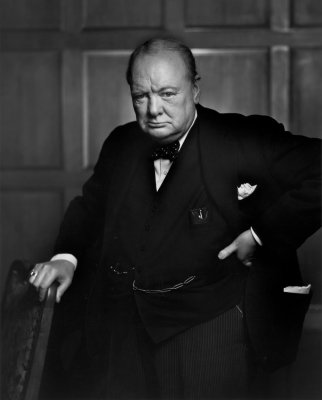
Recorded Winston Churchill said elsewhere, not written here
When I think of the fate of poor old women, so many of whom have no one to look after them and nothing to live on at the end of their lives, I am glad to have had a hand in all that structure of pensions and insurance which no other country can rival and which is especially a help to them.

Chapter of his autobiography, written at Chartwell in 1930, Winston S. Churchill, My Early Life (Thornton Butterworth, 1930), Project Gutenberg Canada, October 1930 source ↗

Others on this question

View all 105 →
Anette Sagen Norwegian former ski jumper and campaigner for women's ski jumping
What I’m most proud of in my ski jumping career is that I helped the sport to get where it is today, with the World Cup, World Championship and the Olympics.
Recorded Written Q&A in the IOC's Athlete Role Model series before Lillehammer 2016, Olympics.com (International Olympic Committee), 2016 source ↗
George H. W. Bush 41st President of the United States, 1989–1993
This may sound like a cliché, but I’ll put it this way. The proudest thing in my life is that my children came home. The proudest moment of my presidency, domestically, was when I signed a piece of civil rights legislation known as the ADA, doing something for the disabled. A massive piece of civil rights legislation that put disabled people, 50 million of them, into the mainstream, or at least removed legal obstacles to their being in the mainstream.
Recorded Academy of Achievement interview, Williamsburg, Virginia, 2 June 1995 source ↗
Dominique Gisin Swiss former World Cup alpine ski racer and Olympic downhill champion
I’m proud, that despite many tough moments, with lots of injuries, I never gave up and made it to the top of an Olympic podium.
Recorded Written Q&A in the IOC's Athlete Role Model series before the Lillehammer 2016 Winter Youth Olympic Games, Olympics.com (International Olympic Committee), 2016 source ↗
Kei May Lau Chair Professor of Electronic and Computer Engineering at HKUST; semiconductor and photonics researcher
I am most proud of the legacy of my students and postdocs. The real triumph, for me, is witnessing the transformation of the individuals who have passed through my lab. They arrive with potential and leave making substantial impacts. Seeing them flourish professionally and contribute meaningfully to our field is, without a doubt, my greatest accomplishment.
Recorded Written Q&A in the journal's Light People series, Light: Science & Applications, 11 March 2024 source ↗

More from Winston Churchill

View profile →
Question When were you happiest? Time & hindsight
But the years 1895 to 1900 which are the staple of this story exceed in vividness, variety and exertion anything I have known—except of course the opening months of the Great War. When I look back upon them I cannot but return my sincere thanks to the high gods for the gift of existence. All the days were good and each day better than the other. Ups and downs, risks and journeys, but always the sense of motion, and the illusion of hope.
Recorded Chapter of his autobiography, written at Chartwell in 1930, Winston S. Churchill, My Early Life (Thornton Butterworth, 1930), Project Gutenberg Canada, October 1930 source ↗
Question What advice would you give your twenty-year-old self, and what should they ignore? Time & hindsight
Come on now all you young men, all over the world. You are needed more than ever now to fill the gap of a generation shorn by the War. You have not an hour to lose. You must take your places in life's fighting line. Twenty to twenty-five! These are the years! Don't be content with things as they are. 'The earth is yours and the fulness thereof'. Enter upon your inheritance, accept your responsibilities. Raise the glorious flags again, advance them upon the new enemies, who constantly gather upon the front of the human army, and have only to be assaulted to be overthrown. Don't take No for an answer. Never submit to failure.
Recorded Chapter of his autobiography, written at Chartwell in 1930, Winston S. Churchill, My Early Life (Thornton Butterworth, 1930), Project Gutenberg Canada, October 1930 source ↗
Question Which book changed the way you think, and what did it change? Taste & recommendation
In history I decided to begin with Gibbon. Someone had told me that my father had read Gibbon with delight; that he knew whole pages of it by heart, and that it had greatly affected his style of speech and writing. So without more ado I set out upon the eight volumes of Dean Milman's edition of Gibbon's Decline and Fall of the Roman Empire . I was immediately dominated both by the story and the style. All through the long glistening middle hours of the Indian day, from when we quitted stables till the evening shadows proclaimed the hour of Polo, I devoured Gibbon. I rode triumphantly through it from end to end and enjoyed it all.
Recorded Chapter of his autobiography, written at Chartwell in 1930, Winston S. Churchill, My Early Life (Thornton Butterworth, 1930), Project Gutenberg Canada, October 1930 source ↗
Question What is an unusual habit or an absurd thing that you love? Daily life
Until this time I had never been able to drink whisky. I disliked the flavour intensely. I could not understand how so many of my brother officers were so often calling for a whisky and soda. I liked wine, both red and white, and especially champagne; and on very special occasions I could even drink a small glass of brandy. But this smoky-tasting whisky I had never been able to face. ... Once one got the knack of it, the very repulsion from the flavour developed an attraction of its own; and to this day, although I have always practised true temperance, I have never shrunk when occasion warranted it from the main basic standing refreshment of the white officer in the East.
Recorded Chapter of his autobiography, written at Chartwell in 1930, Winston S. Churchill, My Early Life (Thornton Butterworth, 1930), Project Gutenberg Canada, October 1930 source ↗
Question What is your favourite side project? Craft & work
Painting is complete as a distraction. I know of nothing which, without exhausting the body, more entirely absorbs the mind. Whatever the worries of the hour or the threats of the future, once the picture has begun to flow along, there is no room for them in the mental screen. They pass out into shadow and darkness. All one's mental light, such as it is, becomes concentrated on the task. Time stands respectfully aside, and it is only after many hesitations that luncheon knocks gruffly at the door.
Recorded Essay first published in the Strand Magazine in 1921–22 and collected in Amid These Storms, 1932, Winston S. Churchill, Painting as a Pastime, Project Gutenberg Canada, 1932 source ↗
Question What inspires you to learn? Attention & the world
At this school I was allowed to learn things which interested me: French, History, lots of Poetry by heart, and above all Riding and Swimming. The impression of those years makes a pleasant picture in my mind, in strong contrast to my earlier schoolday memories.
Recorded Chapter of his autobiography, written at Chartwell in 1930, Winston S. Churchill, My Early Life (Thornton Butterworth, 1930), Project Gutenberg Canada, October 1930 source ↗

More on identity & self

Also answered this

David Boies, Ronald Reagan, Norman Schwarzkopf, Cristina Duarte, Ruth Bader Ginsburg, Ellen Johnson Sirleaf

Search the directory for somebody in particular.

Explore further

Report this answer