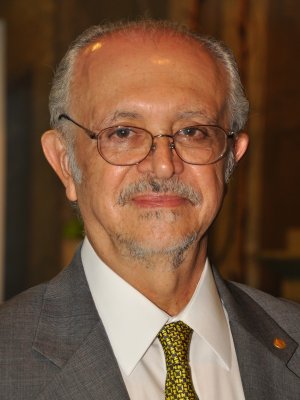
One of the saints in my life is this woman named Imogene Hill, who was a fourth-grade teacher who taught this advanced class. She got hip to my whole situation in about a month and kindled a passion in me for learning things. I learned more that year than I think I learned in any year in school.
Originally asked
Vox, to writers and thinkers, 9 Questions, 2017
This exact prompt is one of Vox's nine recurring questions about intellectual habits.
You answer as yourself. Nobody on FLAPSS answers as anybody else.
Laureate-written autobiography, provided by the laureate in November 2007, Nobel Prize Outreach, 1 November 2007 source ↗
Others on this question
View all 8 →At this school I was allowed to learn things which interested me: French, History, lots of Poetry by heart, and above all Riding and Swimming. The impression of those years makes a pleasant picture in my mind, in strong contrast to my earlier schoolday memories.
Ultimately, it’s a man who was teaching us English Literature in what we call matricula, the last 2 years of high school. He really was quite extraordinary. When he spoke of a Shakespearean play, you almost thought that he grew up with Shakespeare! He was very good, yes. A black guy who was fantastic and gave us a deep love for literature.
I got very interested in so-called “knockout mouse” technology. Knockout mouse is a way to study the function of genes. You know, both human and mouse have approximately 20,000 genes. With knockout mouse technology, we can select one gene out of those 20,000 genes, and completely destroy that one particular gene so that we can understand the function of that particular gene. I got very interested in that technology. It was 1992 or 1993 when I graduated from my Ph.D. school. So I decided to study — I decided to learn about knockout mouse technology. But at that time in Japan, only a few scientists were working on knockout mouse technology. That’s why I decided to move to the States, San Francisco
More from Mario Molina
View profile →For me, it was just a thrill. I just remember thinking at that time, this is the sort of thing I would like to do, if I could. I did not come from a family of scientists. My father was a lawyer, my older brother was a lawyer.
It was probably a series of biographies of scientists like Pasteur, or even earlier ones — Leeuwenhoek inventing the microscope and Madame Curie. I forget how many others, but it was really just, for me, a fascination to learn about these great heroes. At that time, of course, they were totally inaccessible, almost non-human, to me. It became very interesting to me.
I then converted a bathroom, seldom used by the family, into a laboratory and spent hours playing with chemistry sets. With the help of an aunt, Esther Molina, who was a chemist, I continued with more challenging experiments along the lines of those carried out by freshman chemistry students in college.
It’s easy to try to exaggerate the problems just to get more attention. So for me, it was very clear that the best way to deal with that was to do the best science that I was capable of doing.
The advice that I would give is try to find something that you like. Try to devote your energies to being very good at it. Try to achieve excellence. Don’t necessarily have as a goal success or getting prizes or whatever, but just doing very good work. And work hard. Keep working at it. Be patient. Realize that you don’t always see the benefits of what you’re doing, short-term. But in the end, the activities that I do, for example, scientific research, can be extremely rewarding. It’s really a very fascinating career.
Although my years at Irvine were very productive, I missed not doing experiments myself because of the many responsibilities associated with a faculty position: teaching courses, supervising graduate students, meetings, etc. After spending seven years at Irvine as Assistant and then Associate Professor, I decided to move to a non-academic position. I joined the Molecular Physics and Chemistry Section at the Jet Propulsion Laboratory in 1982. I had a smaller group – only a few postdoctoral fellows – but I also had the luxury of conducting experiments with my own hands, which I enjoyed very much.
More on attention & the world
Also answered this
Richard Feynman, Christiane Nüsslein-Volhard, Shinya Yamanaka, Winston Churchill, Steve Jobs, John Lewis
Search the directory for somebody in particular.
Explore further
- All attention & the world questions
- The 9 Questions questionnaire — 5 questions from the same format
- Explore the archive — by field, age, era, and subject