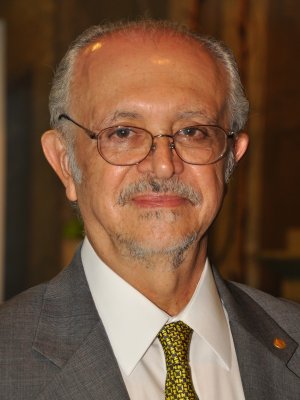
What is the biggest obstacle you have faced professionally?

Originally asked

The American Academy of Achievement, to its honourees, its oral-history interviews

The Academy of Achievement repeatedly asks honorees to identify a major professional obstacle or challenge and describe confronting it.

You answer as yourself. Nobody on FLAPSS answers as anybody else.

Recorded Mario Molina said elsewhere, not written here
In terms of this issue of these industrial gases affecting the environment, at the beginning the road was not easy, because we were suggesting that society had to change, that industries had to do something different than they were doing at that time. And of course, initially we did not meet with a good reception to these ideas from industry. And even from the scientific community — even though our ideas were well received in the small group of specialists in what we were doing — it was not necessarily well received by the scientific community at large. So we really had to continue doing as good a science as we could, and at the same time trying to well communicate our conviction that it was something important, something that had to change in the way society was functioning.

Academy of Achievement interview, Sun Valley, Idaho, 29 June 1996 source ↗

Others on this question

View all 23 →
Bill Clinton 42nd President of the United States, 1993–2001
I do think my mother had a lot to do with that. I mean, after all, you know her — it was not near as bad as having your husband die in a car wreck after — he survives World War II. They had a great life planned, and he gets killed in a car wreck, not because of a concussion, but because in a fluke, the tire blows out on his car. He’s thrown out of the car. He lands in a ditch in a field, and the ditch is full of water, and he can’t get out of the ditch before he drowns. There’s — it made it look a little whiny for me to be all bent out of shape about losing an election, and I realized that it was a weird deal. It was 1980. It was Reagan’s election. It was a period not unlike now, widespread resentment over the stagnant economy, the Iran hostage crisis, and I bet I had a hundred people coming to — I’m not exaggerating — coming to me and saying, “God, Bill, I didn’t know you were going to lose. I just voted against you to because I didn’t like some of the things you’d done.” And I remember once — one of the funniest things that ever happened to me. I was driving over to see my mother. I lived in Little Rock, and she lived in Hot Springs 50 miles away, and in the middle of the trip was a little country store owned by a guy who ran the elections in that area and was real smart, so I went in to get a Coke, and started talking to him. And this little boy came up to me in overalls, and he said, “You’re Bill Clinton, aren’t you?” I said, “Yes.” He said, “I helped to beat you. I cost you 11 votes, and it was no accident.” I said, “You did?” He said, “Yeah.” He said, “It was me, my wife, our two boys and their wives, and five of my friends. We just decked you.” I said, “Why’d you do it?” He said, “I had to because you raised my car tax. The car license.” And so we’re standing on the interstate. I said, “Look over there. You remember when I was governor? That highway broke wide open, and even big trucks were off in the ditch, and I had to send the National Guard down here to clean it up, and we had to fix it.” He said, “Yeah, I remember. I don’t care. I still didn’t want to pay it.” So I was laughing at the guy, and I said, “Let me ask you something.” I said, “If I ever ran again, would you vote for me?” He said, “Absolutely.” I said, “You would?” He said, “Sure. We’re even now.” And I went — and there were no cell phones, so I had a dime. I went and put it in the payphone, and I called Hillary, and I said, “You know, I’m not dead yet. We might have to run again.
Recorded Academy of Achievement interview source ↗
Sundar Pichai Chief executive of Alphabet and Google
The second filter is to gravitate towards working on hard things. I’d love to tell you I was an immediate success after leaving Stanford… I wasn’t. Even a decade later, I felt like I wasn’t on the right path, and it took me a while to find my footing. Until I applied to Google. I had my final interview there in 2004, it was April Fool’s Day and the day Gmail launched. So when my interviewers asked me about it, I wasn’t sure if it was a joke or a real product. That’s because at the time, one gigabyte of free storage for everyone felt super ambitious, and almost impossible. A couple years into the job, I got my chance to work on a seemingly impossible problem, too. It was around this time that the internet was moving into a new phase. The web was evolving from simple web pages to rich applications. There was a group of us that felt we could reimagine the browser to be much better and faster, and we had an early prototype that we thought was pretty good. Internally there was a consensus that building a browser would be incredibly difficult, requiring hundreds of engineers; we had a group of about ten. The consensus was right. It was going to be really hard. In some ways we were naive, and it's good to be a bit irrational when you approach new things. And in 2008, we launched what we thought was a great browser. We had eight million users in the first twenty-four hours, and the reviews were really positive. And then user growth stagnated. After a year, we had around two percent share. I remember Steve Ballmer, the CEO of Microsoft, made fun of Chrome in an interview and called it a rounding error. It could have been demoralizing. But with that California optimism, I told the team that the fact he went out of his way to dismiss us meant we were doing something right. We kept going, setting highly aggressive stretch goals to keep the team pushing. We rapidly iterated, shipping the browser every six weeks while others shipped one maybe every six months to a year. Success began to follow. Working on hard things has taught me a lot: It typically attracts other great and optimistic people. And even if you miss meeting the high goals you set, you’ll still achieve something great. So when you have the choice to work on something hard — say yes. Do what excites you
Recorded Stanford University Commencement, Google (The Keyword), 14 June 2026 source ↗
David Herbert Donald, Ph.D. Historian; twice winner of the Pulitzer Prize for Biography
I have generally had few setbacks and few obstacles. I have been very fortunate in that things have been handed to me rather than my going out after them. There are a few roads that I didn’t take that I maybe could have. When I was a graduate student, maybe a second-year graduate student, I worked frequently at the Illinois State Library in Springfield, and one day, the director of that library called me into his office and said, “I have some news to tell you that is still very hush-hush, but I’m resigning from this job. I’m going to the Chicago Historical Society, and I’m going to recommend that you be appointed in my place.
Recorded Academy of Achievement, Academy of Achievement interview, Cambridge, Massachusetts, 1 April 2005 source ↗
John M. Martinis Physicist; Nobel laureate in Physics, 2025
I would say there are many challenges, and that's kind of what's hard about it. And my particular thesis, since leaving Google and doing my own company, is that building a quantum computer is a little bit harder than the scientists think about because of the system engineering. Building a powerful computer is hard. So what we're particularly working on is the manufacturing of qubits and doing that much better than what people are doing right now. I really enjoyed being in academia, and even at Google working on that. But I really enjoy right now trying to think very practically about what we have to do to get this to work. And what kind of people we have to collaborate with in order to put all the pieces together and build a quantum computer in a cost effective, economic way that makes business sense.
Recorded Adam Smith, Telephone interview recorded shortly after the prize announcement, October 2025, Nobel Prize Outreach, 1 October 2025 source ↗

More from Mario Molina

View profile →
Question What inspires you to learn? Attention & the world
I have also benefited from teaching; as I try to explain my views to students with critical and open minds, I find myself continually being challenged to go back and rethink ideas. I now see teaching and research as complementary, mutually reinforcing activities.
Recorded Laureate-written autobiography, provided by the laureate in November 2007, Nobel Prize Outreach, 1 November 2007 source ↗
Question How has a failure, or apparent failure, set you up for later success? Do you have a favourite failure? Failure & regret
At first the research did not seem to be particularly interesting – I carried out a systematic search for processes that might destroy the CFCs in the lower atmosphere, but nothing appeared to affect them. We knew, however, that they would eventually drift to sufficiently high altitudes to be destroyed by solar radiation. The question was not only what destroys them, but more importantly, what the consequences are.
Recorded Laureate-written autobiography, provided by the laureate in November 2007, Nobel Prize Outreach, 1 November 2007 source ↗

More on craft & work

Also answered this

Richard Feynman, Katalin Karikó, Jocelyn Bell Burnell, John Clauser, John M. Martinis, Shinya Yamanaka

Search the directory for somebody in particular.

Explore further

Report this answer