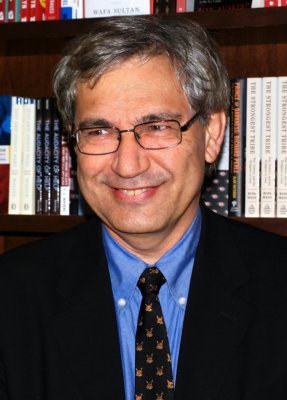
What is the part of your job that people would be surprised is most of your job?
Recorded Orhan Pamuk said elsewhere, not written here
As I sit at my table, for days, months, years, slowly adding new words to the empty page, I feel as if I am creating a new world, as if I am bringing into being that other person inside me, in the same way someone might build a bridge or a dome, stone by stone. The stones we writers use are words. As we hold them in our hands, sensing the ways in which each of them is connected to the others, looking at them sometimes from afar, sometimes almost caressing them with our fingers and the tips of our pens, weighing them, moving them around, year in and year out, patiently and hopefully, we create new worlds. The writer’s secret is not inspiration – for it is never clear where it comes from – it is his stubbornness, his patience. That lovely Turkish saying – to dig a well with a needle – seems to me to have been said with writers in mind.

Swedish Academy, Stockholm, 7 December 2006, The Nobel Foundation (nobelprize.org), 7 December 2006 source ↗

Others on this question

View all 41 →
August Wilson Playwright; two Pulitzer Prizes for Drama
And I acted when the actors didn’t show up. As the director, I knew all the lines and I took over more times than I wanted to. I didn’t know much about directing, but I was the only one willing to do it. Someone had looked around and said, “Who’s going to be the director?” I said, “I will.” I said that because I knew my way around the library. So I went to look for a book on how to direct a play. I found one called The Fundamentals of Play Directing and checked it out. I didn’t understand anything in it. It was all about form and mass and balance. I flipped through the book and there in Appendix A I discovered what to do on the first day of rehearsal. It said, “Read the play.” So I went to the first rehearsal very confidently and I said, “Okay, this is what we’re going to do. We’re going to read the play.” We did that. Now what? I hadn’t got to Appendix B. So I said, “Let’s read the play again.” That night I went back to the book and sort of figured out what to do from that point on.
Recorded Bonnie Lyons and George Plimpton, Interview conducted over lunch at the Sheraton Hotel’s Fourteenth Street Bar, Atlanta, The Paris Review, Issue 153, Winter 1999, 1999 source ↗
Li Na Chinese professional tennis player, 1999–2014
After four knee surgeries and hundreds of shots injected into my knee weekly to alleviate swelling and pain, my body is begging me to stop the pounding. My previous three surgeries were on my right knee. My most recent knee surgery took place this July and was on my left knee.
Recorded Open letter, 'My dear friends', WTA (archived), 19 September 2014 source ↗
Lynsey Addario Photojournalist and war photographer; Pulitzer Prize winner, 2009
For a photographer — it’s like actually taking a picture is like five percent of what I do. And the rest is research, reading, contact, setting things up, making contact, getting access, making people feel comfortable, doing the reporting, doing the interviews, getting the captions. It’s not getting there physically, the logistics on the ground. I mean, literally, taking a picture is the easiest part of my job.
Recorded Academy of Achievement recorded interview, American Academy of Achievement, 21 October 2017 source ↗
Mario Molina Atmospheric chemist; Nobel laureate in Chemistry, 1995
Although my years at Irvine were very productive, I missed not doing experiments myself because of the many responsibilities associated with a faculty position: teaching courses, supervising graduate students, meetings, etc. After spending seven years at Irvine as Assistant and then Associate Professor, I decided to move to a non-academic position. I joined the Molecular Physics and Chemistry Section at the Jet Propulsion Laboratory in 1982. I had a smaller group – only a few postdoctoral fellows – but I also had the luxury of conducting experiments with my own hands, which I enjoyed very much.
Recorded Laureate-written autobiography, provided by the laureate in November 2007, Nobel Prize Outreach, 1 November 2007 source ↗

More from Orhan Pamuk

View profile →
Question Whose work makes you jealous? Craft & work
Actually I was angry at my father because he had not led a life like mine, because he had never quarrelled with his life, and had spent his life happily laughing with his friends and his loved ones. But part of me knew that I could also say that I was not so much ‘angry’ as ‘jealous’, that the second word was more accurate, and this, too, made me uneasy.
Recorded Swedish Academy, Stockholm, 7 December 2006, The Nobel Foundation (nobelprize.org), 7 December 2006 source ↗
Question What is the thing you are best at that nobody watching can see? Craft & work
For me, to be a writer is to acknowledge the secret wounds that we carry inside us, the wounds so secret that we ourselves are barely aware of them, and to patiently explore them, know them, illuminate them, to own these pains and wounds, and to make them a conscious part of our spirits and our writing. A writer talks of things that everyone knows but does not know they know.
Recorded Swedish Academy, Stockholm, 7 December 2006, The Nobel Foundation (nobelprize.org), 7 December 2006 source ↗

More on craft & work

Also answered this

Bong Joon-ho, Nick Cave, August Wilson, Twyla Tharp, Marjane Satrapi, Suzan-Lori Parks

Search the directory for somebody in particular.

Explore further

Report this answer