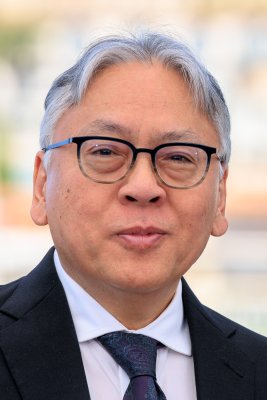
What is the part of your job that people would be surprised is most of your job?
Recorded Kazuo Ishiguro said elsewhere, not written here
I’ve been emphasising here the small and the private, because essentially that’s what my work is about. One person writing in a quiet room, trying to connect with another person, reading in another quiet – or maybe not so quiet – room. Stories can entertain, sometimes teach or argue a point. But for me the essential thing is that they communicate feelings. That they appeal to what we share as human beings across our borders and divides. There are large glamorous industries around stories; the book industry, the movie industry, the television industry, the theatre industry. But in the end, stories are about one person saying to another: This is the way it feels to me. Can you understand what I’m saying? Does it also feel this way to you?

Swedish Academy, Stockholm, 7 December 2017, The Nobel Foundation (nobelprize.org), 7 December 2017 source ↗

Others on this question

View all 41 →
Barbara Jordan U.S. Representative from Texas, 1973–1979; Texas State Senator 1967–1973
And now, what are those of us who are elected public officials supposed to do? We call ourselves "public servants" but I'll tell you this: We as public servants must set an example for the rest of the nation. It is hypocritical for the public official to admonish and exhort the people to uphold the common good if we are derelict in upholding the common good. More is required -- More is required of public officials than slogans and handshakes and press releases. More is required. We must hold ourselves strictly accountable. We must provide the people with a vision of the future.
Recorded Democratic National Convention, Madison Square Garden, New York, AmericanRhetoric.com, 12 July 1976 source ↗
Li Na Chinese professional tennis player, 1999–2014
After four knee surgeries and hundreds of shots injected into my knee weekly to alleviate swelling and pain, my body is begging me to stop the pounding. My previous three surgeries were on my right knee. My most recent knee surgery took place this July and was on my left knee.
Recorded Open letter, 'My dear friends', WTA (archived), 19 September 2014 source ↗
Marjane Satrapi Graphic novelist, cartoonist and film director
Now my job is to defend everybody. But I don’t mind. Because I travel, and I like to talk to people and really listen to them. And I have no prejudices. I figured out a long time ago that, whatever I think I know, I don’t know anything. Once I realized that, I really started learning. That’s a great strength: I know that I don’t know.
Recorded Joshuah Bearman, A brasserie near her studio, Paris, The Believer, Issue 36, 1 August 2006 source ↗
Tim Cook Chief executive of Apple
In every way at every turn, the question we ask ourselves is not what can we do, but what should we do?.”
Recorded Duke University Commencement, Duke Today, 13 May 2018 source ↗

More from Kazuo Ishiguro

View profile →
Question Which writers or artists most influenced your work? Taste & recommendation
I always suspected that she was the biggest influence on me. It seems unlikely, but I always suspected that. I used to say that in interviews, and people would think I was just being smart and evasive. But I reread Jane Eyre recently, and also Villette , her other great novel. I just came across episode after episode where I thought “Oh my goodness, I just ripped that off from this book!” Perhaps you wouldn’t recognize it, but I did. Certain kinds of techniques, certain moments when you understand that the narrator is crying, not because she tells you, but because somebody watching her makes a remark. All these little things that I thought, “Oh, I used that in that book,” or “Oh, that trick.” I think Charlotte Brontë had an enormous influence on me, and I think it’s something to do with that use of first-person and the evasiveness, the indirectness, of her first-person narrative. I mean this phrase, “the unreliable narrator,” has become very popular in creative writing. So it’s not quite that, but a very subtle use of the relationship between the writer and the book and the reader — something I tuned in on, I homed in on instantly, when I started to read Charlotte Brontë. But I’ll tell you, my favorite author — novelist — is somebody who you probably wouldn’t think had any relationship to me, which is Dostoyevsky. I’ve always loved Dostoyevsky, ever since I first read him. I think he’s one of the reasons I started to read, you know, when I read Crime and Punishment when I was about 17 or 18. Dostoyevsky and Chekhov for me remain like two poles in terms of a way to approach things. I love the messiness of Dostoyevsky, the improvised — I mean a lot of it is a mess, but I like the way that strange, unexpected things have obviously come tumbling out of him that he didn’t want to necessarily have come tumbling out. On the other hand, you know, Chekhov, another great Russian writer, exemplifies the calm, controlled, very carefully structured, understated kind of work. I aspire to them both. They’re two of my great heroes.
Recorded Academy of Achievement interview, London, England, 18 October 2017 source ↗
Question How do you know when a piece of work is finished? Craft & work
It’s funny you say that because I never have this moment when I feel, “Ah, I’ve finished!” I watch footballers at the end of the match, you know, the whistle goes and they’ve won or lost. Until then they’ve been giving everything and at that moment they know it’s over. It’s funny for an author. There’s never a finishing whistle. It’s not very spectacular.
Recorded The Talks, 14 October 2015 source ↗

More on craft & work

Also answered this

Bong Joon-ho, Suzan-Lori Parks, Haruki Murakami, Marjane Satrapi, Tom Stoppard, Sarah Waters

Search the directory for somebody in particular.

Explore further

Report this answer