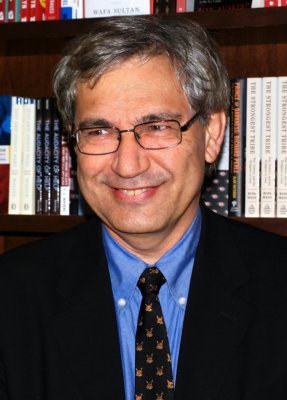
What is the thing you are best at that nobody watching can see?
Recorded Orhan Pamuk said elsewhere, not written here
For me, to be a writer is to acknowledge the secret wounds that we carry inside us, the wounds so secret that we ourselves are barely aware of them, and to patiently explore them, know them, illuminate them, to own these pains and wounds, and to make them a conscious part of our spirits and our writing. A writer talks of things that everyone knows but does not know they know.

Swedish Academy, Stockholm, 7 December 2006, The Nobel Foundation (nobelprize.org), 7 December 2006 source ↗

Others on this question

View all 26 →
Barack Obama 44th President of the United States, 2009–2017; United States Senator from Illinois 2005–2008
And finally, change requires more than just speaking out -- it requires listening, as well. In particular, it requires listening to those with whom you disagree, and being prepared to compromise. When I was a state senator, I helped pass Illinois's first racial profiling law, and one of the first laws in the nation requiring the videotaping of confessions in capital cases. And we were successful because, early on, I engaged law enforcement.
Recorded Howard University, Washington, D.C., The White House (Obama administration archive), 7 May 2016 source ↗
Brian Eno Composer, record producer and visual artist
I find that you’re a completely different person as a maker than you are as a listener. That’s one of the reasons I so often leave the studio to listen to things. A lot of people never leave the studio when they’re making something, so they’re always in that maker mode, screwdriving things in - adding, adding, adding. Because it seems like the right thing to be doing in that room. But it’s when you come out that you start to hear what you like.
Recorded Pitchfork, Eno's London studio, February 2017, Pitchfork, reproduced in the More Dark Than Shark archive, 1 February 2017 source ↗
Bill Clinton 42nd President of the United States, 1993–2001
Well, it wasn’t a game to me. We were taught, interestingly enough, given the current state of political affairs, that you should try not to hate anyone, that hatred was a sickness and a weakness, and that there were very few people who were completely evil, so you should go out of your way to figure out what makes them tick and see if you can find some way to communicate with them. I learned that more with my family — even before I was old enough to know what I was doing —when I was eating meals, my grandmother’s brother and his family had — they had four kids, and they always fed a lot of people, and we ate there a lot, and they would talk about whatever had happened that week. And the kids could talk, but they had to prove they could listen first, so before I could tell a story I had to recount what I had just heard, because if you weren’t listening, nobody wanted to listen to you. And it was like a primer in human nature, and I was fortunate in having people all along the way who tried to help explain other people to me, and I developed an obsessive interest in doing it.
Recorded Academy of Achievement interview source ↗
Tanni Grey-Thompson British wheelchair racer, 1988–2007; member of the House of Lords
I love training. It's not just about the competing. I had an amount of natural talent – you need that to go so far – but, actually, what I had, I think, is an ability to make myself work hard, to do the things I didn't like doing, to do the things that I wasn't so good at.
Recorded Oral history interview, People's Collection Wales, 1 January 2015 source ↗

More from Orhan Pamuk

View profile →
Question Whose work makes you jealous? Craft & work
Actually I was angry at my father because he had not led a life like mine, because he had never quarrelled with his life, and had spent his life happily laughing with his friends and his loved ones. But part of me knew that I could also say that I was not so much ‘angry’ as ‘jealous’, that the second word was more accurate, and this, too, made me uneasy.
Recorded Swedish Academy, Stockholm, 7 December 2006, The Nobel Foundation (nobelprize.org), 7 December 2006 source ↗
Question What is the part of your job that people would be surprised is most of your job? Craft & work
As I sit at my table, for days, months, years, slowly adding new words to the empty page, I feel as if I am creating a new world, as if I am bringing into being that other person inside me, in the same way someone might build a bridge or a dome, stone by stone. The stones we writers use are words. As we hold them in our hands, sensing the ways in which each of them is connected to the others, looking at them sometimes from afar, sometimes almost caressing them with our fingers and the tips of our pens, weighing them, moving them around, year in and year out, patiently and hopefully, we create new worlds. The writer’s secret is not inspiration – for it is never clear where it comes from – it is his stubbornness, his patience. That lovely Turkish saying – to dig a well with a needle – seems to me to have been said with writers in mind.
Recorded Swedish Academy, Stockholm, 7 December 2006, The Nobel Foundation (nobelprize.org), 7 December 2006 source ↗

More on craft & work

Also answered this

Elmore Leonard, Athol Fugard, Tom Stoppard, Haruki Murakami, Tenley Albright, Terence Tao

Search the directory for somebody in particular.

Explore further

Report this answer