When you feel overwhelmed or unfocused, what do you do?
Recorded Winston Churchill said elsewhere, not written here
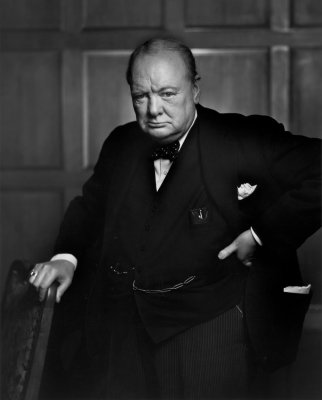
You cannot tell from appearances how things will go. Sometimes imagination makes things out far worse than they are; yet without imagination not much can be done. Those people who are imaginative see many more dangers than perhaps exist; certainly many more than will happen; but then they must also pray to be given that extra courage to carry this far-reaching imagination.

Harrow School, International Churchill Society, 29 October 1941 source ↗

Others on this question

View all 22 →
Ahmed Zewail Chemist; Nobel laureate in Chemistry, 1999
Arriving in the States, I had the feeling of being thrown into an ocean. The ocean was full of knowledge, culture, and opportunities, and the choice was clear: I could either learn to swim or sink. The culture was foreign, the language was difficult, but my hopes were high. I did not speak or write English fluently, and I did not know much about western culture in general, or American culture in particular.
Recorded Laureate-written autobiography for Les Prix Nobel, Nobel Prize Outreach, 1 December 1999 source ↗
Chris Hoy British track cyclist, 1994–2013
The real problem is that the pain actually gets worse. You have created massive acidosis in your muscles so there is a huge quantity of hydrogen ions and the pH in your blood changes. For 15 minutes you lie there thinking, "God, this is really bad. I'm going to die. It has never been this bad before." And every time you think exactly the same thing. You have to lie to yourself by saying you're not doing a second set. Then, without moving for 15 minutes, almost to the second, I would roll over and think, "OK, I think I can do a second set now." During those sessions I have never felt more alive or so close to death.
Recorded Cyclist, 1 January 2018 source ↗
Don’t panic. Midway through writing a novel, I have regularly experienced moments of bowel-curdling terror, as I contemplate the drivel on the screen before me and see beyond it, in quick succession, the derisive reviews, the friends’ embarrassment, the failing career, the dwindling income, the repossessed house, the divorce . . . Working doggedly on through crises like these, however, has always got me there in the end. Leaving the desk for a while can help. Talking the problem through can help me recall what I was trying to achieve before I got stuck. Going for a long walk almost always gets me thinking about my manuscript in a slightly new way.
Recorded The Guardian Review, 20 February 2010 source ↗
Hilary Mantel Novelist and critic
If you get stuck, get away from your desk. Take a walk, take a bath, go to sleep, make a pie, draw, listen to ­music, meditate, exercise; whatever you do, don’t just stick there scowling at the problem. But don’t make telephone calls or go to a party; if you do, other people’s words will pour in where your lost words should be. Open a gap for them, create a space. Be patient.
Recorded The Guardian Review, 20 February 2010 source ↗

More from Winston Churchill

View profile →
Question What inspires you to learn? Attention & the world
At this school I was allowed to learn things which interested me: French, History, lots of Poetry by heart, and above all Riding and Swimming. The impression of those years makes a pleasant picture in my mind, in strong contrast to my earlier schoolday memories.
Recorded Chapter of his autobiography, written at Chartwell in 1930, Winston S. Churchill, My Early Life (Thornton Butterworth, 1930), Project Gutenberg Canada, October 1930 source ↗
Question Which book changed the way you think, and what did it change? Taste & recommendation
In history I decided to begin with Gibbon. Someone had told me that my father had read Gibbon with delight; that he knew whole pages of it by heart, and that it had greatly affected his style of speech and writing. So without more ado I set out upon the eight volumes of Dean Milman's edition of Gibbon's Decline and Fall of the Roman Empire . I was immediately dominated both by the story and the style. All through the long glistening middle hours of the Indian day, from when we quitted stables till the evening shadows proclaimed the hour of Polo, I devoured Gibbon. I rode triumphantly through it from end to end and enjoyed it all.
Recorded Chapter of his autobiography, written at Chartwell in 1930, Winston S. Churchill, My Early Life (Thornton Butterworth, 1930), Project Gutenberg Canada, October 1930 source ↗
Question How does a new work begin for you? Craft & work
Having bought the colours, an easel, and a canvas, the next step was to begin. But what a step to take! The palette gleamed with beads of colour; fair and white rose the canvas; the empty brush hung poised, heavy with destiny, irresolute in the air. My hand seemed arrested by a silent veto.
Recorded Essay first published in the Strand Magazine in 1921–22 and collected in Amid These Storms, 1932, Winston S. Churchill, Painting as a Pastime, Project Gutenberg Canada, 1932 source ↗
Question What scares you about getting older? Time & hindsight
One by one the more vigorous sports and exacting games fall away. Exceptional exertions are purchased only by a more pronounced and more prolonged fatigue. Muscles may relax, and feet and hands slow down; the nerve of youth and manhood may become less trusty. But painting is a friend who makes no undue demands, excites to no exhausting pursuits, keeps faithful pace even with feeble steps, and holds her canvas as a screen between us and the envious eyes of Time or the surly advance of Decrepitude. Happy are the painters, for they shall not be lonely.
Recorded Essay first published in the Strand Magazine in 1921–22 and collected in Amid These Storms, 1932, Winston S. Churchill, Painting as a Pastime, Project Gutenberg Canada, 1932 source ↗
Question How close have you come to death? Death & what remains
But in a flash there came across me a great project. The chine which the bridge spanned was full of young fir trees. Their slender tops reached to the level of the footway. 'Would it not' I asked myself 'be possible to leap on to one of them and slip down the pole-like stem, breaking off each tier of branches as one descended, until the fall was broken?' I looked at it. I computed it. I meditated. Meanwhile I climbed over the balustrade. My young pursuers stood wonder-struck at either end of the bridge. To plunge or not to plunge, that was the question! In a second I had plunged, throwing out my arms to embrace the summit of the fir tree. The argument was correct; the data were absolutely wrong. It was three days before I regained consciousness and more than three months before I crawled from my bed. The measured fall was 29 feet on to hard ground. But no doubt the branches helped.
Recorded Chapter of his autobiography, written at Chartwell in 1930, Winston S. Churchill, My Early Life (Thornton Butterworth, 1930), Project Gutenberg Canada, October 1930 source ↗
Question What single thing would improve the quality of your life? Daily life
The cultivation of a hobby and new forms of interest is therefore a policy of first importance to a public man. But this is not a business that can be undertaken in a day or swiftly improvised by a mere command of the will. The growth of alternative mental interests is a long process. The seeds must be carefully chosen; they must fall on good ground; they must be sedulously tended, if the vivifying fruits are to be at hand when needed. To be really happy and really safe, one ought to have at least two or three hobbies, and they must all be real.
Recorded Essay first published in the Strand Magazine in 1921–22 and collected in Amid These Storms, 1932, Winston S. Churchill, Painting as a Pastime, Project Gutenberg Canada, 1932 source ↗

More on daily life

Also answered this

Mohamed ElBaradei, Jacinda Ardern, Václav Havel, Albie Sachs, Jeanette Winterson, Neil Gaiman

Search the directory for somebody in particular.

Explore further

Report this answer