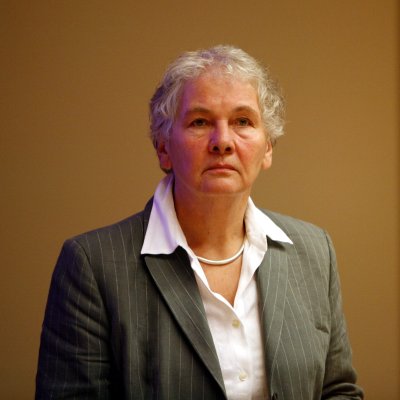
What inspires you to learn?

Originally asked

Vox, to writers and thinkers, 9 Questions, 2017

This exact prompt is one of Vox's nine recurring questions about intellectual habits.

You answer as yourself. Nobody on FLAPSS answers as anybody else.

Recorded Christiane Nüsslein-Volhard said elsewhere, not written here
I think a very big curiosity. I’m very curious and I like to understand things and not only science but also other things where I just try to find out why things work or how things work. Science and nature caught my attention as a small child already. I was growing up in a city but we had a garden and I loved the garden and then often on vacation I was at a farm and I loved these animals and plants and so on, so I was attracted very early on and then we had a very good teaching actually at my … I don’t know whether my teachers really had much of a role because I was determined very early, but then I also did music and I did languages and Literature and so on. I have broad interests actually other than science, but this is really true, this curiosity.

Marika Griehsel, Interview at the 53rd Lindau Nobel Laureate Meeting, 30 June–4 July 2003, Nobel Prize Outreach, 1 July 2003 source ↗

Others on this question

View all 21 →
Hiroshi Mikitani Founder, chairman and chief executive of Rakuten
My answer may have surprised some in attendance at the meeting: I don’t have a role model or sensei. Or to be more precise, I don’t have a single teacher. Instead, I take it upon myself to learn from everyone around me. If we open our eyes, we may find that everyone can be our teacher.
Recorded staff meeting, LinkedIn, 27 May 2022 source ↗
Desmond Tutu Anglican Archbishop of Cape Town; chair of South Africa’s Truth and Reconciliation Commission; Nobel Peace Prize, 1984
Ultimately, it’s a man who was teaching us English Literature in what we call matricula, the last 2 years of high school. He really was quite extraordinary. When he spoke of a Shakespearean play, you almost thought that he grew up with Shakespeare! He was very good, yes. A black guy who was fantastic and gave us a deep love for literature.
Recorded Academy of Achievement interview source ↗
David Vélez Co-founder and chief executive of Nubank
I wish I knew more about Clojure, which is the programming language we use most at Nubank. If I did, I could better understand some of the more complex problems we're trying to solve, and I think I could ask better questions when we're setting priorities. I'd like to be able to communicate at that level with the technical side of our team, and I think they would appreciate it, too.
Recorded questionnaire, Sequoia Capital, 15 August 2018 source ↗

More from Christiane Nüsslein-Volhard

View profile →
Question What do you need to believe in order to get through the day? Values & belief
I sing yes sure and I garden, I have a large garden and I really recreate myself by doing gardening and thinking about something else so that when your mind gets free from all the burden of the daily troubles and then you can start putting something fresh in, you know.
Recorded Marika Griehsel, Interview at the 53rd Lindau Nobel Laureate Meeting, 30 June–4 July 2003, Nobel Prize Outreach, 1 July 2003 source ↗
Question What is your greatest fear? Identity & self
I don’t think it’s misused yet, people are afraid of it might be misused but on the other hand, there is also value in finding out about the relation between several particular predispositions. You might be more careful if you are told that your genetic background is such that you shouldn’t eat fat in large amounts or so, it does help you change your life a little bit and so it’s not so bad, but it’s hard to find out which genetic background is causing these things.
Recorded Marika Griehsel, Interview at the 53rd Lindau Nobel Laureate Meeting, 30 June–4 July 2003, Nobel Prize Outreach, 1 July 2003 source ↗
Question What is something everyone in your world agrees about that you think is wrong? Values & belief
I continued the work on dorsal, discovered the recessive phenotype and interpreted the phenotype postulating a gradient determining the dorsoventral axis. At that time, gradients were not widely accepted as mechanisms, in particular biochemists were highly sceptical, however the Tübingen influence made such models attractive to me.
Recorded Laureate-written autobiography for Les Prix Nobel, Nobel Prize Outreach, 1 December 1995 source ↗
Question Which teacher, parent, coach or friend most made you who you are, and what did you learn from them? Relationships
we had a wonderful education because my parents were so practical … Christiane Nüsslein-Volhard: Yes I mean, I have a strong likeness of culture and also I mean my grandmother was a painter and we do music in the family quite a lot and I think that’s very important. What was also important, I thought about that recently, also maybe as a follow-up of an interview but I was asked what my parents did and so on and looking at my brothers and sisters, we had a wonderful education because my parents were so practical, they did books themselves and we did a lot of handicrafts and I knew how to knit and sew and cook and we learnt a lot to do things ourselves, to make things ourselves so we all have some dexterity in doing things ourselves and this is also very important for Science
Recorded Marika Griehsel, Interview at the 53rd Lindau Nobel Laureate Meeting, 30 June–4 July 2003, Nobel Prize Outreach, 1 July 2003 source ↗

More on attention & the world

Also answered this

Arthur Ashkin, Richard Feynman, Shinya Yamanaka, Mario Molina, Ada Yonath, Sonia Sotomayor

Search the directory for somebody in particular.

Explore further

Report this answer