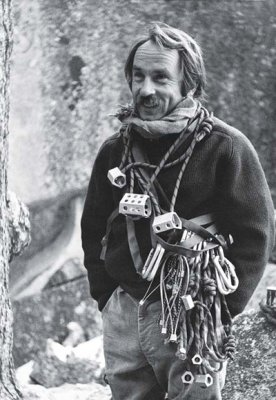
Yvon Chouinard

Founder of Patagonia

Recorded said elsewhere, not written here
I never wanted to be a businessman. I started as a craftsman, making climbing gear for my friends and myself, then got into apparel. As we began to witness the extent of global warming and ecological destruction, and our own contribution to it, Patagonia committed to using our company to change the way business was done. If we could do the right thing while making enough to pay the bills, we could influence customers and other businesses, and maybe change the system along the way.

Open letter published by Patagonia, 14 September 2022 source ↗

Others on this question

View all 42 →
Demis Hassabis Co-founder and chief executive of Google DeepMind; Nobel laureate in Chemistry
I think chess — actually, a number of things that I learned when I was young — it wasn't so much the chess itself; it was the skills that you were training while you were playing chess. So problem-solving, imagination, creative thinking, strategic thinking, all of these things — if you play chess to a high level, what you're really honing is those meta-skills. And I realized from quite young, that's one of the reasons I liked chess was this is a great practice for me to get good — sort of like a mental gym, if you like — to get really good at those other skills, which you could then translate to all sorts of other subjects like science or business.
Recorded Academy of Achievement interview, 2017 source ↗
Venkatraman Ramakrishnan Structural biologist; Nobel laureate in Chemistry, 2009
No, because I started working on ribosomes when I was a post doc, in 1978, when it would have been impossible, really, to solve it. But, it was just a fundamental problem in biology. And we felt, no matter, anything we do to chip away at the problem would be useful. So it was more that that attracted me. And I think the fact that it was large and kind of difficult to come to grips with, yes, it was attractive. Really what was attractive was that it was a fundamental problem.
Recorded Adam Smith, Telephone interview recorded minutes after the prize announcement, Nobel Prize Outreach, 7 October 2009 source ↗
Daniel Kahneman Psychologist; laureate of the Sveriges Riksbank Prize in Economic Sciences, 2002
Amos and I shared the wonder of together owning a goose that could lay golden eggs – a joint mind that was better than our separate minds. … Some of the greatest joys of our collaboration-and probably much of its success – came from our ability to elaborate each other's nascent thoughts: if I expressed a half-formed idea, I knew that Amos would be there to understand it, probably more clearly than I did, and that if it had merit he would see it. Like most people, I am somewhat cautious about exposing tentative thoughts to others – I must first make sure that they are not idiotic. In the best years of the collaboration, this caution was completely absent.
Recorded Laureate-written autobiography for Les Prix Nobel, Nobel Prize Outreach, 1 December 2002 source ↗
Howard Schultz Chief executive of Starbucks, 1987–2000, 2008–2017 and 2022–2023
But from day one, I really wanted to build the kind of company my father never got a chance to work for. A company that honors and respects the dignity of work and the dignity of all men and all women. And that is why we became the first company in all of America to provide comprehensive health insurance 30 years ahead of the affordable care act, as well as ownership in the form of stock options for all of our employees, including part-time people because it is my firm belief that success in business and in life is best when it's shared.
Recorded Arizona State University commencement, Speakola, 2017 source ↗

More from Yvon Chouinard

View profile →
Question What are you unwilling to optimise? Values & belief
One option was to sell Patagonia and donate all the money. But we couldn't be sure a new owner would maintain our values or keep our team of people around the world employed. Another path was to take the company public. What a disaster that would have been. Even public companies with good intentions are under too much pressure to create short-term gain at the expense of long-term vitality and responsibility. Truth be told, there were no good options available. So, we created our own.
Recorded Open letter published by Patagonia, 14 September 2022 source ↗

More on money & investment

Also answered this

Howard Schultz, Warren Buffett, Mellody Hobson, Charlie Munger, Indra Nooyi, Derek Sivers

Search the directory for somebody in particular.

Explore further

Report this answer