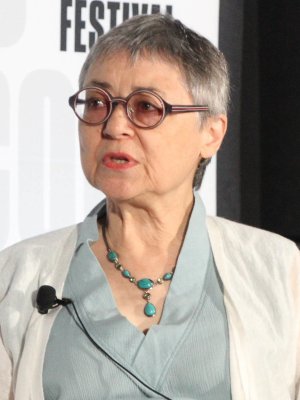
How does a new work begin for you?

Originally asked

The Paris Review, to novelists and poets, The Art of Fiction

A recurrent craft question in The Paris Review's Art of Fiction interviews; wording varies between character, theme, first sentence, image, and idea.

You answer as yourself. Nobody on FLAPSS answers as anybody else.

Recorded Sigrid Nunez said elsewhere, not written here
Well, it’s very simple for me. It’s pretty much always the same. I might have certain things swimming around in my head. We all always do. What’s been on your mind lately? You could ask anybody that, and you’d get a couple of answers. But, I always jump in. I always just try to think of a first sentence. Well, actually, I decide firstly if it’s going to be in third person or first person. And then I just think of something, I just get something moving.

Maddie Crum, The Creative Independent interview, 12 October 2020 source ↗

Others on this question

View all 63 →
Clare Sestanovich American writer
I start with the first sentence. A maddening answer, and, for my own sake, I wish I had a better one. But it’s the only way I know how: one sentence on top of the other, one foot in front of the other. In that way, writing does feel exploratory to me. I never start with a map in my head or even a destination. All I have is a sense that I’m heading in an interesting direction.
Recorded Shy Watson, The Creative Independent interview source ↗
When I’m writing a book, I start gathering material for years before I start writing it. I will find newspaper clippings, overheard dialogue, images that come to my head, sort of vague scenes from a plot, and I just make a huge, messy list of those things. I’m doing that for the next book, and I’ve been doing it for a long time, and I’m still not even close to being ready to start. Maybe in the fall I’ll start it, but I’m not on the cusp of starting it really. I’m just gathering that raw material. And what deserves to go in that document? It’s hard to say, but I know that things come together. I know that this article about Chinese surveillance definitely belongs in the same place with my son telling me about this dream he had. These are somehow connected. I have no idea how, but it’s just a feeling that I have, like an instinct. The Need and The Beautiful Bureaucrat very much began that way.
Recorded Maddie Crum, The Creative Independent interview, 10 July 2019 source ↗
Jeff Bezos Founder and former chief executive of Amazon; founder of Blue Origin
That blank sheet of paper stage is one of the hardest stages, and one of the reasons it’s hard is because at that stage there’s nobody counting on you but yourself. Today it’s easy because we’ve got millions of customers counting on us, and thousands of investors counting on us, and thousands of employees all counting on each other. In that beginning stage it’s really just you, and you can quit any time. Nobody is going to care, so you set about doing the simple things first.
Recorded Academy of Achievement interview, 2001 source ↗
Jocelyn Bell Burnell Radio astronomer; discoverer of pulsars
From one particular piece of the sky an unclassifiable signal sometimes recurred and my brain started to say: “You’ve seen something like this before, haven’t you? You’ve seen something like this before from this bit of the sky , haven’t you?” I got out previous recordings from that bit of sky. It often wasn’t there, but when it was, it was keeping its place amongst the stars.
Recorded Louise Walsh, University of Cambridge 'Journeys of Discovery' interview series, 1 January 2020 source ↗

More from Sigrid Nunez

View profile →
Question How do you know when a piece of work is finished? Craft & work
I think that’s the part of writing that I think is the most intuitive and unpredictable. What happens to me is that I—unlike other writers that I’ve known, particularly mystery writers— I don’t have an ending in mind. And it might happen when I get to a certain point that I think, “Oh, I know how this is going to end probably.” And then I write a little more, and I think, “Well, that won’t work.” So, what always happens is that as I approach the ending, I can sense myself coming to an ending. And then because I’ve been working for such a long time on the book, and it’s all in my head, and many things have happened supposedly, the thing just starts to draw tight. The threads start to come together. “Well, I’ve left this loose, and that loose, and that loose. So how can these be pulled together? And what can I say that would make a satisfying close?”
Recorded Maddie Crum, The Creative Independent, 12 October 2020 source ↗

More on craft & work

Also answered this

John Banville, Morgan Parker, Duncan Hannah, Claudia Dey, Precious Okoyomon, T.C. Boyle

Search the directory for somebody in particular.

Explore further

Report this answer