The question

Does the thought of dying frighten you?

Originally asked

The Talks, to its interviewees, its interview series

The Talks asks this directly or through an equivalent risk-and-mortality formulation across interviews.

You answer as yourself. Nobody on FLAPSS answers as anybody else.

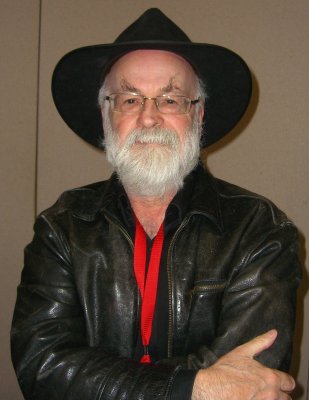
Terry Pratchett

Novelist

Recorded said elsewhere, not written here
Did the Victorians fear death? As Death says in one of my own books, most men don't fear death, they fear those things – the knife, the shipwreck, the illness, the bomb – that proceed, by micro seconds if you're lucky and many years if you're not, the moment of death.

Edited extract from the Richard Dimbleby Lecture, Shaking Hands With Death, broadcast on BBC1 on 1 February 2010, The Guardian, 2 February 2010 source ↗

Others on this question

View all 18 →
Jimmy Carter 39th President of the United States, 1977–1981; Governor of Georgia 1971–1975
At first I - I felt that it was confined to my liver and that they had - the operation had completely removed it. And so I felt quite relieved. And then that same afternoon we had an MRI of my head and neck and it showed up that it was already in four places in my brain. So I would say that night and the next day, until I came back up to Emory, I just thought I had a few weeks left. But I was surprisingly at ease. You know, I've had a wonderful life. I've had thousands of friends and I've had an exciting and adventurous and gratifying existence. So I was surprisingly at ease, much more so than my wife was.
Recorded News conference at the Carter Center, Atlanta, as transcribed by CNN, 20 August 2015 source ↗
Oliver Sacks Neurologist and writer
I cannot pretend I am without fear. But my predominant feeling is one of gratitude. I have loved and been loved; I have been given much and I have given something in return; I have read and traveled and thought and written. I have had an intercourse with the world, the special intercourse of writers and readers. Above all, I have been a sentient being, a thinking animal, on this beautiful planet, and that in itself has been an enormous privilege and adventure.
Recorded The New York Times, Op-Ed, 19 February 2015 source ↗
Alex Honnold Rock climber; first person to free solo El Capitan
I’ve had a couple of ex-girlfriends sort of accuse me of having a personality disorder! … No, I don’t know. I’ve always been afraid of death. I’ve never wanted to die. Last year, I watched this guy die in Red Rock. It was this horrible freak accident thing. He fell and he cracked his head and basically just bled out. That was the first time I’d ever actually seen a climbing accident like that. It was kind of sobering — he was even wearing a helmet — it was a reminder of how dangerous climbing can be if things go wrong even when you have all the ropes on.
Recorded The Talks, 6 February 2019 source ↗
Steve Jobs Co-founder and chief executive of Apple; co-founder of NeXT; chief executive of Pixar
I've always felt that death is the greatest invention of life. I'm sure that life evolved without death at first and found that without death, life didn't work very well because it didn't make room for the young. It didn't know how the world was fifty years ago. It didn't know how the world was twenty years ago. It saw it as it is today, without any preconceptions, and dreamed how it could be based on that. We're not satisfied based on the accomplishment of the last thirty years. We're dissatisfied because the current state didn't live up to their ideals. Without death there would be very little progress.
Recorded Daniel Morrow, Smithsonian Institution Oral and Video Histories, for the Computerworld Smithsonian Awards Program, 20 April 1995 source ↗

More from Terry Pratchett

View profile →
Question What worries you about getting older? Time & hindsight
When my father was in his terminal year, I discussed death with him. I recall very clearly his relief that the cancer that was taking him was at least allowing him "all his marbles". Dementia in its varied forms is not like cancer. Dad saw the cancer in his pancreas as an invader. But Alzheimer's is me, unwinding, losing trust in myself, a butt of my own jokes and on bad days capable of playing hunt the slipper by myself and losing. You can't battle it, you can't be a plucky "survivor". It steals you from yourself. And I'm 60; that's supposed to be the new 40.
Recorded Written for the Alzheimer's Society in 2008; reprinted by the Observer in the week of his death, The Guardian, 2008 source ↗
Question What lesson has mattered most in your life? Time & hindsight
It occurred to me that at one point it was like I had two diseases – one was Alzheimer's and the other was knowing I had Alzheimer's. There were times when I thought I'd have been much happier not knowing, just accepting that I'd lost brain cells and one day they'd probably grow back or whatever. It is better to know, though, and better for it to be known, because it has got people talking, which I rather think was what I had in mind.
Recorded Written for the Alzheimer's Society in 2008; reprinted by the Observer in the week of his death, The Guardian, 2008 source ↗
Question What is the hardest thing that has happened to you, and what did you carry out of it? Failure & regret
When Milton's Satan stood in the pit of hell and raged at heaven, he was merely a trifle miffed compared to how I felt on that day. I felt totally alone, with the world receding away from me in every direction, and you could have used my anger to weld steel. Only my family and the fact I had fans in the medical profession, who were able to give me useful advice, got me through that moment.
Recorded Written for the Alzheimer's Society in 2008; reprinted by the Observer in the week of his death, The Guardian, 2008 source ↗
Question What kind of death would you consider a good one? Death & what remains
I remember what George said and vowed that rather than let Alzheimer's take me, I would take it. I would live my life as ever to the full and die, before the disease mounted its last attack, in my own home, in a chair on the lawn, with a brandy in my hand to wash down whatever modern version of the "Brompton cocktail" some helpful medic could supply. And with Thomas Tallis on my iPod, I would shake hands with Death.
Recorded Edited extract from the Richard Dimbleby Lecture, Shaking Hands With Death, Royal College of Physicians, broadcast on BBC1 on 1 February 2010, The Guardian, 2 February 2010 source ↗
Question Has knowing you will die changed how you live? Death & what remains
Let us consider me as a test case. As I have said, I would like to die peacefully with Thomas Tallis on my iPod before the disease takes me over and I hope that will not be for quite some time to come, because if I knew that I could die at any time I wanted, then suddenly every day would be as precious as a million pounds. If I knew that I could die, I would live. My life, my death, my choice.
Recorded Edited extract from the Richard Dimbleby Lecture, Shaking Hands With Death, broadcast on BBC1 on 1 February 2010, The Guardian, 2 February 2010 source ↗

More on death & what remains

Also answered this

Jenny Diski, Clive James, Christopher Hitchens, Tony Judt, Maurice Sendak, Diana Athill

Search the directory for somebody in particular.

Explore further

Report this answer