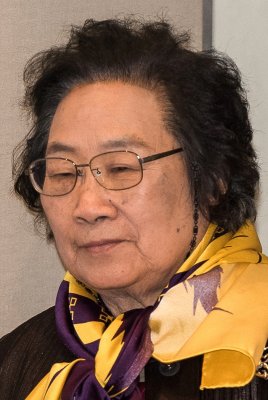
Tu Youyou

Pharmaceutical chemist; Nobel laureate in Physiology or Medicine, 2015

Recorded said elsewhere, not written here
In Ge Hong's A Handbook of Prescriptions for Emergencies (肘后备急方), I noticed one sentence "A handful of Qinghao immersed in two liters of water, wring out the juice and drink it all" (青蒿一握, 以水二升渍, 绞取汁, 尽服之) when Qinghao was mentioned for alleviating malaria fevers. Most herbs were typically boiled in water and made into a decoction before taken by the patients. This unique way of using Qinghao gave me the idea that heating during extraction might have destroyed the active components and the high temperature might need to be avoided in order to preserve the herb's activity.

Laureate-written autobiography for Les Prix Nobel, Nobel Prize Outreach, 1 December 2015 source ↗

Others on this question

View all 82 →
Andrew Huberman American neuroscientist and podcaster
Yeah, well, I love poetry and it’s almost cliche now to say this because so many people like his work, but I think David Whyte’s work is just beautiful and is a wonderful kind of entry point to poetry. I’m also a big Wendell Berry fan. He’s written a lot about farming and the natural world. And I’ve never met him, but I’m a huge Wendell Berry fan. I’ll sometimes give Wendell Berry books as gifts. The book that I think is perhaps, at least to me, the most beautiful book of all is Longitude by Dava Sobel about the history of the discovery of timekeeping at-ocean, which is not a trivial problem to solve. And it’s just a beautiful story of how scientists, or in this case a particular scientist, merged the quest for a technology with a scientific problem with adventure, and going out on boats and risking one’s life for the sake of science is something that resonates with me a bit. And it’s a beautiful, short book, and it’s very accessible to anybody, whether or not you have a background in science or not, and she’s absolutely a wonderful writer. And so that’s the one I gift most often.
Recorded Tim Ferriss, The Tim Ferriss Show podcast, 8 July 2021 source ↗
Nick Thompson Chief executive of The Atlantic; former editor in chief of Wired
Oh, that I can answer. So, each of the last two years I’ve given one book to a bunch of people. And this year, it’s a book by Robert Wright called Why Buddhism is True . And it’s a story about mindfulness and about the science of Buddhism and the current neuroscienc, about how our minds work, making the argument that the things people have said about mindfulness, meditation, and the way it changes your capacity to empathize with other people and to break out of the tribalism that we’re all locked into, the things that Buddhism has said about that turn out to be scientifically correct. And here’s a story about why. Wonderful book. Robert Wright is one of the smartest writers I’ve ever read. His book Nonzero is among my five favorite books of all time. So, that book came out recently, and I gave that to my closest friend and my family. The year before, I gave a book by Larissa MacFarquhar called Strangers Drowning which is a story about people who make extraordinary moral choices like the choice to adopt 23 children and bring them into your lives, who just make crazy choices and why they make those choices. And Larissa is one of the smartest writers at the New Yorker. Everything she writes is absolutely brilliant, and the book is brilliant to get into ten discreet chapters about people who make choices like that. So, I gave Larissa’s book last year and Robert Wright’s book this year. Tim Ferriss: Thank you.
Recorded Tim Ferriss, The Tim Ferriss Show podcast, 26 June 2018 source ↗
Mohamed ElBaradei Director General of the International Atomic Energy Agency, 1997-2009; Nobel Peace Prize 2005
Unfortunately, I don’t. My wife now reads fiction. I don’t have the time to read fiction. My wife reads the fiction and summarizes it to me, but I wish at one point I’ll have time again to read fiction. It is a luxury I cannot afford right now.
Recorded Academy of Achievement interview, 2006 source ↗
The people I most often give books to are children, and the book I love giving is Rivka Galchen’s Rat Rule 79. Technically a book written for children, but a book that will delight readers of all ages.
Recorded Lit Hub Questionnaire, Literary Hub, 27 March 2025 source ↗

More from Tu Youyou

View profile →
Question What is the hardest thing that has happened to you, and what did you carry out of it? Failure & regret
I unfortunately contracted tuberculosis at the age of sixteen and had to take a two-year break and receive treatment at home before I resumed my study at the private Ningbo Xiaoshi High School (1948–1950) and Ningbo High School (1950–1951). This experience led me to make a decision to choose medical research for my advanced education and career – if I could learn and have (medical) skills, I could not only keep myself healthy but also cure many other patients.
Recorded Laureate-written autobiography for Les Prix Nobel, Nobel Prize Outreach, 1 December 2015 source ↗
Question What part of your job would surprise outsiders because it takes up so much of your time? Craft & work
Most pharmaceutical workshops were shut down during the great cultural revolution. Without manufacturing support, we had to extract herbs ourselves using household vats etc. The team worked very long hours every day including the weekends. Due to lack of proper equipment and ventilation, and long-term exposure to the organic solvents, some of my team members included myself started to show unhealthy symptoms. This, however, did not stop our efforts.
Recorded Laureate-written autobiography for Les Prix Nobel, Nobel Prize Outreach, 1 December 2015 source ↗

More on taste & recommendation

Also answered this

Amartya Sen, Andrew Weil, Rita Levi-Montalcini, Shinya Yamanaka, Katalin Karikó, M. Sanjayan

Search the directory for somebody in particular.

Explore further

Report this answer