But poets are the worst. Their work is hopelessly unphotogenic. Someone sits at a table or lies on a sofa while staring motionless at a wall or ceiling. Once in a while this person writes down seven lines only to cross out one of them fifteen minutes later, and then another hour passes, during which nothing happens … Who could stand to watch this kind of thing?
What is the part of your job that people would be surprised is most of your job?
Question
What is the book you have given most as a gift, and why?
Taste & recommendation
Question
What is the hardest thing that has happened to you, and what did you carry out of it?
Failure & regret
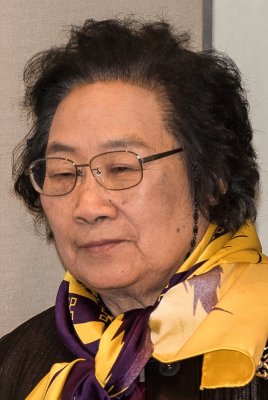
Most pharmaceutical workshops were shut down during the great cultural revolution. Without manufacturing support, we had to extract herbs ourselves using household vats etc. The team worked very long hours every day including the weekends. Due to lack of proper equipment and ventilation, and long-term exposure to the organic solvents, some of my team members included myself started to show unhealthy symptoms. This, however, did not stop our efforts.
Laureate-written autobiography for Les Prix Nobel, Nobel Prize Outreach, 1 December 2015 source ↗
Others on this question
View all 46 →
Wisława Szymborska
Poet and essayist; Nobel laureate in Literature, 1996
Recorded
Swedish Academy, Stockholm, 7 December 1996, The Nobel Foundation (nobelprize.org), 7 December 1996
source ↗
Cathy Freeman
Australian sprinter, 1990–2003
I looked straight across at the clock and I was disappointed with the time. I should have run under 49 and I didn't. And I knew I had a lot more in me.
Recorded
Interview for the documentary Freeman, ABC News (Australia), 12 September 2020
source ↗
Arsène Wenger
French football manager; Arsenal 1996–2018; FIFA Chief of Global Football Development
A good coach is somebody who has a clear concept of what they want and what they love in the game, is capable of expressing it in an understandable way, and is able to obtain it on the football pitch. They're also someone who loves to help others. This means something more than just going out and coaching a session, they really try to understand who a player is and find the key to helping them. All players have different problems, and we have the capacity to help them solve them. That's why this is a very interesting aspect of being a coach, we have the chance to be capable to influence people's lives.
Mario Molina
Atmospheric chemist; Nobel laureate in Chemistry, 1995
Although my years at Irvine were very productive, I missed not doing experiments myself because of the many responsibilities associated with a faculty position: teaching courses, supervising graduate students, meetings, etc. After spending seven years at Irvine as Assistant and then Associate Professor, I decided to move to a non-academic position. I joined the Molecular Physics and Chemistry Section at the Jet Propulsion Laboratory in 1982. I had a smaller group – only a few postdoctoral fellows – but I also had the luxury of conducting experiments with my own hands, which I enjoyed very much.
Recorded
Laureate-written autobiography, provided by the laureate in November 2007, Nobel Prize Outreach, 1 November 2007
source ↗
More from Tu Youyou
View profile →In Ge Hong's A Handbook of Prescriptions for Emergencies (肘后备急方), I noticed one sentence "A handful of Qinghao immersed in two liters of water, wring out the juice and drink it all" (青蒿一握, 以水二升渍, 绞取汁, 尽服之) when Qinghao was mentioned for alleviating malaria fevers. Most herbs were typically boiled in water and made into a decoction before taken by the patients. This unique way of using Qinghao gave me the idea that heating during extraction might have destroyed the active components and the high temperature might need to be avoided in order to preserve the herb's activity.
Recorded
Laureate-written autobiography for Les Prix Nobel, Nobel Prize Outreach, 1 December 2015
source ↗
I unfortunately contracted tuberculosis at the age of sixteen and had to take a two-year break and receive treatment at home before I resumed my study at the private Ningbo Xiaoshi High School (1948–1950) and Ningbo High School (1950–1951). This experience led me to make a decision to choose medical research for my advanced education and career – if I could learn and have (medical) skills, I could not only keep myself healthy but also cure many other patients.
Recorded
Laureate-written autobiography for Les Prix Nobel, Nobel Prize Outreach, 1 December 2015
source ↗
More on craft & work
- What is the worst job you have done? 232 answers
- What do you consider your greatest achievement? 192 answers
- How do you know when a piece of work is finished? 69 answers
- How does a new work begin for you? 69 answers
- What do you do when you feel creatively blocked or stuck? 68 answers
- How much rewriting or revision do you do? 50 answers
Also answered this
Richard Hamming, Shinya Yamanaka, Maryam Mirzakhani, Denis Mukwege, Jocelyn Bell Burnell, Mario Molina
Search the directory for somebody in particular.
Explore further
- All craft & work questions
- Explore the archive — by field, age, era, and subject