The question

What is the biggest obstacle you have faced professionally?

Originally asked

The American Academy of Achievement, to its honourees, its oral-history interviews

The Academy of Achievement repeatedly asks honorees to identify a major professional obstacle or challenge and describe confronting it.

You answer as yourself. Nobody on FLAPSS answers as anybody else.

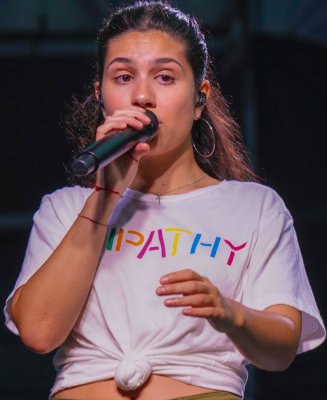
Alessia Cara

Canadian singer-songwriter

Recorded said elsewhere, not written here
It was very challenging at first, as I came straight out of high school where my lifestyle was so different to that of a professional musician. I lived such a secluded life – I went from school to home, school to home, and never travelled anywhere. I hadn’t figured out who I was, as I hadn’t explored anything yet. To jump into the completely opposite lifestyle so quickly and so young was difficult – I was very afraid, and didn’t know how to say no.

Cordelia Lam, The Forty-Five, 30 July 2021 source ↗

Others on this question

View all 39 →
Mohamed ElBaradei Director General of the International Atomic Energy Agency, 1997-2009; Nobel Peace Prize 2005
No. Unfortunately, it hasn’t worked out quite that way. At that time, everybody was euphoric that we will have a new world order, you know, a world order that does not rely on nuclear weapons, nuclear deterrence. Unfortunately, it didn’t work that way. ... We still have thousands of warheads in existence. We still have more than 20 — 30 countries relying on nuclear deterrence for their own survival.
Recorded Academy of Achievement interview, 2006 source ↗
Clive James Critic, essayist, poet and broadcaster
What I’ve got doesn’t hurt. I’ve been lucky. The treatment has been benign. I don’t know if I could concentrate if I was in pain. I’ve never had to stop.
Recorded Robert McCrum, Interview at James's home in Cambridge, published in the Observer New Review, The Observer, 15 March 2015 source ↗
Ernst Mayr Naturalist and evolutionary biologist
Very often I had to fight for the recognition of my ideas, particularly since, in those earlier days, I wasn’t in any prominent position where people would listen to me.
Recorded Academy of Achievement interview, 5 April 2001 source ↗
Richard Feynman Theoretical physicist; Nobel laureate in Physics, 1965
At Cornell, I’d work on preparing my courses, and I’d go over to the library a lot and read through the Arabian Nights and ogle the girls that would go by.  But when it came time to do some research, I couldn’t get to work.  I was a little tired; I was not interested; I couldn’t do research!  This went on for what I felt was a few years, but when I go back and calculate the timing, it couldn’t have been that long.  Perhaps nowadays I wouldn’t think it was such a long time, but then, it seemed to go on for a very long time.  I simply couldn’t get started on any problem: I remember writing one or two sentences about some problem in gamma rays and then I couldn’t go any further.  I was convinced that from the war and everything (the death of my wife) I had simply burned myself out.
Recorded Excerpt from “Surely You’re Joking, Mr. Feynman”, Engineering and Science / Caltech Magazine, 1985 source ↗

More from Alessia Cara

View profile →
Question When you feel overwhelmed or unfocused, what do you do? Daily life
This is something I still have to learn and figure out because I'm not perfect at it yet — but I've learned that just even something as simple as breathing properly can be a really nice form of meditation. Also talking to people about it. I started going to therapy, which has been really helpful just to get it out. Of course for me as a songwriter, writing helps. So does taking things a day at a time and stopping to just breathe because I'm a person who really thinks so far in advance all the time.
Recorded Ella Cerón, Teen Vogue, 15 June 2018 source ↗

More on craft & work

Also answered this

Shinya Yamanaka, Mario Molina, Mike Krzyzewski, Sundar Pichai, Kiran Mazumdar-Shaw, Bill Clinton

Search the directory for somebody in particular.

Explore further

Report this answer