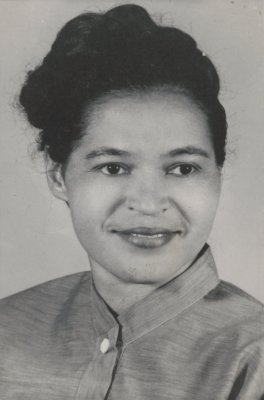
The question

What has life taught you about being human?

Originally asked

Krista Tippett, to her guests, On Being

Krista Tippett uses this as a recurring, sometimes-closing On Being question; the wording is intentionally adapted to each guest.

You answer as yourself. Nobody on FLAPSS answers as anybody else.

Rosa Parks

Civil-rights activist

Recorded said elsewhere, not written here
There were so many needs for us to continue to work for freedom, because I didn’t think that we should have to be treated in the way we were, just for the sake of white supremacy, because it was designed to make them feel superior, and us feel inferior. That was the whole plan of racially enforced segregation.

Academy of Achievement interview source ↗

Others on this question

View all 15 →
Mellody Hobson Co-chief executive and president of Ariel Investments
I could be strong and not tough. I could be kind without being soft. ... But in that moment, that olive branch of kindness was actually one that became a physical hug, and I think it taught me and the room a lot. And I said: You know what? I think this is an advantage.
Recorded Kathleen J. McInnis, Smart Women, Smart Power podcast, Center for Strategic and International Studies, 28 August 2024 source ↗
Warren Buffett Chairman and chief executive of Berkshire Hathaway, 1970–2025
Well, I won't say what I thought about them, particularly related to Bill Gates, but I would say it's astounding to me how human people are. I mean, it, here you had a guy that was a convicted guy, a sensational con man, and the percentage of people that he knocked off. I mean, whether it was, he found their weakness, it might have been sex. It might be power, it might be, whatever it might be.
Recorded Becky Quick, CNBC “Squawk Box”, recorded in Omaha; CNBC's own transcript of its own broadcast, 31 March 2026 source ↗
Barack Obama 44th President of the United States, 2009–2017; United States Senator from Illinois 2005–2008
Part of what separates us from the other creatures on earth is that we make up stories. We are storytellers. And we can tell bad stories and we can tell good stories. We can tell stories that lead to division and hate and war. Or we can tell stories that lead to cooperation and peace and progress.
Recorded Ben Tiggelaar, Forward Thinking Leadership, Amsterdam, Ben Tiggelaar, 28 September 2018 source ↗
Oliver Sacks Neurologist and writer
My generation is on the way out, and each death I have felt as an abruption, a tearing away of part of myself. There will be no one like us when we are gone, but then there is no one like anyone else, ever. When people die, they cannot be replaced. They leave holes that cannot be filled, for it is the fate — the genetic and neural fate — of every human being to be a unique individual, to find his own path, to live his own life, to die his own death.
Recorded The New York Times, Op-Ed, 19 February 2015 source ↗

More from Rosa Parks

View profile →
Question What is the hardest thing that has happened to you, and what did you carry out of it? Failure & regret
Back in Montgomery during my growing up there, it was completely legally enforced racial segregation, and of course, I struggled against it for a long time. I felt that it was not right to be deprived of freedom when we were living in the Home of the Brave and Land of the Free. Of course, when I refused to stand up, on the orders of the bus driver, for a white passenger to take the seat, and I was not sitting in the front of the bus, as so many people have said, and neither was my feet hurting, as many people have said. But I made up my mind that I would not give in any longer to legally-imposed racial segregation and of course my arrest brought about the protests for more than a year.
Recorded Academy of Achievement interview source ↗
Question Which teacher, parent, coach, or friend most made you who you are, and what did you learn from them? Relationships
My family, I would say, my mother, and my maternal grandparents. I grew up with them. My mother was a teacher in a little school, and she believed in freedom and equality for people, and did not have the notion that we were supposed to live as we did, under legally enforced racial segregation. She didn’t believe in it.
Recorded Academy of Achievement interview source ↗
Question What side project are you most glad you pursued? Craft & work
We work with young people, from the ages of 11 to 17. Our main program is the Pathways to Freedom. And we’ll be going from Memphis, Tennessee through ten other states, and Washington, DC, and to Canada. It began July 13th and ends August 8th. We hope to take as many young people and their chaperons as possible throughout these areas, and stop and have workshops and programs. They’ll be traveling in buses, and we hope that will inspire and give them a sense of history and also to encourage them to be concerned about their self and history and motivated to reach their highest potential.
Recorded Academy of Achievement interview source ↗

More on values & belief

Also answered this

Bill Clinton, Barack Obama, Desmond Tutu, Oliver Sacks, Kate Bowler, Ram Dass

Search the directory for somebody in particular.

Explore further

Report this answer