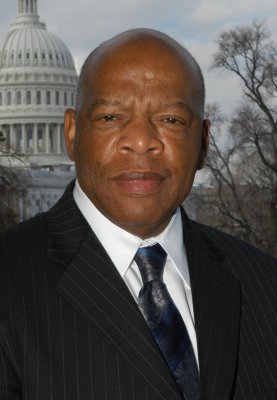
John Lewis

U.S. Representative from Georgia, 1987–2020; Chairman of the Student Nonviolent Coordinating Committee 1963–1966

Recorded said elsewhere, not written here
I never thought that we would fail or that I would fail. I knew from time to time we may make some blunders. We may make some mistakes, but we were not going to fail.

Academy of Achievement interview, Chicago, 10 June 2004 source ↗

Others on this question

View all 69 →
Amy Tan Novelist; author of The Joy Luck Club
I didn’t fear failure. I expected failure. I think I’ve always been somebody, since the deaths of my father and brother, who was afraid to hope. So, I was more prepared for failure and for rejection than success. The success took me by surprise and it frightened me.
Recorded Academy of Achievement interview, 28 June 1996 source ↗
Richard Leakey Palaeoanthropologist and conservationist; head of the Kenya Wildlife Service
So Cambridge rejected me. Quite rightly, although at the time I thought it was a little churlish. So, I had to do it without any university training. ... and I began to realize that there were probably a lot more of these things, and that if you find these things, you get a position in the ladder which you can’t get to unless you have either got an education or something else. So by finding important things, you immediately get into the game, which you’d been excluded from otherwise.
Recorded Academy of Achievement recorded interview, American Academy of Achievement, 21 June 2007 source ↗
Paula Scher Graphic designer
When you’re working and you make mistakes, particularly when you’re young, you make discoveries because you do things that are inappropriate and wrongheaded, but within the wrongheadedness you find an unexpected way to go. These things are truly the breakthroughs.
Recorded Debbie Millman, Psychology Today, 'Brainstorm' column, 1 May 2009 source ↗
J.K. Rowling Novelist and screenwriter
So why do I talk about the benefits of failure? Simply because failure meant a stripping away of the inessential. I stopped pretending to myself that I was anything other than what I was, and began to direct all my energy into finishing the only work that mattered to me. Had I really succeeded at anything else, I might never have found the determination to succeed in the one arena I believed I truly belonged. I was set free, because my greatest fear had been realised, and I was still alive, and I still had a daughter whom I adored, and I had an old typewriter and a big idea. And so rock bottom became the solid foundation on which I rebuilt my life.
Recorded Harvard University Commencement, 2008, Harvard Gazette, 5 June 2008 source ↗

More from John Lewis

View profile →
Question Which writers or artists have most influenced your work? Taste & recommendation
Jim Lawson. Jim Lawson was an unbelievable human being. Born in Ohio. He was a pacifist. He studied Gandhi. He was part of the Methodist Student Movement. He lived in India. He became an organizer for FOR, the Fellowship of Reconciliation.
Recorded Julian Bond, Explorations in Black Leadership interview, Explorations in Black Leadership, University of Virginia source ↗

More on failure & regret

Also answered this

Mikhail Gorbachev, Angela Merkel, Theodore Roosevelt, Wendy Kopp, Ben Bradlee, Mohamed ElBaradei

Search the directory for somebody in particular.

Explore further

Report this answer