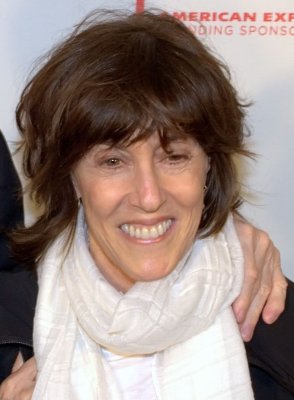
Nora Ephron

Journalist, essayist, screenwriter and film director

Recorded said elsewhere, not written here
My advice to everyone is: “Become a journalist.” ... if you have a chance to be a newspaper reporter for three or four years — before you do whatever you want to do — do it, because you will know so much.

Academy of Achievement interview, 21 June 2007 source ↗

Others on this question

View all 78 →
Megan Rapinoe United States international footballer, 2006–2023
Even more simply, you can ask yourself this question: "Do I truly care about equality for all people in this country?" If the answer is yes, then demand to be a better, more educated, more empathetic version of yourself. And demand the same of every single person you know.
Recorded First-person essay, The Players' Tribune, 6 October 2016 source ↗
Grace Hopper United States Navy rear admiral; computer scientist; co-designer of COBOL
Always remember that it's much easier to apologize than to get permission. In this world of computers, the best thing to do is to do it.
Recorded Lake Forest College, Chicago Tribune, 9 December 1982 (via Quote Investigator), 9 December 1982 source ↗
Derek Sivers Founder of CD Baby; author of Anything You Want
Yeah, anybody asks me about it, my advice was always, do not do it. In fact, it still is. Somebody just asked me last week, I was like, do not do it.
Recorded Tim Ferriss, The Tim Ferriss Show podcast, 23 April 2023 source ↗
Elie Wiesel Writer and human rights advocate; Nobel Peace Prize laureate, 1986
Sensitivity. Be sensitive in every way possible about everything in life. Be sensitive. Insensitivity brings indifference and nothing is worse than indifference. Indifference makes that person dead before the person dies.
Recorded Academy of Achievement interview, 29 June 1996 source ↗

More from Nora Ephron

View profile →
Question Which teacher, parent, coach, or friend most made you who you are, and what did you learn from them? Relationships
Yes. I had a couple of great, great teachers. The teacher who changed my life was my journalism teacher, whose name was Charles Simms. I always tell this story. I love it. I had already decided that I was going to be a journalist. I didn’t know why exactly, except that I had seen a lot of Superman comics. Lois Lane and all of those major literary characters like that, but Mr. Simms got up the first day of class, and he went to the blackboard, and he wrote “Who, what, where, why, when, and how,” which are the six things that have to be in the lead of any newspaper story. Then he did what most journalism teachers do, which is that he dictated a set of facts to us, and then we were all meant to write the lead that was supposed to have “who, what, where, why, when, and how” in it. He dictated a set of facts that went something like, “The principal of Beverly Hills High School announced today that the faculty of the high school will travel to Sacramento, Thursday, for a colloquium in new teaching methods. Speaking there will be Margaret Mead, the anthropologist, and two other people.” So we all sat down at our typewriters, and we all kind of inverted that and wrote, “Margaret Mead and X and Y will address the faculty in Sacramento, Thursday, at a colloquium on new teaching methods, the principal announced today.” Something like that. We were very proud of ourselves, and we gave it to Mr. Simms, and he just riffled through them and tore them into tiny bits and threw them in the trash, and he said, “The lead to this story is: There will be no school Thursday!” and it was this great epiphany moment for me. It was this, “Oh my God, it is about the point! It is about figuring out what the point is.” And I just fell in love with journalism at that moment. I just fell in love with the idea that underneath, if you sifted through enough facts, you could get to the point, and you had to get to the point. You could not miss the point. That would be bad. So he really kind of gave that little shift of mind a major push.
Recorded Academy of Achievement interview source ↗
Question What does everyone in your world seem to agree on that you think is wrong? Values & belief
People think that when you write something it’s cathartic, and I had written a lot of personal articles at Esquire, and people always say, “Oh God, it must have been so great when you finally wrote about having small breasts.” No. You get through that, and then you write it. It is not the writing that is the catharsis.
Recorded Academy of Achievement interview, 21 June 2007 source ↗

More on time & hindsight

Also answered this

Werner Herzog, Wole Soyinka, Amy Tan, J.K. Rowling, Patti Smith, Richard Ford

Search the directory for somebody in particular.

Explore further

Report this answer