To let things go.
Originally asked
The Guardian, to a different person each week, The Q&A
Verbatim recurring item in The Guardian Q&A; two fully readable publisher-hosted respondent pages establish institutional recurrence.
You answer as yourself. Nobody on FLAPSS answers as anybody else.
Marika Griehsel, Interview at the 53rd Lindau Nobel Laureate Meeting, 30 June–4 July 2003, Nobel Prize Outreach, 1 July 2003 source ↗
Others on this question
View all 137 →That everything happens for a reason.
Stress is bad for your health.
Well, I—I've experienced that the stroke was grace. It was grace, for me, to play, to get inside, grace. I was dependent. These are things that I—those, those were graceful things. You know, pushed. And just go inside, to be—you're a quote "author" and it's a cultural thing, that role, to get into your head. But it's a head game. It's a head game. And I wanted to get down to my spiritual identity. And the stroke placed me at the spiritual identity.
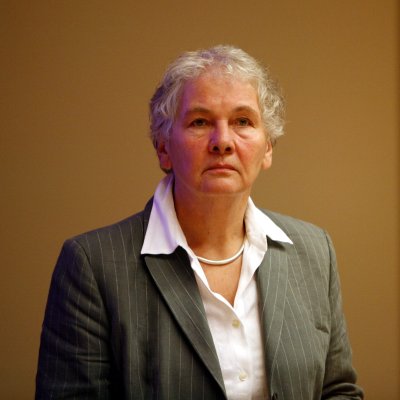
More from Christiane Nüsslein-Volhard
View profile →so I sometimes think, why should I talk young women into being a scientist if they then end up being sort of disliked or not accepted by their contemporaries and so it’s a tricky business actually.
I sing yes sure and I garden, I have a large garden and I really recreate myself by doing gardening and thinking about something else so that when your mind gets free from all the burden of the daily troubles and then you can start putting something fresh in, you know.
I continued the work on dorsal, discovered the recessive phenotype and interpreted the phenotype postulating a gradient determining the dorsoventral axis. At that time, gradients were not widely accepted as mechanisms, in particular biochemists were highly sceptical, however the Tübingen influence made such models attractive to me.
I felt at the time that Eric was much more successful than I, he was extremely productive during his time in Zurich, and worked on many very original projects, germ line, cell lineage, sex determination, where not many people could follow him. I also had the impression that I was dependent on him because he had more fly experience and without him I would not have gotten the job. This made our start in Heidelberg a little difficult, until we sorted things out, and from then on we thoroughly enjoyed working in the same lab.
I don’t think it’s misused yet, people are afraid of it might be misused but on the other hand, there is also value in finding out about the relation between several particular predispositions. You might be more careful if you are told that your genetic background is such that you shouldn’t eat fat in large amounts or so, it does help you change your life a little bit and so it’s not so bad, but it’s hard to find out which genetic background is causing these things.
They were blocked in their minds to do this because they thought, oh this is not done, we don’t do that in our field and you can’t do that, and I said: Why not?
More on time & hindsight
- When were you happiest? 577 answers
- What advice would you give your twenty-year-old self, and what should they ignore? 77 answers
- What scares you about getting older? 61 answers
- What is the best advice you have ever received? 28 answers
- If you could have a gigantic billboard anywhere, what would it say and why? 23 answers
- What is something you were told by a parent, teacher, or mentor that you still repeat to yourself? 22 answers
Also answered this
Clare Bailey Mosley, Paul Kalanithi, Richard Feynman, Mario Molina, Oliver Sacks, Shinya Yamanaka
Search the directory for somebody in particular.
Explore further
- All time & hindsight questions
- The The Q&A questionnaire — 25 questions from the same format
- Explore the archive — by field, age, era, and subject