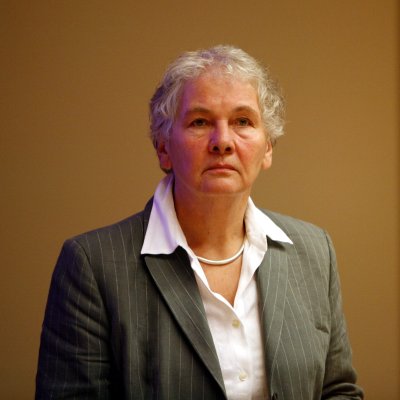
What advice would you give your twenty-year-old self, and what should they ignore?
Recorded Christiane Nüsslein-Volhard said elsewhere, not written here
so I sometimes think, why should I talk young women into being a scientist if they then end up being sort of disliked or not accepted by their contemporaries and so it’s a tricky business actually.

Marika Griehsel, Interview at the 53rd Lindau Nobel Laureate Meeting, 30 June–4 July 2003, Nobel Prize Outreach, 1 July 2003 source ↗

Others on this question

View all 78 →
Tim Cook Chief executive of Apple
Fearlessness means taking the first step, even if you don't know where it will take you. It means being driven by a higher purpose rather than by applause.”
Recorded Duke University Commencement, Duke Today, 13 May 2018 source ↗
Mellody Hobson Co-chief executive and president of Ariel Investments
I'd say be just like you. I once had someone tell me that I don't remind them of anyone that they ever met. And I took that as a huge compliment, which meant I was original. And so I would suggest to her that she speak her truth with her life, with her own sense of purpose and pursue her dreams.
Recorded Farai Chideya, News & Notes, Leading Ladies series, NPR, 22 March 2007 source ↗
Wole Soyinka Playwright, poet and novelist; Nobel laureate in Literature, 1986
I just say, “Follow your instincts.” Don’t feel you have to follow the paths of others, because you may not be temperamentally fitted for it. And so you’ll just harm yourself and your cause and others. But just follow your instinct, and don’t ever pretend to be what you’re not.
Recorded Academy of Achievement interview, 3 July 2009 source ↗
Richard Feynman Theoretical physicist; Nobel laureate in Physics, 1965
So I wish to you—I have no more time, so I have just one wish for you—the good luck to be somewhere where you are free to maintain the kind of integrity I have described, and where you do not feel forced by a need to maintain your position in the organization, or financial support, or so on, to lose your integrity. May you have that freedom. May I also give you one last bit of advice: Never say that you'll give a talk unless you know clearly what you're going to talk about and more or less what you're going to say.
Recorded Caltech commencement address, Pasadena, California, Caltech Engineering and Science (Caltech Library archive), 1 June 1974 source ↗

More from Christiane Nüsslein-Volhard

View profile →
Question How has a failure, or apparent failure, set you up for later success? Do you have a favourite failure? Failure & regret
As I was lazy and rarely did my homework, I finished high school with a rather mediocre exam. I almost did not pass in English language. Recently, my previous teachers allowed me to see their report on my high school performances, which included the following statements: Despite the fact that her talents are rather equally spread among many areas of knowledge, her performances are rather different depending on the distribution of her interests. Thus, with her strong display of self will she can be decidedly lazy in some topics over years, while in her areas of interests she performs to a degree far extending that required for normal school purposes.
Recorded Laureate-written autobiography for Les Prix Nobel, Nobel Prize Outreach, 1 December 1995 source ↗
Question What is the most important lesson life has taught you? Time & hindsight
Not really. I thought that getting the Nobel Prize was a big interruption in my career, I thought and it was very distracting. It takes a lot of time you know, it just takes time to be honoured, you have to travel and you have to give speeches of things you have, oh it’s so often that you get bored to tears when you hear your own voice. And it’s really taking a lot of your time and there’s no way that during this time you can start something new, I mean you just profit from what you’ve done and there is no time to develop new ideas.
Recorded Marika Griehsel, Interview at the 53rd Lindau Nobel Laureate Meeting, 30 June–4 July 2003, Nobel Prize Outreach, 1 July 2003 source ↗
Question What do you need to believe in order to get through the day? Values & belief
I sing yes sure and I garden, I have a large garden and I really recreate myself by doing gardening and thinking about something else so that when your mind gets free from all the burden of the daily troubles and then you can start putting something fresh in, you know.
Recorded Marika Griehsel, Interview at the 53rd Lindau Nobel Laureate Meeting, 30 June–4 July 2003, Nobel Prize Outreach, 1 July 2003 source ↗
Question What problem are you still trying to solve? Craft & work
we know the fish, we know the worm, we know the fly, but we don’t know the links between and we don’t know, when we go back to the branches in evolution, we really don’t know what happened there when they branched and how they divert and what is the major drive for evolution.
Recorded Marika Griehsel, Interview at the 53rd Lindau Nobel Laureate Meeting, 30 June–4 July 2003, Nobel Prize Outreach, 1 July 2003 source ↗
Question Whose work makes you jealous? Craft & work
I felt at the time that Eric was much more successful than I, he was extremely productive during his time in Zurich, and worked on many very original projects, germ line, cell lineage, sex determination, where not many people could follow him. I also had the impression that I was dependent on him because he had more fly experience and without him I would not have gotten the job. This made our start in Heidelberg a little difficult, until we sorted things out, and from then on we thoroughly enjoyed working in the same lab.
Recorded Laureate-written autobiography for Les Prix Nobel, Nobel Prize Outreach, 1 December 1995 source ↗

More on time & hindsight

Also answered this

George Schaller, Richard Feynman, Norman Borlaug, Paul Farmer, Ellen Ochoa, Frederick Sanger

Search the directory for somebody in particular.

Explore further

Report this answer