There were times when I thought I wanted to be a cartoonist. If I weren’t a film director, I think cartoons would have been a good alternative. But I never properly studied drawing, so my drawings are strange. But when I’m prepping films, it’s good preparation — and comforting to me — to do the storyboards. It’s fun, too, like drawing a whole comic.
What are you unwilling to optimise?
Question
Which teacher, parent, coach or friend most made you who you are, and what did you learn from them?
Relationships
Question
What is something everyone in your world agrees about that you think is wrong?
Values & belief
Question
What problem are you still trying to solve?
Craft & work
Question
What is your greatest fear?
Identity & self
Question
What is the most important lesson life has taught you?
Time & hindsight
Question
What inspires you to learn?
Attention & the world
They were blocked in their minds to do this because they thought, oh this is not done, we don’t do that in our field and you can’t do that, and I said: Why not?
Marika Griehsel, Interview at the 53rd Lindau Nobel Laureate Meeting, 30 June–4 July 2003, Nobel Prize Outreach, 1 July 2003 source ↗
Others on this question
View all 33 →
Bong Joon-ho
Film director and screenwriter
Annie Proulx
Novelist and short-story writer
Proceed slowly and take care. […] To ensure that you proceed slowly, write by hand.
Werner Herzog
Film director, screenwriter and opera director
It’s how we are made as homo sapiens. We are biologically organized to cover distances on foot. That’s what we did for tens of thousands of years until we started to use horses, of course, until the mechanical age. And I would not call it “walking” because it’s not going out for a stroll or going out for a “power walk” or ambling in your city. It’s “traveling on foot.” You are reading the world, learning the essence of the world.
Recorded
National Geographic, National Geographic, interview conducted via Zoom, 1 January 2020
source ↗
Adam Zagajewski
Poet and essayist
Well, that’s the optimistic reading of it, which you are never able to apply when it happens. You can read it this way when it’s over. Rationally speaking, it’s a period that’s needed, because the danger for every poet, I think, is to write too much. So these are the blessed moments of silence, protecting you from writing too many poems, diluting you and what you have to say in a stream of banal poems. It’s necessary, but still very painful, because I just don’t know what to do if I don’t write poems. I still survive, but it is painful.
Recorded
Brian Barker and Todd Samuelson, AGNI Online (Boston University), 25 April 2003
source ↗
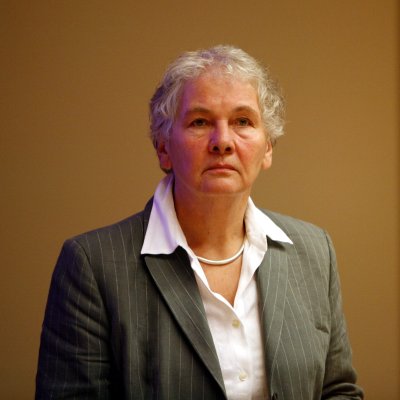
More from Christiane Nüsslein-Volhard
View profile →we had a wonderful education because my parents were so practical … Christiane Nüsslein-Volhard: Yes I mean, I have a strong likeness of culture and also I mean my grandmother was a painter and we do music in the family quite a lot and I think that’s very important. What was also important, I thought about that recently, also maybe as a follow-up of an interview but I was asked what my parents did and so on and looking at my brothers and sisters, we had a wonderful education because my parents were so practical, they did books themselves and we did a lot of handicrafts and I knew how to knit and sew and cook and we learnt a lot to do things ourselves, to make things ourselves so we all have some dexterity in doing things ourselves and this is also very important for Science
Recorded
Marika Griehsel, Interview at the 53rd Lindau Nobel Laureate Meeting, 30 June–4 July 2003, Nobel Prize Outreach, 1 July 2003
source ↗
I continued the work on dorsal, discovered the recessive phenotype and interpreted the phenotype postulating a gradient determining the dorsoventral axis. At that time, gradients were not widely accepted as mechanisms, in particular biochemists were highly sceptical, however the Tübingen influence made such models attractive to me.
Recorded
Laureate-written autobiography for Les Prix Nobel, Nobel Prize Outreach, 1 December 1995
source ↗
we know the fish, we know the worm, we know the fly, but we don’t know the links between and we don’t know, when we go back to the branches in evolution, we really don’t know what happened there when they branched and how they divert and what is the major drive for evolution.
Recorded
Marika Griehsel, Interview at the 53rd Lindau Nobel Laureate Meeting, 30 June–4 July 2003, Nobel Prize Outreach, 1 July 2003
source ↗
I don’t think it’s misused yet, people are afraid of it might be misused but on the other hand, there is also value in finding out about the relation between several particular predispositions. You might be more careful if you are told that your genetic background is such that you shouldn’t eat fat in large amounts or so, it does help you change your life a little bit and so it’s not so bad, but it’s hard to find out which genetic background is causing these things.
Recorded
Marika Griehsel, Interview at the 53rd Lindau Nobel Laureate Meeting, 30 June–4 July 2003, Nobel Prize Outreach, 1 July 2003
source ↗
Not really. I thought that getting the Nobel Prize was a big interruption in my career, I thought and it was very distracting. It takes a lot of time you know, it just takes time to be honoured, you have to travel and you have to give speeches of things you have, oh it’s so often that you get bored to tears when you hear your own voice. And it’s really taking a lot of your time and there’s no way that during this time you can start something new, I mean you just profit from what you’ve done and there is no time to develop new ideas.
Recorded
Marika Griehsel, Interview at the 53rd Lindau Nobel Laureate Meeting, 30 June–4 July 2003, Nobel Prize Outreach, 1 July 2003
source ↗
I think a very big curiosity. I’m very curious and I like to understand things and not only science but also other things where I just try to find out why things work or how things work. Science and nature caught my attention as a small child already. I was growing up in a city but we had a garden and I loved the garden and then often on vacation I was at a farm and I loved these animals and plants and so on, so I was attracted very early on and then we had a very good teaching actually at my … I don’t know whether my teachers really had much of a role because I was determined very early, but then I also did music and I did languages and Literature and so on. I have broad interests actually other than science, but this is really true, this curiosity.
Recorded
Marika Griehsel, Interview at the 53rd Lindau Nobel Laureate Meeting, 30 June–4 July 2003, Nobel Prize Outreach, 1 July 2003
source ↗
More on values & belief
- Which living person do you most admire, and why? 410 answers
- What is the trait you most deplore in others? 202 answers
- What is something everyone in your world agrees about that you think is wrong? 82 answers
- What have you come to understand about what it means to be human? 21 answers
- What do you need to believe in order to get through the day? 16 answers
- What important truth do very few people agree with you on? 15 answers
Also answered this
Anthony Fauci, Richard Hamming, Mario Molina, Oliver Sacks, Bong Joon-ho, François Ozon
Search the directory for somebody in particular.
Explore further
- All values & belief questions
- Explore the archive — by field, age, era, and subject