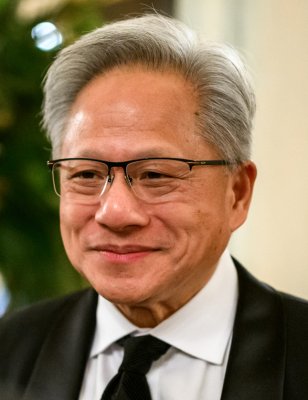
Jensen Huang

Co-founder, president and chief executive of NVIDIA

Recorded said elsewhere, not written here
I begin each morning, I do every single morning exactly the same way, I begin each morning by doing my highest priority work first. I have a very clear priority list and I start from the highest priority work first. Before I even get to work, my day is already a success. I've already completed my most important work and can dedicate my day to helping others.

California Institute of Technology 130th Annual Commencement, The Singju Post, 14 June 2024 source ↗

Others on this question

View all 17 →
Magnus Carlsen Norwegian chess grandmaster; World Chess Champion 2013–2023
I would want to be a role model. As you talk about an athlete who wakes up at seven every day, then you have two training sessions...for me, it's not like that. I definitely think about chess all the time. I work at chess every day but it's not like I have a routine. It's always been based on inspiration for me. Fortunately, I haven't run out of inspiration yet...Sometimes I play better when I haven't slept that much, because you kind of play more creative.
Recorded On-stage interview, Milken Institute Global Conference, Los Angeles, Chess.com, 5 May 2017 source ↗
I get to my desk (in a very small room at the top of the house) at about 10, and fiddle about with the height of the desk and the chair until I’m comfortable. I have a desk that I can raise or lower according to the state of my aching back. Sometimes I stand at it, and sometimes I have it high up to write at, and sometimes a bit lower to type.
Recorded The Guardian, 'My writing day' series, 23 December 2017 source ↗
Haruki Murakami Novelist, short-story writer and translator
When I’m in writing mode for a novel, I get up at four a.m. and work for five to six hours. In the afternoon, I run for ten kilometers or swim for fifteen hundred meters (or do both), then I read a bit and listen to some music. I go to bed at nine p.m. I keep to this routine every day without variation. The repetition itself becomes the important thing; it’s a form of mesmerism. I mesmerize myself to reach a deeper state of mind. But to hold to such repetition for so long—six months to a year—requires a good amount of mental and physical strength. In that sense, writing a long novel is like survival training. Physical strength is as necessary as artistic sensitivity.
Recorded John Wray, The Paris Review, issue 170, Summer 2004, 1 January 2004 source ↗
Toni Morrison Novelist and editor; Nobel laureate in Literature, 1993
Writing before dawn began as a necessity—I had small children when I first began to write and I needed to use the time before they said, “Mama”—and that was always around five in the morning. Many years later, after I stopped working at Random House, I just stayed at home for a couple of years. I discovered things about myself I had never thought about before.
Recorded Elissa Schappell, The Paris Review, issue 128, Fall 1993, 1 January 1993 source ↗

More from Jensen Huang

View profile →
Question What are you best at that nobody watching would notice? Craft & work
Of all of the things that I value most about my abilities, intelligence is not top of that list. My ability to endure pain and suffering, my ability to work on something for a very, very long period of time, my ability to handle setbacks and see the opportunity just around the corner I consider to be my superpowers, and I hope they're yours.
Recorded California Institute of Technology 130th Annual Commencement, YouTube (recording of the Caltech commencement address), 14 June 2024 source ↗

More on daily life

Also answered this

David Vélez, Steve Jobs, Hilary Mantel, Will Self, Haile Gebrselassie, Ellie Simmonds

Search the directory for somebody in particular.

Explore further

Report this answer