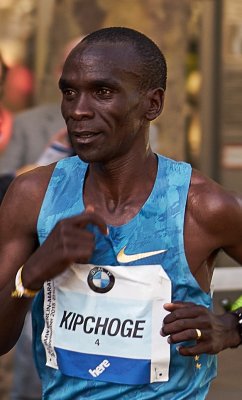
Eliud Kipchoge

Kenyan marathon runner

Recorded said elsewhere, not written here
When I have a lot of pain, I try to confuse my mind to forget about the pain and think about the distance. I don't want pain to be in my mind, because I'd really lose focus on running. After winning, you won't have that pain, but it comes later. The marathon is hard; the second day, you don't go up or down stairs.

Address and Q&A at the Oxford Union Society, November 2017, Outside, 10 February 2018 source ↗

Others on this question

View all 26 →
Jamie Dimon Chairman and chief executive of JPMorgan Chase from 2005
Curiosity is a form of humility — acknowledging that you don't know everything. Responding to curiosity allows other people to speak freely. Facts and details matter and inform a deeper and deeper analysis that allows you to continually revise and update your plans. This, of course, also means that you are constantly admitting prior mistakes. You need to shed sacred cows, seek out blind spots and challenge the status quo.
Recorded JPMorgan Chase annual report, JPMorgan Chase & Co., 2024 source ↗
Athol Fugard Playwright, director and actor
That is true. That one little corner of South Africa, Port Elizabeth and its immediate surroundings, is a region that I know like the back of the hand that holds my pen as I write about it. I can stand on a street corner in Port Elizabeth, look at anybody and put together some sort of biography. I know where they come from, where they’re going. I have a feel of the textures of their life. If I stand on a street corner in New Haven, which is a place I’ve gotten to know as well as any place outside of South Africa, I am still at a total loss to identify the people passing me on that street.
Recorded Lloyd Richards, Interview conducted in front of an audience at the Poetry Center of the 92nd Street YMHA, New York, The Paris Review, Issue 111, Summer 1989, 13 October 1985 source ↗
Edmund Hillary Mountaineer and explorer; first ascent of Everest, 1953
I always have, in my expeditions, people who are academically far cleverer than I am, and even technically, far more competent. So if you want to lead an expedition, in a sense, you’ve got to keep ahead of them. These bright, competent characters you have with you who are marvelous to have on the expedition. And I’ve always found you can do that by, each night, when you go to bed, just let your mind dwell on the likely things that may happen next day, and think out carefully the sort of decisions that might be necessary to make in order to have the program carried through. So next day, when something happens, you’re the one that’s thought about it and you’re the one who has the ideas.
Recorded Academy of Achievement interview source ↗
Ruth Bader Ginsburg Associate Justice of the Supreme Court of the United States, 1993–2020; Judge, U.S. Court of Appeals for the D.C. Circuit 1980–1993
I have followed that advice - with, I confess, occasional lapses not only at home, but in the places I have worked, even in relating to my colleagues at the Supreme Court. It is important to be a good listener if you are to work with others effectively, but it also pays, sometimes, to be a little deaf - for example, in my current position, when a colleague, academic commentator, or journalist writes that an opinion on which I labored endless hours, worrying over every word, is "sloppy," "smug," "strange," or "profoundly misguided." I am making none of those up.
Recorded New York Law School Law Review dinner, New York Law School Law Review (digitalcommons.nyls.edu), 12 February 1999 source ↗

More from Eliud Kipchoge

View profile →

More on craft & work

Also answered this

Magnus Carlsen, Tanni Grey-Thompson, Cathy Freeman, Simone Biles, Chris Hoy, Tom Stoppard

Search the directory for somebody in particular.

Explore further

Report this answer