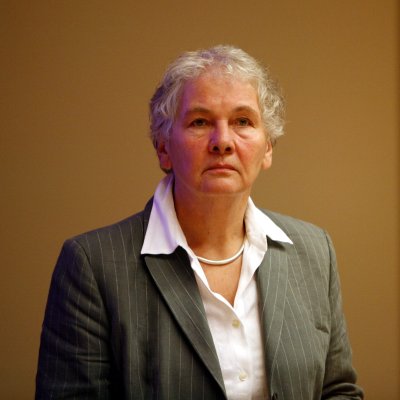
What is your greatest fear?

Originally asked

Vanity Fair, to its interview subject, The Proust Questionnaire

The exact prompt is fixed in Vanity Fair's Proust Questionnaire and independently sustained in The Guardian's The Q&A over multiple decades.

You answer as yourself. Nobody on FLAPSS answers as anybody else.

Recorded Christiane Nüsslein-Volhard said elsewhere, not written here
I don’t think it’s misused yet, people are afraid of it might be misused but on the other hand, there is also value in finding out about the relation between several particular predispositions. You might be more careful if you are told that your genetic background is such that you shouldn’t eat fat in large amounts or so, it does help you change your life a little bit and so it’s not so bad, but it’s hard to find out which genetic background is causing these things.

Marika Griehsel, Interview at the 53rd Lindau Nobel Laureate Meeting, 30 June–4 July 2003, Nobel Prize Outreach, 1 July 2003 source ↗

Others on this question

View all 266 →
Failure. I hate losing, particularly at football and politics. I play five-a-side every week – middle of midfield, barking orders. Some people say it’s the taking part that counts. I am not in that camp. It’s the winning that counts.
Recorded The Q&A, The Guardian, 19 August 2023 source ↗
Jane Asher English actress and author
I’ve always been frightened of the dark. I sometimes wonder whether it stems from being away filming from the age of five. I can remember being devastatingly homesick and having a little nightlight I used to look at to reassure myself things were all right.
Recorded The Guardian, The Q&A, The Guardian, 6 May 2023 source ↗
A bumpy flight … or driving with my son Sam, who drives great, but I still can’t believe he’s old enough.
Recorded Vanity Fair, The Proust Questionnaire, Vanity Fair, March 2016 source ↗

More from Christiane Nüsslein-Volhard

View profile →
Question What inspires you to learn? Attention & the world
I think a very big curiosity. I’m very curious and I like to understand things and not only science but also other things where I just try to find out why things work or how things work. Science and nature caught my attention as a small child already. I was growing up in a city but we had a garden and I loved the garden and then often on vacation I was at a farm and I loved these animals and plants and so on, so I was attracted very early on and then we had a very good teaching actually at my … I don’t know whether my teachers really had much of a role because I was determined very early, but then I also did music and I did languages and Literature and so on. I have broad interests actually other than science, but this is really true, this curiosity.
Recorded Marika Griehsel, Interview at the 53rd Lindau Nobel Laureate Meeting, 30 June–4 July 2003, Nobel Prize Outreach, 1 July 2003 source ↗
Question Whose work makes you jealous? Craft & work
I felt at the time that Eric was much more successful than I, he was extremely productive during his time in Zurich, and worked on many very original projects, germ line, cell lineage, sex determination, where not many people could follow him. I also had the impression that I was dependent on him because he had more fly experience and without him I would not have gotten the job. This made our start in Heidelberg a little difficult, until we sorted things out, and from then on we thoroughly enjoyed working in the same lab.
Recorded Laureate-written autobiography for Les Prix Nobel, Nobel Prize Outreach, 1 December 1995 source ↗
Question What is the most important lesson life has taught you? Time & hindsight
Not really. I thought that getting the Nobel Prize was a big interruption in my career, I thought and it was very distracting. It takes a lot of time you know, it just takes time to be honoured, you have to travel and you have to give speeches of things you have, oh it’s so often that you get bored to tears when you hear your own voice. And it’s really taking a lot of your time and there’s no way that during this time you can start something new, I mean you just profit from what you’ve done and there is no time to develop new ideas.
Recorded Marika Griehsel, Interview at the 53rd Lindau Nobel Laureate Meeting, 30 June–4 July 2003, Nobel Prize Outreach, 1 July 2003 source ↗
Question How has a failure, or apparent failure, set you up for later success? Do you have a favourite failure? Failure & regret
As I was lazy and rarely did my homework, I finished high school with a rather mediocre exam. I almost did not pass in English language. Recently, my previous teachers allowed me to see their report on my high school performances, which included the following statements: Despite the fact that her talents are rather equally spread among many areas of knowledge, her performances are rather different depending on the distribution of her interests. Thus, with her strong display of self will she can be decidedly lazy in some topics over years, while in her areas of interests she performs to a degree far extending that required for normal school purposes.
Recorded Laureate-written autobiography for Les Prix Nobel, Nobel Prize Outreach, 1 December 1995 source ↗
Question What do you need to believe in order to get through the day? Values & belief
I sing yes sure and I garden, I have a large garden and I really recreate myself by doing gardening and thinking about something else so that when your mind gets free from all the burden of the daily troubles and then you can start putting something fresh in, you know.
Recorded Marika Griehsel, Interview at the 53rd Lindau Nobel Laureate Meeting, 30 June–4 July 2003, Nobel Prize Outreach, 1 July 2003 source ↗

More on identity & self

Also answered this

Helen Skelton, Christine Baranski, Rosie Jones, Paul Merson, Jamie Lee Curtis, Penny Lancaster

Search the directory for somebody in particular.

Explore further

Report this answer