we can select one gene out of those 20,000 genes, and completely destroy that one particular gene so that we can understand the function of that particular gene. I got very interested in that technology. It was 1992 or 1993 when I graduated from my Ph.D. school. So I decided to study — I decided to learn about knockout mouse technology. But at that time in Japan, only a few scientists were working on knockout mouse technology
Originally asked
Lifehacker, to people about their working day, How I Work
Lifehacker repeatedly used this exact closing prompt in its named How I Work questionnaire.
You answer as yourself. Nobody on FLAPSS answers as anybody else.
Marika Griehsel, Interview at the 53rd Lindau Nobel Laureate Meeting, 30 June–4 July 2003, Nobel Prize Outreach, 1 July 2003 source ↗
Others on this question
View all 11 →So a great deal has changed, but we in the Truth and Reconciliation Commission said, “Watch it. You can kiss reconciliation and forgiveness goodbye, unless the gap between the rich and the poor — the haves and the have-nots — is narrowed, and narrowed quickly and dramatically.” So yes, we face very, very considerable problems.
The mystery of summoning up words. Where are they in the mind, in the brain? They appear to be an agency from nowhere. They exist somewhere in our ground or in our air. They come from unknown darkness. From a place we normally don't think about.
Well, I think the most single important issue today is to make sure that nuclear weapons will not proliferate beyond the eight, or nine, countries that already have nuclear weapons; and absolutely make sure that none of these nuclear weapons or this nuclear material will fall into the hands of any extremist or terrorist group, because if they got hold of this material, they would use it. That would be the beginning of the end for civilisation as we know it.
More from Christiane Nüsslein-Volhard
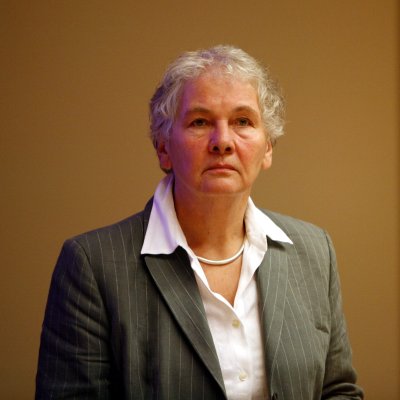
View profile →we had a wonderful education because my parents were so practical … Christiane Nüsslein-Volhard: Yes I mean, I have a strong likeness of culture and also I mean my grandmother was a painter and we do music in the family quite a lot and I think that’s very important. What was also important, I thought about that recently, also maybe as a follow-up of an interview but I was asked what my parents did and so on and looking at my brothers and sisters, we had a wonderful education because my parents were so practical, they did books themselves and we did a lot of handicrafts and I knew how to knit and sew and cook and we learnt a lot to do things ourselves, to make things ourselves so we all have some dexterity in doing things ourselves and this is also very important for Science
I think a very big curiosity. I’m very curious and I like to understand things and not only science but also other things where I just try to find out why things work or how things work. Science and nature caught my attention as a small child already. I was growing up in a city but we had a garden and I loved the garden and then often on vacation I was at a farm and I loved these animals and plants and so on, so I was attracted very early on and then we had a very good teaching actually at my … I don’t know whether my teachers really had much of a role because I was determined very early, but then I also did music and I did languages and Literature and so on. I have broad interests actually other than science, but this is really true, this curiosity.
Not really. I thought that getting the Nobel Prize was a big interruption in my career, I thought and it was very distracting. It takes a lot of time you know, it just takes time to be honoured, you have to travel and you have to give speeches of things you have, oh it’s so often that you get bored to tears when you hear your own voice. And it’s really taking a lot of your time and there’s no way that during this time you can start something new, I mean you just profit from what you’ve done and there is no time to develop new ideas.
I don’t think it’s misused yet, people are afraid of it might be misused but on the other hand, there is also value in finding out about the relation between several particular predispositions. You might be more careful if you are told that your genetic background is such that you shouldn’t eat fat in large amounts or so, it does help you change your life a little bit and so it’s not so bad, but it’s hard to find out which genetic background is causing these things.
so I sometimes think, why should I talk young women into being a scientist if they then end up being sort of disliked or not accepted by their contemporaries and so it’s a tricky business actually.
I felt at the time that Eric was much more successful than I, he was extremely productive during his time in Zurich, and worked on many very original projects, germ line, cell lineage, sex determination, where not many people could follow him. I also had the impression that I was dependent on him because he had more fly experience and without him I would not have gotten the job. This made our start in Heidelberg a little difficult, until we sorted things out, and from then on we thoroughly enjoyed working in the same lab.
More on craft & work
- What is the worst job you have done? 229 answers
- What do you consider your greatest achievement? 192 answers
- How do you know when a piece of work is finished? 67 answers
- What do you do when you feel creatively blocked or stuck? 66 answers
- How does a new work begin for you? 63 answers
- How much rewriting or revision do you do? 46 answers
Also answered this
Mario Molina, Jocelyn Bell Burnell, Shinya Yamanaka, Desmond Tutu, Tom Lubbock, Mohamed ElBaradei
Search the directory for somebody in particular.
Explore further
- All craft & work questions
- The How I Work questionnaire — 3 questions from the same format
- Explore the archive — by field, age, era, and subject